 Birch Bay Siding
 Why Lummi Island Roofs Age Differently Than Inland Roofs
A roof on Lummi Island does more work than a roof twenty miles inland in Whatcom County. It sits closer to open water, catches salt-laden air off the Salish Sea, takes driving rain straight off winter storms with almost nothing to break the wind first, and spends a good chunk of the year under the kind of damp shade that grows moss faster than most homeowners expect. None of that means an island roof is doomed to fail early — it means it needs to be built and maintained with those specific conditions in mind, not treated like a generic reroof.
Salt air is corrosive to exposed metal fasteners, flashing, and vent stacks over time. Driving rain finds every weak lap, nail pop, and undersized flashing detail a standard installation might get away with elsewhere. And moss isn't just cosmetic — its root structure lifts shingle tabs, holds moisture against the roof deck, and shortens the life of whatever's underneath it. A roof replacement done right here accounts for all three from the start, not as an afterthought.
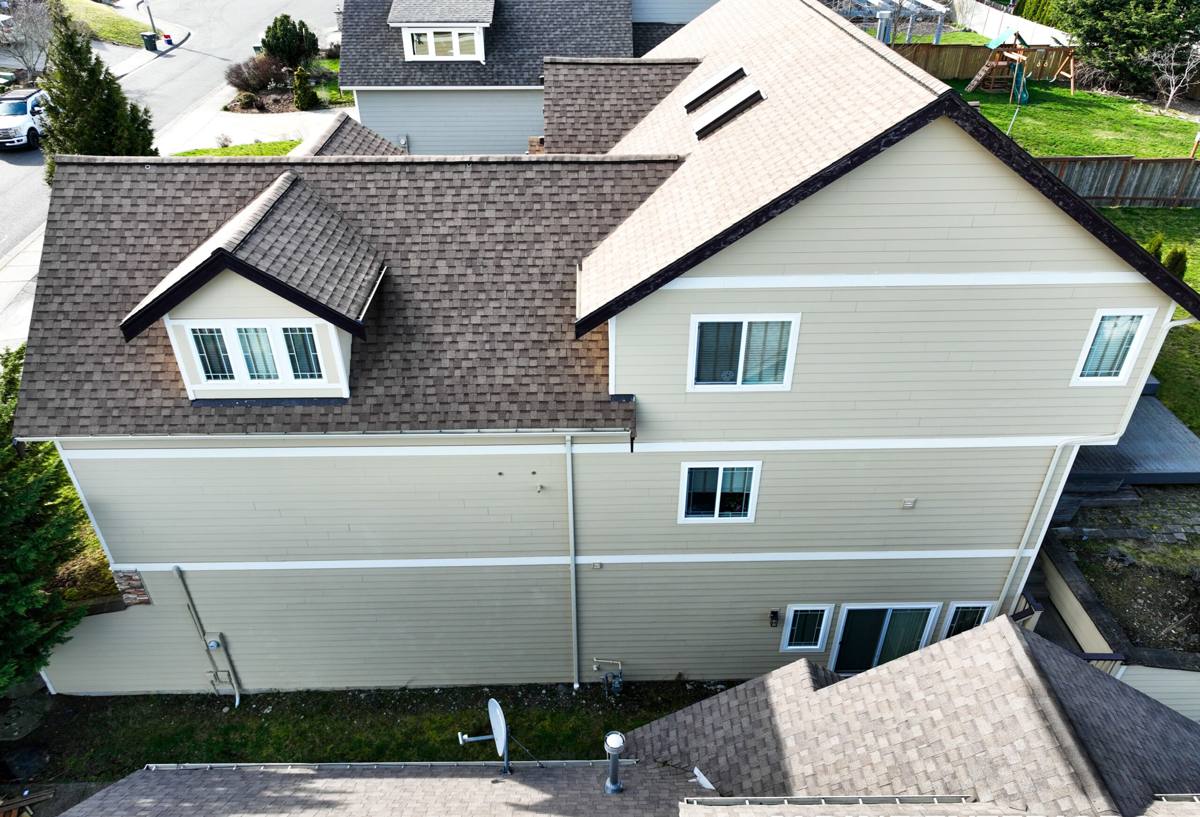
Signs a Lummi Island Roof Needs Replacement, Not Just Repair
Repairs make sense when the problem is isolated — a cracked pipe boot, a handful of wind-lifted shingles, a flashing detail that failed at one valley. Replacement becomes the honest answer when the damage is spread across the roof or when the roof deck itself has been compromised by long-term moisture. Common signs we see on island and near-shoreline homes include:
- Granule loss heavy enough that you can see it collecting in gutters or at downspout outlets
- Moss mats thick enough to hold visible moisture even on dry days
- Soft or spongy spots underfoot on the roof deck, especially near valleys and eaves
- Daylight or water staining visible in the attic along the ridge or at roof-to-wall connections
- Multiple past repairs in different areas rather than one clear point of failure
- A roof approaching or past the manufacturer's rated lifespan for the material installed
If only one or two of these apply and they're localized, a repair is often the right call and we'll say so. Replacement gets recommended when the roof as a system — deck, underlayment, flashing, and covering — is wearing out together, which is common once moss and moisture have had years to work on a roof this close to the water.
Why "Just a Little Moss" Is Worth Taking Seriously
Moss doesn't cause failure overnight, which is exactly why it gets ignored. It spreads slowly, holds moisture against the shingle surface long after rain has stopped, and works its rhizoids under shingle tabs and granules. On a shaded, north-facing slope — common on wooded island lots — a roof can go from a light green tint to genuine structural concern over a few wet seasons if it's never treated or cleaned. Catching it early is a maintenance job. Catching it late is a replacement conversation.
What a Correct Roof Replacement Involves Here
A roof replacement is more than stripping old material and nailing down new. In a climate that sees this much rain and salt exposure, the details under the visible roofing are what determine whether the job lasts fifteen years or thirty. A properly done replacement includes:
Tear-off and deck inspection
Full removal of the old roofing down to the deck, not an overlay. This is the only way to actually see and address rot, soft sheathing, or moisture damage that's been hiding underneath — which is common on roofs that have carried moss for several seasons.
Underlayment built for wet climates
A synthetic underlayment rated for high-moisture exposure, with self-adhering ice-and-water membrane at eaves, valleys, and any roof penetration. This is the layer that protects the deck when wind-driven rain gets past the roofing material itself — a regular occurrence on exposed, water-facing slopes.
Flashing that's actually sealed, not just placed
New step flashing, counterflashing, and pipe boots at every wall intersection, chimney, and vent. Flashing is where most leaks actually start, and it's the detail most likely to get shortcut on a rushed job.
Ventilation that matches the home
Balanced intake and exhaust ventilation keeps the attic dry and temperature-regulated, which slows moss regrowth from the underside and prevents condensation-driven rot — a real issue in a marine climate with persistent humidity.
Roofing Material Options for Coastal and Island Homes
There's no single "best" roofing material for every Lummi Island home — the right choice depends on the home's exposure, roof pitch, tree cover, and budget. Here's how the common options actually perform under salt air, driving rain, and moss pressure:
| Material | Typical Lifespan | Moss Resistance | Salt-Air Performance | Relative Cost |
|---|---|---|---|---|
| Architectural asphalt shingle | 25–30 years | Moderate (better with algae-resistant granules) | Good with corrosion-resistant fasteners | $ |
| Standing seam metal | 40–50+ years | Strong — sheds moss and debris well | Very good with coated/marine-grade fasteners | $$$ |
| Synthetic composite shingle | 30–40 years | Good, doesn't absorb moisture like wood | Good | $$ |
| Cedar shake | 20–30 years with upkeep | Poor without regular treatment | Fair — needs consistent maintenance | $$–$$$ |
We don't push one product on every home. We do steer homeowners honestly on trade-offs — cedar shake, for example, can look great on the right home, but it demands a maintenance commitment (regular treatment and moss removal) that a lot of owners underestimate given how fast moss establishes here. If a homeowner wants it anyway with eyes open, that's their call to make; our job is making sure they're making it with accurate information.
Our Process, Start to Finish
- On-site assessment — we inspect the deck, attic ventilation, flashing points, and existing moss or moisture damage before quoting anything.
- Written estimate — material options, scope, and timeline laid out clearly, with no vague allowances that turn into surprise change orders.
- Material staging — delivery and dumpster placement planned around the property's access, which on Lummi Island often means coordinating around the ferry schedule and narrower driveways.
- Tear-off and deck repair — old roofing removed, deck inspected, any rot or soft sheathing replaced before anything new goes down.
- Underlayment, flashing, and roofing installation — installed to manufacturer spec, not shortcut spec.
- Final walkthrough — gutters, vents, and flashing checked with the homeowner before we consider the job done.
Access and Logistics Unique to Lummi Island
Working on the island isn't the same as working a mainland job, and pretending otherwise is how timelines slip. Everything — crew, dump trailer, shingles or metal panel bundles, ladders and equipment — has to move on and off the island by ferry, which runs on a set schedule with limited capacity. That means material deliveries and crew arrival get planned around sailing times, not just around weather. We build that into the schedule up front rather than discovering it mid-project.
Wooded, hilly lots are common on the island, and driveway or roof access can be tighter than a typical mainland property. We walk the site before quoting specifically to catch access issues — where a dumpster can realistically sit, whether a crane or extra ladder work is needed, where debris can be staged for hauling back to the mainland — so the estimate reflects the actual job, not a generic one.
Maintenance That Actually Matters After Installation
A correctly installed roof still benefits from upkeep in this climate, especially with the tree cover common around Lummi Island homes:
- Keep gutters clear of needles and debris — clogged gutters back water up under the roof edge
- Have moss treated at the first sign of growth rather than waiting for a visible mat
- Check attic ventilation isn't blocked by insulation or debris, which affects moisture control year-round
- Have flashing and pipe boots visually checked every couple of years, since these are the first details to show wear
- Trim back overhanging branches where practical — less shade means faster drying and slower moss growth
None of this is complicated, but it's the difference between a roof that reaches its full rated lifespan and one that needs premature attention because small issues went unnoticed.
Why a Crew That Already Works Lummi Island Matters
A roofing job on the island has real logistics that a crew unfamiliar with the area will underestimate: ferry timing, tighter access on wooded lots, permitting through Whatcom County, and weather windows that close faster on an exposed shoreline than they do a few miles inland. A crew that's planned around these factors before quotes exactly what the job will cost and how long it will take — instead of running into the ferry schedule or a access problem halfway through and pushing the timeline. Familiarity with the island's conditions isn't a nice-to-have here; it's what keeps a project on schedule and on budget.
If you're weighing repair against replacement, or just want a straight answer on what your roof actually needs, we're glad to take a look. Estimates are free, there's no pressure attached, and you'll get a clear answer either way — use the form below to get started.