 Birch Bay Siding
 Cottonwood Beach's Climate Puts Real Demands on Exterior Siding
Homes in Cottonwood Beach sit close enough to the water that the exterior envelope is doing more work than it would a few miles inland. Salt-laden air off the water, wind-driven rain that doesn't fall so much as get pushed sideways, and a moss season that stretches from fall through spring are the three forces that determine how long a siding job actually lasts here. A product and installation that would be perfectly fine on a sheltered inland lot in Whatcom County can fail early on a home that catches the full brunt of coastal weather. That's the lens we use on every Cottonwood Beach estimate: not "what siding looks good," but "what siding and what installation detail will still be doing its job in twenty years on this specific lot."
Salt Air and Corrosion
Airborne salt accelerates corrosion on anything metal — fasteners, flashing, trim screws — and it also breaks down paint finishes faster than an inland environment would. Siding that relies on field-applied paint tends to chalk and fade noticeably sooner near the water. Fastener choice and finish quality matter more here than almost anywhere else in the county.
Wind-Driven Rain
Rain that comes in at an angle, driven by wind off the water, finds every gap a calm, straight-down rain would never reach. It works its way into laps, seams, and any penetration that isn't flashed correctly. This is why installation detail — not just the siding material itself — is often the difference between a wall assembly that stays dry and one that doesn't.
A Long Moss Season
Whatcom County's damp season runs long, and shaded, north-facing walls near Cottonwood Beach hold moisture for extended stretches. Moss and algae growth on a wall isn't just cosmetic — it holds water against the siding surface, which matters a great deal for any product that isn't dimensionally stable or that can absorb moisture at its edges.
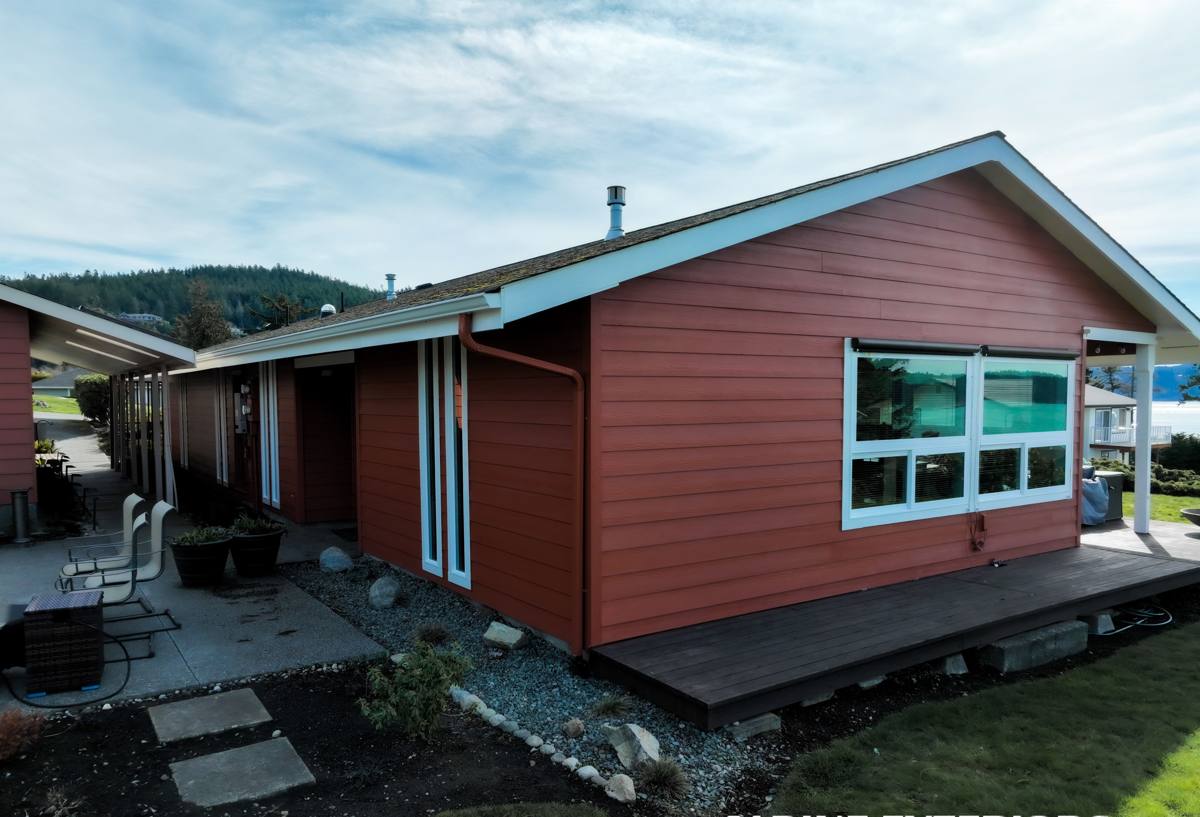
Why James Hardie Fiber Cement Fits This Kind of Exposure
James Hardie siding is fiber cement — a mix of cement, sand, and cellulose fiber — and it behaves fundamentally differently from wood-based or vinyl products in this climate. It doesn't swell, warp, or rot the way wood-based siding can when it takes on repeated moisture cycles. It's non-combustible. And it comes from the factory with a ColorPlus finish that's baked on and warranted, rather than relying on a field-applied coat of paint that has to fight salt air and UV on its own.
The HardieZone Engineering Difference
James Hardie manufactures its products in different formulations for different climate zones under what it calls the HardieZone system. HZ5 products are engineered for wetter, colder climates like ours — the Pacific Northwest — while HZ10 is formulated for hot, dry regions like the desert Southwest. Using the correctly zoned product isn't a marketing detail; it affects how the board handles moisture cycling over decades. Part of doing this job right in Whatcom County is making sure the product specified is actually the one engineered for this weather, not a shipment meant for a different region.
What a Correct Installation Looks Like on a Coastal Home
The material is only half the equation. On a Cottonwood Beach home, installation detail is where most siding failures actually originate — not in the panel itself, but in the flashing, fastening, and clearances around it.
Drainage Plane and Rain Screen Gap
A properly lapped water-resistive barrier behind the siding, combined with a rain screen gap that lets any moisture that does get past the cladding drain and dry out, is what keeps a wall assembly resilient against wind-driven rain instead of just hoping the face of the siding never gets wet.
Flashing and Penetrations
Every window, door, and roof-to-wall intersection is a place where water wants to get behind the siding. Correct kick-out flashing at roof lines, head flashing above openings, and careful sealing around anything that penetrates the wall (vents, hose bibs, light fixtures) matter more here than on a sheltered inland wall, because there's more water pressure trying to find those gaps.
Fastener Choice and Spacing
Given the salt exposure, fastener material isn't a place to cut corners. Stainless steel or hot-dip galvanized fasteners hold up far better than standard galvanized fasteners near the water, and following Hardie's published fastening schedule (spacing, edge distance, embedment) is what keeps the siding performing the way it's engineered to.
Clearances and Caulking
Proper clearance from grade, roof lines, and decks or patios keeps splash-back and standing water away from the bottom edge of the siding. Cut ends get factory touch-up paint before installation, and butt joints get the manufacturer-approved sealant — small steps that are easy to skip and expensive to have skipped for you later.
Our Process, Start to Finish
A siding job on a coastal lot has a few extra checkpoints compared to a straightforward inland re-side, and we build those into the process rather than treating them as surprises.
- Inspection and moisture check — we look at the existing wall assembly, check for hidden rot or moisture damage at trim, windows, and the lower courses, and assess what the current siding and flashing are actually doing.
- Measurement and product selection — we spec the correct HZ5 product line, profile, and ColorPlus color for the home and confirm exposure and accent details.
- Tear-off and substrate repair — old siding comes off, and any rotted sheathing or framing found underneath gets repaired before anything new goes back up. This step is where coastal homes most often turn up hidden moisture damage.
- Water-resistive barrier and flashing — a new WRB is installed and lapped correctly, with flashing detailed at every window, door, and penetration.
- Siding and trim installation — Hardie siding and trim go up to manufacturer fastening specs, with corrosion-resistant fasteners throughout.
- Final sealing, touch-up, and walk-through — cut ends and joints are sealed, the site is cleaned up, and we walk the finished job with the homeowner before calling it done.
Problems We Commonly Find on Older Homes Near the Water
When we're called out to look at an older Cottonwood Beach home, a handful of issues show up repeatedly. Moss and algae buildup on shaded walls that's been trapping moisture against the siding for years. Caulk that failed at butt joints long before the siding itself did, letting water track behind the panels. Rust streaking below fasteners that were never rated for salt exposure in the first place. And rot at trim boards and corner boards where flashing was missing or undersized. None of these are unusual for the exposure this neighborhood gets — they're exactly what you'd expect when a wall assembly wasn't detailed for driving rain and salt air. It's also exactly what correct installation is designed to prevent.
How Materials Compare in This Exposure
| Material | How It Handles Salt Air & Moisture | How It Handles Moss/Algae Contact |
|---|---|---|
| Vinyl siding | Doesn't corrode, but can warp or become brittle with UV and temperature cycling over time | Moss and algae can grow on the surface; panels can trap moisture behind them at loose seams |
| Engineered wood / wood-based siding | Vulnerable to swelling and edge deterioration if moisture reaches the substrate | Sustained moss contact is one of the harder conditions for wood-based products to tolerate long-term |
| Cedar | Natural material that needs ongoing sealing/staining to resist moisture intrusion | Requires regular maintenance to keep moss and mildew from taking hold |
| James Hardie fiber cement (HZ5) | Dimensionally stable, non-combustible, factory finish resists salt-driven fading | Doesn't absorb moisture the way wood-based products do; surface growth can be cleaned without compromising the board |
James Hardie Product Lines We Use in This Area
| Product | Typical Use | Why It Fits Cottonwood Beach |
|---|---|---|
| HardiePlank lap siding | Primary wall cladding | Traditional lap profile, ColorPlus finish holds up against salt-driven fading |
| HardiePanel vertical siding | Accent walls, gables | Fewer horizontal laps means fewer joints for wind-driven rain to work into |
| HardieShingle siding | Gable and accent detail | Shingle look without the moisture and moss vulnerability of real wood shingles |
| HardieTrim boards | Corners, fascia, window and door trim | Stays dimensionally stable at high-moisture trim points where rot typically starts |
Why We Install Only James Hardie
We looked at vinyl, engineered wood products, and cedar before standardizing our crews on James Hardie exclusively, and the decision came down to what actually holds up under this exposure over the long run. Vinyl doesn't rot, but it can warp and doesn't offer the same rigidity or paintability. Engineered wood and cedar both depend on staying dry and well-maintained to avoid moisture-related failure — a tough ask on a wall that takes wind-driven rain and salt air on a regular basis. Fiber cement gave us a non-combustible, dimensionally stable product with a factory-applied finish and a strong transferable warranty, and installed to spec it has a long track record in exactly this kind of coastal, high-moisture climate. That's why it's the only siding we put on homes.
Cost Factors for a Cottonwood Beach Siding Project
Every job is different, but the line items that move the price on a coastal siding project are fairly consistent:
| Factor | Why It Matters Here |
|---|---|
| Square footage and home shape | More corners, dormers, and wall breaks mean more cutting, flashing, and trim work |
| Hidden moisture damage | Coastal homes more often reveal rotted sheathing or framing once old siding comes off |
| Trim and accent detail | Corner boards, window trim, and any shingle or panel accents add labor beyond a straight lap-siding wall |
| Site access | Waterfront and tight-lot properties can affect staging, material handling, and scaffolding needs |
| Color and finish selection | Factory ColorPlus finishes vs. custom field-applied paint affect both cost and long-term fade resistance |
Maintenance Checklist for Coastal Hardie Siding
Fiber cement is low-maintenance compared to wood-based alternatives, but "low-maintenance" isn't "no-maintenance" — especially this close to the water. A short annual routine keeps a Hardie installation performing the way it's designed to:
- Rinse accumulated salt residue off the siding periodically, especially on walls that face the water directly
- Keep gutters and downspouts clear so runoff isn't sheeting down the wall and feeding moss growth
- Inspect caulk joints at trim and butt joints annually and re-caulk any that have cracked or pulled away
- Trim back vegetation and shrubs that block airflow along shaded, moss-prone walls
- Watch for staining or streaking below fasteners, which can signal a fastener starting to corrode
- Use a gentle rinse rather than an aggressive close-range power wash, which can force water behind laps and joints
If you're planning a siding project in Cottonwood Beach or anywhere around Birch Bay, we're happy to walk your home, point out what the coastal exposure has already done to your current siding, and put together a straightforward, no-pressure estimate using the free form below.