 Birch Bay Siding
 Why Moisture Is the Real Enemy of Siding in Birch Bay
Most siding failures people blame on "old age" are actually moisture failures. Paint fades, caulk cracks, panels warp — but the damage that actually costs money is what happens behind the siding, where water gets in and doesn't get a chance to dry out. In Birch Bay, that risk is higher than in a lot of Western Washington towns because of the specific combination of conditions here: salt-laden air off the bay, wind-driven rain that hits walls sideways instead of falling straight down, and a long, damp moss season that keeps north- and west-facing walls wet for weeks at a stretch.
None of this means your house is doomed. It means the siding system, the water-resistive barrier behind it, and the way the two were installed together matter more here than they would in a drier inland climate. This guide walks through how moisture actually gets into a wall, what it does once it's there, and how to tell the difference between a cosmetic problem and a structural one.
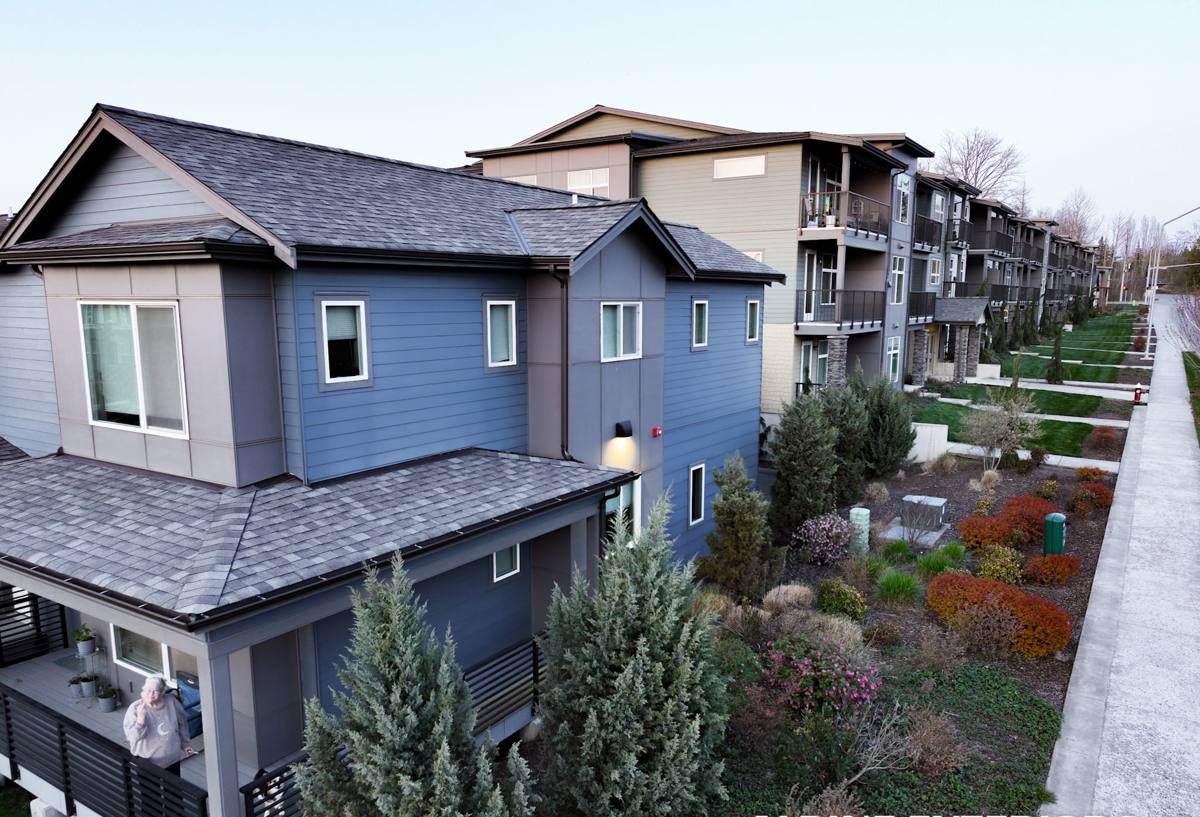
How Water Actually Gets Behind Siding
Siding is not a waterproof shell — no siding product is, including the ones we install. Every siding system is designed to shed the vast majority of water while managing the small amount that inevitably gets past seams, fasteners, and penetrations. Problems start when that managed drainage path is missing, blocked, or was never built correctly in the first place.
The most common entry points
- Butt joints and seams where panels meet, especially if they weren't flashed or caulked correctly
- Around windows and doors where flashing was skipped or installed in the wrong order relative to the house wrap
- Fastener holes, particularly where nails or screws were overdriven and crushed the material
- Bottom edges near grade, decks, and porches where siding sits too close to soil or hardscape
- Roof-to-wall intersections and chimney transitions
- Hose bibs, light fixtures, and vents that penetrate the wall without proper sealant or flashing
Driving rain off the bay makes this worse because wind pushes water sideways and upward into laps and joints that would stay dry in a calm, straight-down rain. A wall that's fine in a light shower can still take on water during a windstorm coming off the water.
What Happens Once Water Gets In
Wood-based sheathing and framing can handle occasional, brief wetting if they get the chance to dry. The damage happens when moisture is trapped — held against wood by a siding material that doesn't dry quickly, or by a wall assembly with no drainage plane behind it. Trapped moisture leads to a fairly predictable sequence:
- Sheathing and framing absorb moisture and stay damp longer than they should
- Fungal decay (rot) begins in the wood, often invisibly, behind the siding
- Paint or finish on the siding itself starts to blister, peel, or discolor from the back side out
- Siding panels swell, delaminate, or lose their shape as the substrate underneath deteriorates
- In advanced cases, structural sheathing softens enough to affect nail-holding strength
By the time rot is visible from the outside — soft spots, dark staining, a soft "give" when you press on siding — it's usually been developing for a while. This is why moisture problems are expensive to fix relative to how they start: a small flashing gap that would've cost very little to correct at install time can turn into a multi-panel or multi-stud repair a few years later.
Moss, Algae, and the Difference Between Cosmetic and Structural
Whatcom County's damp, mild winters are ideal for moss and algae growth on north-facing walls, under eaves, and anywhere sun and airflow are limited. Green or black staining on siding is usually cosmetic on its own — it's ugly, but it doesn't mean the wall is failing. The concern is what moss and algae growth tells you indirectly: that a surface is staying wet longer than it should. A wall that supports heavy moss growth is a wall that's slow to dry, and slow-to-dry walls are the ones where trapped moisture eventually becomes rot. Persistent moss is worth a closer look, not necessarily an alarm.
Siding Materials and How They Handle Moisture Differently
Different siding materials respond to water exposure in very different ways. This is the core reason we made the call to install James Hardie fiber cement exclusively and stopped installing several products we used to offer.
| Material | How It Responds to Moisture | What That Means Long-Term |
|---|---|---|
| Wood-based composite siding (e.g., LP SmartSide) | Engineered wood strand product; resin-treated but still wood-based, so edges and cut ends are vulnerable if not fully sealed | Manufacturer specifies strict caulking, sealing, and clearance rules — skipping any of them raises swelling and edge-rot risk |
| Primed spruce / solid wood | Natural wood; absorbs and releases moisture readily, expands and contracts with humidity | Needs frequent repainting and caulk maintenance to stay ahead of moisture intrusion |
| Vinyl siding | Doesn't rot itself, but is not a water barrier — water passes behind and through vents/seams by design | Performance depends entirely on what's behind it; hides moisture problems in the wall rather than preventing them |
| Fiber cement (James Hardie) | Cement-based core with no wood content to rot; factory-applied ColorPlus finish resists moisture at the surface | Doesn't decay from moisture the way wood-based products can; performance still depends on correct installation and flashing |
It's worth being fair to the products we don't install: LP SmartSide is engineered to a real standard and performs well when installed exactly to spec, with every cut end sealed and every clearance respected. Vinyl is genuinely low-maintenance in terms of surface care. Wood siding, properly maintained, has been used successfully for generations. Our decision isn't that these products are bad — it's that fiber cement's core material doesn't carry the same rot risk that wood-based products do, and in a climate like Birch Bay's, that difference matters over the life of the siding. That's a big part of why we standardized on James Hardie rather than carrying multiple product lines.
Installation Details That Determine Whether Moisture Becomes a Problem
The material matters, but installation quality is what actually determines whether a wall stays dry. Even the best siding material fails early if these details are skipped:
Water-resistive barrier and drainage plane
Behind any siding should be a continuous water-resistive barrier (house wrap or building paper), lapped correctly so water sheds down and out, not into seams. On many homes, a drainage gap or rainscreen behind the siding gives incidental moisture a path to escape and lets the wall dry faster — increasingly standard practice in wet coastal climates like ours.
Flashing at every penetration and transition
Windows, doors, roof lines, and anywhere something pierces the wall need flashing installed in the correct sequence — flashing goes over the barrier below it and under the barrier above it, so water is always directed outward, never funneled behind the siding.
Fastening to manufacturer spec
Fasteners driven too deep crush the siding material and create a wick point for water. Fasteners placed in the wrong location can void a manufacturer's warranty outright. This is a detail that's invisible once the job is done but shows up as a problem years later.
Clearances at grade, roofs, and decks
Siding that terminates too close to soil, roofing, or deck surfaces stays wet from splash-back and standing moisture. Manufacturers specify minimum clearances for a reason.
Warning Signs Worth Investigating
- Soft or spongy siding when pressed, especially near the bottom courses
- Paint that's bubbling, peeling, or discoloring from underneath rather than the surface wearing evenly
- Visible gaps, cracked caulk, or separated seams at joints and trim
- Staining or streaking below window sills or at panel seams after rain
- A musty smell in an adjacent interior room, or bubbling interior paint on an exterior wall
- Heavy, persistent moss or algae growth that doesn't clear up seasonally
Any one of these on its own isn't necessarily an emergency, but they're worth a professional look rather than waiting. Moisture problems get cheaper to fix the earlier they're caught.
What We Look At During a Siding Assessment
When we walk a property in Birch Bay, Blaine, or anywhere else in Whatcom County, we're not just looking at the surface condition of the existing siding. We're checking clearances at grade, flashing at windows and rooflines, condition at seams and butt joints, and whether there's evidence of past moisture intrusion at trim and corner boards. That tells us whether a home needs full siding replacement, targeted repair, or just better maintenance going forward.
Maintenance That Actually Reduces Moisture Risk
Regardless of what siding is currently on a home, a few habits meaningfully reduce moisture exposure:
- Keep gutters clear so water doesn't overflow and run down the wall face
- Trim vegetation back from siding to improve airflow and sun exposure, which discourages moss
- Recaulk seams, trim, and penetrations every few years — caulk is a wear item, not a one-time install
- Address peeling or blistering paint promptly rather than waiting for a full repaint cycle
- Keep an eye on areas below decks, near downspouts, and at ground-contact points where splash-back is worst
If you're seeing signs of moisture damage, dealing with heavy moss buildup, or just want an honest read on how your current siding is holding up against Birch Bay's weather, we're happy to take a look. Estimates are free and there's no pressure — we'll tell you straight whether you're looking at maintenance, repair, or replacement.