 Birch Bay Siding
 Blaine and Birch Bay: Two Waterfront Communities, One Set of Problems
Blaine sits at the very top of Whatcom County, wrapped around Semiahmoo Bay and Drayton Harbor just south of the Canadian border, with Birch Bay a short drive down the coastline. Both towns share the same basic exposure: open water on one side, mild wet winters, and long stretches of the year when a house's exterior is dealing with salt-laden air, sideways rain, and shade-driven moss growth all at once. A home a few miles inland in Ferndale or Lynden faces a noticeably gentler climate. A home in Blaine or Birch Bay doesn't get that break.
We work on siding, roofing, windows, and decks across this stretch of the county, and we treat those systems as one connected building envelope rather than four separate jobs. On siding, we install James Hardie fiber cement exclusively — not because of a supplier deal, but because of what we've seen come off houses in this exact kind of coastal, marine climate during repairs and replacements over the years.
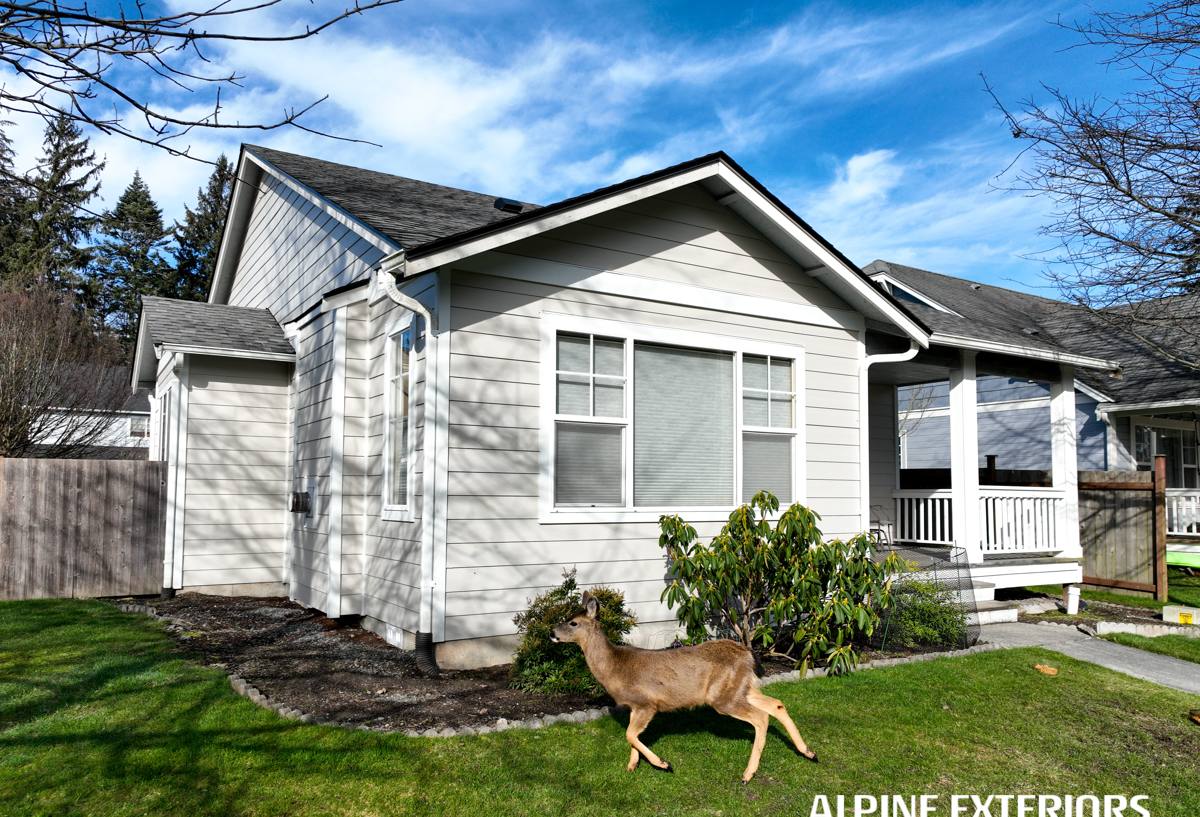
What Waterfront Exposure Actually Does to a House
Salt Air and Corrosion
Proximity to Semiahmoo Bay, Drayton Harbor, and the open water off Birch Bay means homes here take on more airborne salt than most of Whatcom County. Salt is corrosive to exposed metal — fasteners, flashing, hinges, deck hardware — and it can degrade a weak paint or finish system faster than a drier inland climate would. Anything installed on the outside of a Blaine or Birch Bay home needs to be chosen with that corrosion exposure in mind, not just picked off a sample board.
Wind-Driven Rain
Open water also means more wind, and wind-driven rain doesn't behave like a simple straight-down shower. It gets pushed sideways into siding laps, window flashing, and the transitions where a roof meets a wall. That sideways force is why a house that seems fine from the street can still be taking on water at a poorly flashed joint — the moisture load here is heavier than annual rainfall totals suggest, because so much of it is pushed horizontally into the wall assembly during storms.
A Long Moss and Mildew Season
Mild temperatures, persistent moisture, and plenty of shaded, tree-lined lots add up to a moss and mildew season that runs most of the year in this part of Whatcom County. North-facing walls, roofs, and anything shaded by trees or a neighboring structure tend to show growth first. Porous or moisture-retentive materials give moss and mildew something to hold onto; denser, factory-finished materials give it a lot less to work with.
Why We Only Install James Hardie Fiber Cement Siding
We didn't always limit ourselves to one siding brand. That changed after enough tear-offs and service calls in this specific climate — salt exposure, sustained moisture, heavy moss pressure — showed a clear pattern in which materials held up and which ones needed constant attention.
- Non-combustible core: Fiber cement doesn't burn or feed a fire the way wood-based siding products can, which matters for both safety and, in many cases, insurance considerations.
- Factory-applied ColorPlus finish: The color coat is baked on in a controlled factory process rather than brushed on at the jobsite, so it resists fading, chalking, and moisture intrusion far better than field-applied paint over time.
- Climate-engineered HZ5 formulation: Hardie builds region-specific product lines, and the HZ5 formulation is engineered for areas with heavy moisture exposure and freeze-thaw cycling — a good match for waterfront Whatcom County.
- Dimensional stability: Fiber cement doesn't swell, cup, or warp the way engineered wood siding can after repeated wet-season moisture cycles.
- A strong, transferable warranty: Hardie's warranty coverage is among the more substantial in the industry, provided the installation follows their published specifications.
We don't install LP SmartSide, vinyl siding, Cemplank, Allura, primed spruce, or cedar. Each has homeowners who are satisfied with it in the right setting. But on a coastal exposure like Blaine or Birch Bay, we've made the professional call to stand fully behind one system rather than offer a lower-cost option that quietly shifts more long-term maintenance and moisture risk onto the homeowner.
Installation Is What Makes the Material Perform
Fiber cement only delivers on its durability when it's installed exactly to spec — correct fastener type and spacing, proper clearance above grade and roofline, drainage or rain-screen detailing behind the panels where the assembly calls for it, and joints that are either factory-mitered or properly sealed. A Hardie board installed loosely in this climate will still develop problems. The product and the installation have to both be right.
Roofing in a Salt-Air, Moss-Heavy Climate
The roof takes the most direct and continuous exposure of any exterior surface — sun, wind-driven rain, and moss all land there first. A roof system needs correctly lapped flashing at every penetration and wall transition, underlayment that's actually doing its job, and ventilation that lets the roof deck and attic dry out between storms rather than trap moisture underneath the shingles. Those fundamentals matter more in Blaine and Birch Bay than they do a few miles inland, simply because the roof spends more of the year wet.
Signs a Roof in This Area Needs a Closer Look
- Moss returning quickly in valleys or on north-facing slopes even after cleaning
- Granules collecting in gutters or at the base of downspouts
- Soft or spongy spots underfoot, or visible sagging along the roofline
- Interior ceiling stains near exterior walls, especially after a windy rainstorm
- Flashing around chimneys, vents, or skylights that's lifted, rusted, or missing sealant
Windows: Flashing Matters as Much as the Unit Itself
In a wind-driven-rain climate, how a window is flashed into the surrounding wall matters at least as much as the window's own build quality. A premium window with poor flashing detail will still leak under sustained coastal wind, and a solid mid-grade window installed with correct flashing integration will often outperform it. When we replace windows on a Blaine or Birch Bay home, the flashing tie-in to the wall assembly and siding is where we spend the most attention, because that's the point where water most often finds its way in on waterfront properties.
Decks: Salt, Sun, and Repeated Wetting
Decks near Semiahmoo Bay, Drayton Harbor, and the Birch Bay shoreline deal with a combination inland decks rarely see — steady salt exposure, direct UV, and constant cycling between wet and dry. That combination is hard on fasteners and structural connectors, and it's hard on lower-grade decking materials as well. We use hardware rated for corrosive, coastal exposure, and we talk homeowners through the real differences between wood and composite decking for this specific setting rather than pushing one option across the board.
Comparing Siding Materials for This Climate
| Material | How It Handles Moisture | Salt-Air Maintenance | Realistic Longevity Here |
|---|---|---|---|
| James Hardie fiber cement | Dimensionally stable; resists swelling and warping | Low — factory finish resists fading and chalking | 30+ years with correct installation |
| Vinyl siding | Can distort or warp with heat cycling over time | Low upfront cost, but seams and fasteners are exposure points | Variable; often shorter in high-wind waterfront spots |
| LP SmartSide / engineered wood | Wood-based core sensitive to moisture at cut edges and seams | Moderate — edge sealing and caulk upkeep are ongoing | Heavily dependent on installation quality and upkeep |
| Cedar / primed wood | Absorbs and releases moisture readily | High — regular refinishing needed in salty, wet air | Shorter without consistent, ongoing maintenance |
Why a Contractor Who Knows This Coastline Matters
A crew that regularly works the Blaine and Birch Bay shoreline already knows how salt exposure, wind, and prolonged moisture behave here compared to a job just a few miles inland. That familiarity isn't abstract — it shows up in specific choices: how flashing gets lapped at a wall-to-roof transition, which fastener grade goes into a deck facing open water, where extra drainage detailing gets added behind siding. Those choices are what determine whether an exterior system lasts a couple of wet seasons or several decades.
Questions Worth Asking Before You Hire
- What siding material do they install, and will they explain why in plain terms?
- Do they carry current Washington contractor licensing and active liability insurance?
- How do they detail flashing at windows, doors, and roof-to-wall transitions for wind-driven rain specifically?
- What fastener and hardware grade do they use for decks and roofing in salt-air exposure?
- Will you get a clear, written scope of work before any contract is signed?
How We Approach a Project in Blaine or Birch Bay
We start with an on-site look at the existing exterior — whatever combination of siding, roofing, windows, or decking is at issue — and pay close attention to how the current system has actually handled moisture and salt exposure over time, not just how it looks from the curb. From there we put together a written scope and timeline before anything begins. The flashing, drainage, and fastener details that matter most in this climate are handled as standard practice on every job, not offered as an optional upgrade.
A Note on Maintenance
Even the right materials, correctly installed, benefit from a little homeowner attention in this climate. Rinsing accumulated salt residue off siding and hardware periodically, keeping gutters and downspouts clear so water isn't backing up against fascia and trim, and having moss removed from roofs and shaded siding before it builds up all extend the life of an exterior system. None of that replaces good materials and correct installation — it just protects the investment once the work is done.
If you're weighing siding, roofing, window, or deck work on a home in Blaine or Birch Bay, we're glad to walk the property with you and give you a straight read on what it actually needs. Reach out below for a free, no-pressure estimate.