 Birch Bay Siding
 Point Roberts sits in a strange spot on the map — a slice of the U.S. mainland you can only reach by driving through Canada, surrounded on three sides by the Strait of Georgia and Boundary Bay. That geography makes it one of the more exposed places to own a home in Whatcom County. Salt air rolls in off the water almost constantly, driving rain comes in sideways during winter storms, and the mild, damp Pacific Northwest climate means moss and algae have a long growing season on anything that stays shaded and wet. If you own a home out here, your siding, roof, and windows are working harder than they would almost anywhere else in the county.
We're based in Birch Bay and have serviced homes throughout this corner of Whatcom County for years, including the drive out to Point Roberts. We know the peninsula isn't a typical suburban job — it takes planning, it takes a crew that shows up prepared, and it takes materials that can actually stand up to what the water throws at a house here. This page walks through what we see on Point Roberts homes, how our siding, roofing, window, and deck work applies to this specific environment, and why we standardized on one siding product instead of offering the usual lineup of options.
What the Climate Does to a Point Roberts Home
Every coastal community in Whatcom County deals with moisture, but Point Roberts gets a concentrated version of it. The peninsula has almost no landmass to break incoming weather off the strait, so wind-driven rain hits exterior walls at angles that flatter siding profiles and loose trim simply can't shed. Add in salt spray, and you've got a slow, steady corrosive process working on fasteners, flashing, and any exposed wood.
Salt Air and Corrosion
Salt-laden air doesn't just sit on the surface of a house — it works into fastener heads, gets behind poorly sealed trim, and accelerates rust on anything that isn't corrosion-resistant. Over years, this shows up as staining around nail heads, rust bleed on lighter-colored siding, and premature failure of hardware that would have lasted decades a few miles inland.
Moss, Algae, and the Long Wet Season
Whatcom County's mild winters and wet shoulder seasons give moss and algae a long window to establish themselves on north-facing walls, roof valleys, and anywhere shade keeps a surface from drying out. Left unchecked, moss holds moisture against roofing and siding materials far longer than rain alone would, which is where a lot of rot and premature wear actually starts — not from the rain itself, but from what grows because of it.
Driving Rain and Wall Assemblies
Point Roberts' exposure means rain doesn't just fall — it's pushed. That matters for how a wall is built, not just what's on the outside of it. Proper flashing details, weather-resistant barriers, and correctly lapped siding courses are what actually keep water out; the exterior cladding is only one layer of a system that has to work together.
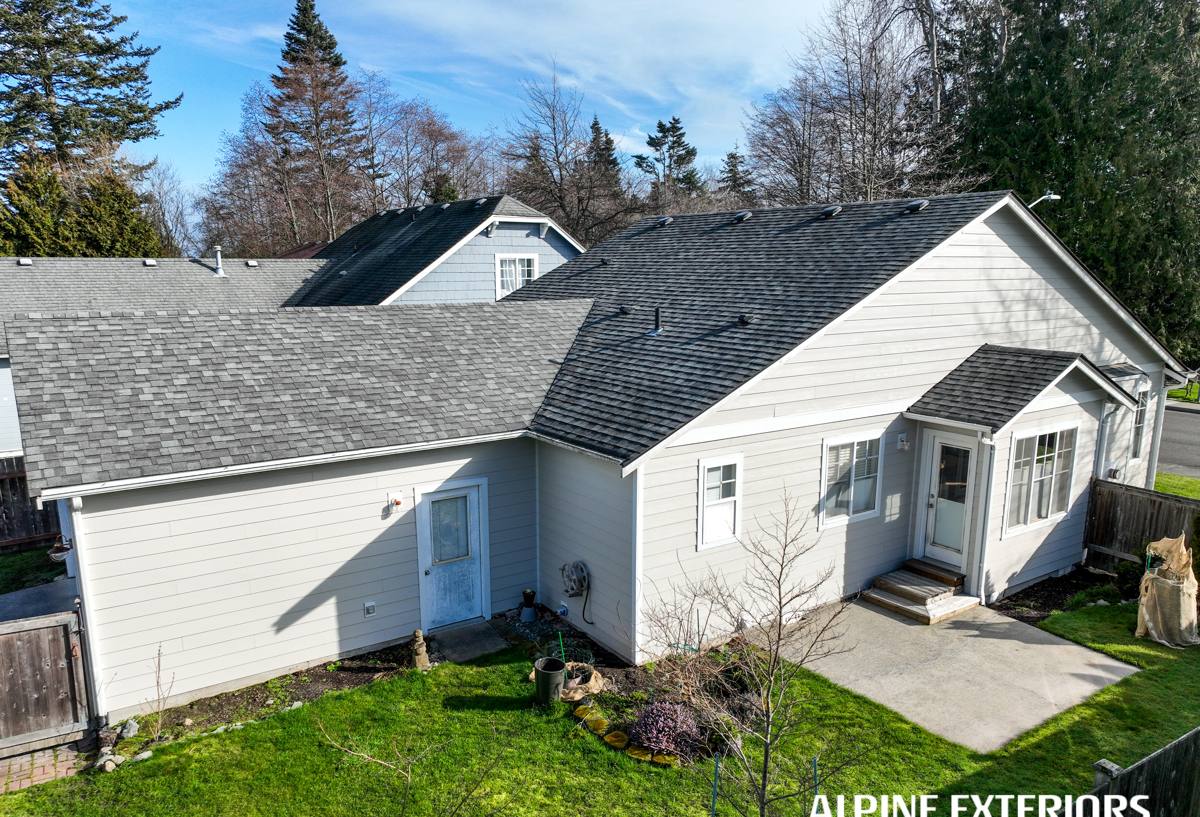
Siding: Why We Only Install James Hardie
We get asked fairly often why we don't offer vinyl, LP SmartSide, or the other fiber cement brands like Cemplank or Allura. The honest answer is that after years of doing exterior work in exactly this kind of environment, we standardized on James Hardie fiber cement and stopped installing the alternatives — not because every other product is bad, but because Hardie is the one we're comfortable standing behind on homes that take this much weather.
Vinyl
Vinyl siding is affordable and low-maintenance in mild conditions, and plenty of it is out there doing fine. But it's a thin, flexible material that expands and contracts with temperature swings, and in high-wind coastal exposure like Point Roberts gets, seams and panel edges are more prone to working loose over time. It also can't be painted to refresh a faded color without specialty products, and it doesn't offer the same fire resistance as fiber cement.
LP SmartSide
LP SmartSide is an engineered wood product — strand board with a resin-saturated overlay. It performs well when installed exactly to spec and maintained on schedule, but it's still wood-based at its core, which means edges and cut ends need diligent sealing to keep moisture from wicking in. In a location with this much salt spray and driving rain, that maintenance margin for error is thinner than we're willing to build a reputation on.
Other Fiber Cement Brands
Cemplank and Allura are also fiber cement, and fiber cement as a category is the right call for this climate — it's non-combustible, dimensionally stable, and doesn't rot. Where we draw the line is the finish system and warranty structure. James Hardie's ColorPlus factory-applied finish is baked on and backed by a dedicated finish warranty separate from the substrate warranty, and Hardie's HZ5 product line is specifically engineered for cold, wet, high-moisture climates like ours. We'd rather install one product exceptionally well than juggle several we install occasionally.
James Hardie: What Actually Goes On the Wall
James Hardie fiber cement is a mix of cement, sand, and cellulose fibers, cured into boards and panels that don't burn, don't rot, and resist the kind of moisture cycling that damages wood-based sidings. For a peninsula like Point Roberts, the relevant advantages are straightforward:
- Non-combustible — meaningful for insurance conversations and general fire safety
- Doesn't swell, rot, or attract pests the way wood products can
- ColorPlus factory finish resists fading and chipping better than field-applied paint
- HZ5 climate-engineered formulation built for cold, wet regions
- Transferable limited warranty that follows the home if it's sold
None of that replaces correct installation. Hardie's own installation guidelines specify fastener type and spacing, minimum clearances from grade and roofline, proper caulking at joints, and specific lap requirements — and in a high-exposure location like this, skipping any of that is where failures actually start. A crew that's installed a lot of Hardie in this exact climate knows where to add extra attention: corner details, window and door flashing integration, and bottom-course clearance where splashback and standing moisture are a bigger risk near the water.
Roofing on the Peninsula
Roofs on Point Roberts take a beating from the same forces as the siding — wind, salt, and moss — plus direct sun exposure with almost nothing to block it. We look at a few things specific to this area on every roofing job:
- Moss and algae growth in shaded valleys and north slopes, which holds moisture against shingles
- Flashing condition around chimneys, vents, and roof-to-wall transitions, where wind-driven rain finds gaps first
- Fastener and metal corrosion from sustained salt exposure
- Ventilation, since a poorly vented attic traps moisture that works against the roof deck from underneath
Roof replacement or repair timing on this peninsula often comes down to how well a roof has been maintained rather than age alone — two roofs installed the same year can be in very different condition if one has had moss cleared regularly and the other hasn't.
Windows: Sealing Out Wind-Driven Rain
Window failures on exposed coastal homes are rarely about the glass — they're about the seal between the window unit and the wall. On a property that takes rain at an angle as often as Point Roberts does, flashing integration around the window opening matters as much as the window itself. We pay close attention to:
- Proper flashing tape and pan flashing at the sill, so any water that gets past the window has somewhere to drain
- Correct integration with the siding and weather-resistant barrier, not just caulk at the trim
- Energy performance suited to a marine climate with cool, damp winters
- Condition of existing frames, since older wood or aluminum frames near the water often show corrosion or rot well before the glass itself fails
Replacing windows without addressing the flashing underneath is one of the more common ways a "window problem" turns into a wall problem a few years later.
Decks in a Salt-Air Environment
Outdoor living space is part of why people love this stretch of coastline, but decks here face accelerated wear from the same salt air and moisture cycling that affects siding and roofing. Fastener corrosion, ledger board moisture intrusion where the deck meets the house, and UV/salt breakdown of surface materials are the recurring issues we see. Composite decking generally holds up better than untreated wood in this kind of exposure, but the ledger board connection and proper flashing at the house are what actually determine whether a deck stays structurally sound over the long run — that detail matters more here than the decking material choice itself.
Cost Factors for Point Roberts Exterior Projects
Every home and project is different, and we don't quote sight unseen, but these are the main factors that tend to move the price on exterior work out here:
| Factor | Why It Matters |
|---|---|
| Access and logistics | Point Roberts' location affects material delivery and crew scheduling more than a typical Whatcom County job |
| Existing wall/roof condition | Hidden rot or moisture damage found once old siding or roofing comes off adds scope |
| Home size and complexity | Roofline angles, multiple stories, and wall cutouts (windows, doors) affect labor time |
| Product line and finish | Hardie panel vs. lap siding, and standard vs. premium ColorPlus finishes, carry different material costs |
| Flashing and detail work | High-exposure sites need more careful (and time-consuming) flashing at every transition |
| Scope bundling | Combining siding, roofing, or windows in one project can reduce total mobilization and setup costs |
Why a Local, Familiar Crew Matters Here
Point Roberts isn't a place you send a crew that's never dealt with this kind of exposure before. A contractor who mostly works inland jobs may not think twice about fastener corrosion resistance, moss-prone roof valleys, or the extra flashing attention wind-driven rain demands — because those aren't daily concerns most places in Whatcom County. We've built our process around this specific coastline, which means we're not learning on your house.
There's also a practical side to hiring local: a crew based in Birch Bay isn't disappearing after the job. If a warranty question comes up or something needs a look years down the road, we're a short drive away, not a company that worked the area once and moved on.
Questions Worth Asking Any Contractor Before You Hire
- Have you worked on homes in this specific coastal exposure before, and what did you see?
- What's your plan for flashing at windows, doors, and roof transitions — not just the siding itself?
- What warranty comes with the material, and is it transferable if the home sells?
- Are you licensed and insured for work in Washington, and can you show proof?
- What does your written estimate include, and what would trigger a change order?
Our Process for Point Roberts Projects
Because of the peninsula's location, we plan Point Roberts jobs a little differently than in-town Birch Bay work — material staging and crew scheduling get mapped out ahead of time so the job runs efficiently once we're on site. The core process is the same everywhere we work: an in-person assessment of your home's current siding, roofing, windows, or deck condition, an honest conversation about what actually needs to happen versus what can wait, a clear written estimate, and a crew that shows up and does the work to spec — not just the visible layer, but the flashing, fastening, and moisture-management details underneath it.
If your Point Roberts home is dealing with worn siding, a roof that's seeing more moss every year, drafty or leaking windows, or a deck that's starting to show its age, we're happy to take a look. Reach out for a free, no-pressure estimate using the form below.