 Birch Bay Siding
 Every siding estimate looks different, and that's not because contractors are making numbers up. Siding replacement cost is driven by a specific set of variables — house size and shape, what's underneath the old siding, material choice, and how much moisture damage has already happened. If you understand those variables, you can read any estimate you get and know whether it makes sense, instead of just comparing bottom-line numbers.
Birch Bay adds its own wrinkle. Salt air off the water, driving rain that comes in sideways during winter storms, and a long moss season that keeps north-facing walls damp for months all put more stress on a home's exterior than you'd see further inland. That doesn't change the basic cost drivers, but it does change which ones matter most here.
The Big Cost Drivers, In Order
For most homes, the price of a siding job breaks down into a handful of categories. Understanding the order of importance helps you know where your money is actually going.
1. House size and complexity
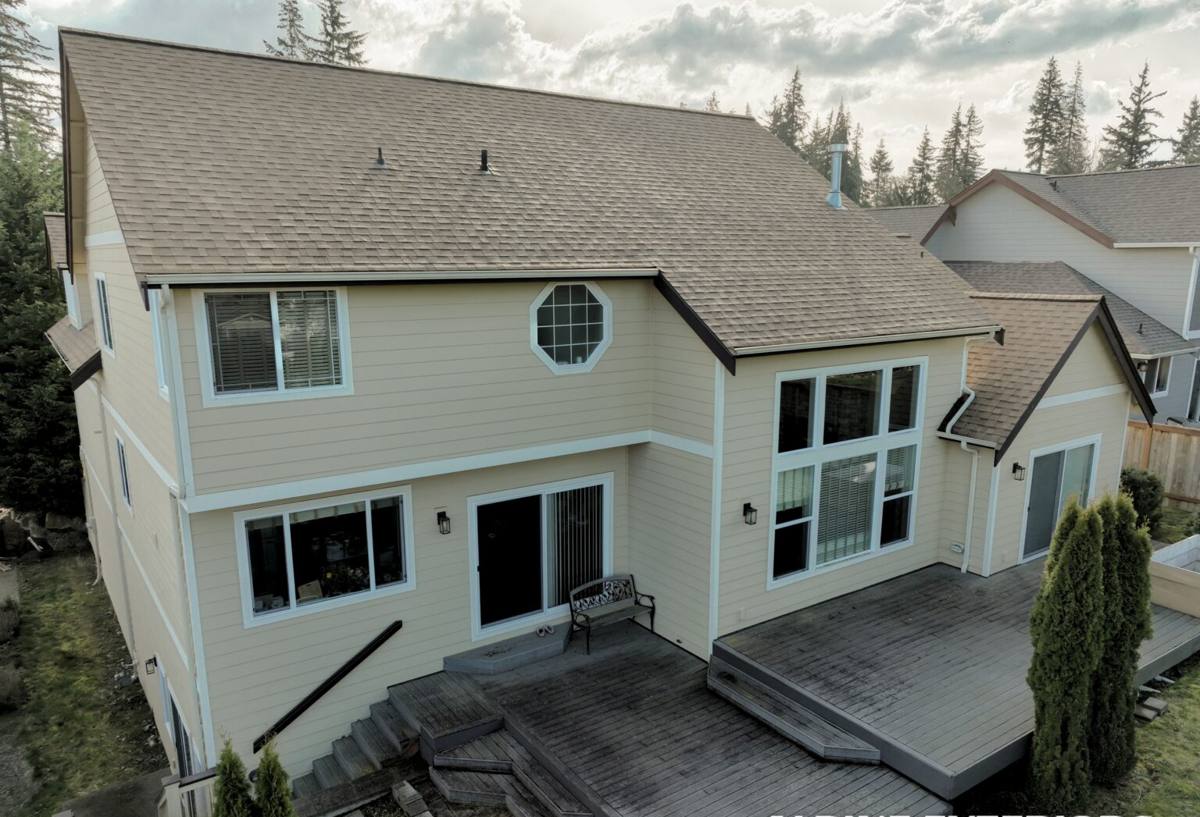
Square footage of wall area is the starting point, but complexity matters more than most homeowners expect. A simple rectangular home with few corners, gables, or dormers costs less per square foot to side than a home with lots of architectural detail. Every inside corner, outside corner, window trim run, and roofline intersection adds labor time — and Birch Bay's mix of older beach cottages and newer custom builds means complexity varies a lot from house to house.
2. What's underneath
This is the variable that surprises homeowners most. Once the old siding comes off, the contractor can see the sheathing, the house wrap or building paper, and the framing behind it. If there's rot from long-term moisture intrusion — common on homes that have taken decades of salt air and wind-driven rain — that damaged wood has to be cut out and replaced before new siding goes on. A quote based on a visual estimate before tear-off is always a starting point, not a final number, because nobody can see through the wall.
3. Material choice
Vinyl, engineered wood (LP SmartSide), fiber cement (James Hardie, Cemplank, Allura), and traditional wood products all sit at different price points, with different labor requirements and different lifespans. We'll get into why we only install one of these further down, but material is a real line item, not just a preference.
4. Moisture and rot remediation
Tied to point two, this deserves its own mention because it's the item most likely to change a quote after the walls are opened up. Flashing details around windows and doors, especially on the weather-facing sides of a home, are common failure points. Fixing them correctly the first time — not just papering over rot — is what prevents the same problem five years later.
5. Trim, accessories, and finish details
Corner boards, window and door trim, fascia, soffit work, and color-matched caulking and touch-up paint all add up. These are often bundled into a quote as a single line, but they're worth asking about individually so you know what's included.
A Rough Cost-Factor Comparison
The table below isn't a price list — it's a way to see which factors push a project's cost up or down, and why. Actual numbers depend on your specific home, so treat this as a framework for asking good questions.
| Factor | Pushes Cost Down | Pushes Cost Up |
|---|---|---|
| House shape | Simple rectangle, few corners | Many gables, dormers, bump-outs |
| Sheathing condition | Dry, sound wood underneath | Rot requiring cut-out and replacement |
| Material | Vinyl (lowest install cost) | Fiber cement (higher install labor, longer life) |
| Wall exposure | Sheltered sides, south-facing | North/west exposure to driving rain and wind |
| Access | Ground-level, clear yard | Second story, tight lot, landscaping in the way |
| Trim detail | Simple modern trim | Extensive window/door trim, multiple accent colors |
Why Tear-Off Costs More Than You'd Think — But Usually Pays Off
Some contractors offer to install new siding directly over old siding to save money. It's cheaper up front, but it means nobody ever looks at the sheathing, the house wrap, or the framing before covering it back up. In a climate like Whatcom County's — with sustained damp weather and a moss season that can run six months or longer on shaded north walls — that's a real gamble. Full tear-off costs more, but it's the only way to actually verify what's happening behind the old siding and fix it before it becomes a bigger, more expensive problem.
Why We Standardized on One Material
We get asked constantly why we don't offer vinyl, LP SmartSide, or the various fiber cement competitors like Cemplank or Allura alongside James Hardie. The honest answer is that we install one product because we've found it's the one that holds up best to Birch Bay's specific combination of salt air, wind-driven rain, and near-constant winter moisture — and because offering five products means being mediocre at installing all of them instead of being genuinely expert in one.
What James Hardie gets right for this climate
- Fiber cement doesn't absorb and swell with moisture the way engineered wood products can if a seam or edge is compromised.
- It's non-combustible, which matters for insurance considerations and peace of mind, though that's a secondary factor here compared to moisture performance.
- The ColorPlus factory finish is baked on and warrantied against fading and chipping, which matters on a coastline where UV and salt spray both work on painted surfaces.
- Hardie's HZ5 product line is engineered specifically for climates with sustained moisture exposure, which describes Whatcom County's marine weather well.
- Correctly installed with proper flashing and clearances, it has a long track record of holding up in Pacific Northwest coastal conditions.
The honest trade-off
Fiber cement costs more to install than vinyl, and more than engineered wood, largely because it's heavier, requires specific fastening patterns, and needs to be cut and installed to a stricter spec to perform as designed. That upfront labor cost is the real trade-off — and it's why some contractors default to cheaper, faster-to-install materials. We think the long-term performance difference, especially in this climate, is worth that difference.
Where Corners Get Cut — And How to Spot It
Because siding installation is labor-intensive no matter the material, the temptation to save time shows up in predictable places. Knowing what to ask about protects you regardless of who you hire.
A practical checklist for any siding quote
- Does the quote include full tear-off and disposal of old siding, or install-over?
- Is house wrap or weather-resistive barrier replacement included, or reused?
- Are flashing details around windows, doors, and roof intersections spelled out, or just assumed?
- Is rot remediation an allowance (an estimate) or a change order surprise after tear-off?
- Does the quote specify fastener type and spacing for the material being installed?
- Is manufacturer-required clearance from grade, decks, and roof lines called out?
- What's actually covered by warranty — material only, or material and labor?
How Local Climate Shapes the Right Answer
Birch Bay sits right on the water, which means homes here take a different kind of weathering than homes even a few miles inland. Salt-laden air accelerates corrosion on fasteners and hardware that aren't rated for it. Driving rain, pushed sideways by wind off the strait, finds gaps in flashing that would never be tested on a sheltered inland wall. And the long stretch of grey, damp months each year keeps shaded siding wet longer, which is exactly the condition that lets moss and mildew take hold and exactly the condition that punishes materials prone to moisture absorption.
None of that means every home needs the most expensive option available. It does mean that in Whatcom County, the "what's it made of and how is it installed" questions matter more than they would in a drier climate, and it's worth weighing that against the up-front price difference.
Getting an Estimate You Can Actually Compare
The best way to compare two siding quotes isn't to look at the bottom line — it's to make sure both contractors are quoting the same scope: full tear-off, sheathing inspection, comparable materials, and clearly stated flashing and trim work. A lower number that skips tear-off or assumes no hidden rot isn't actually a lower price; it's a different, incomplete scope.
If you're weighing a siding replacement on your Birch Bay home and want a straight answer about what your specific house needs, we're happy to take a look and walk you through it. Reach out for a free, no-pressure estimate — we'll tell you what we see and what we'd recommend, no obligation either way.