 Birch Bay Siding
 Primed Spruce Siding: A Straight Answer for Birch Bay Homeowners
If you've priced out siding for a home near Birch Bay's shoreline, you've probably run into primed spruce lap siding — sometimes sold as finger-jointed spruce, sometimes as solid-sawn boards. It's been a staple of Pacific Northwest home construction for decades, and there's a reason contractors still install it: it's affordable, it's easy to work with, and it looks the part of a classic Northwest home. We get asked about it often enough that we think homeowners deserve an honest explanation of why we don't put it on houses anymore, especially not this close to the water.
This isn't a knock on spruce as a species or on the contractors who still install it well. It's a explanation of the trade-offs we ran into repeatedly in Whatcom County's climate, and why we made the call to standardize on James Hardie fiber cement instead. You should know both sides before you decide what goes on your walls.
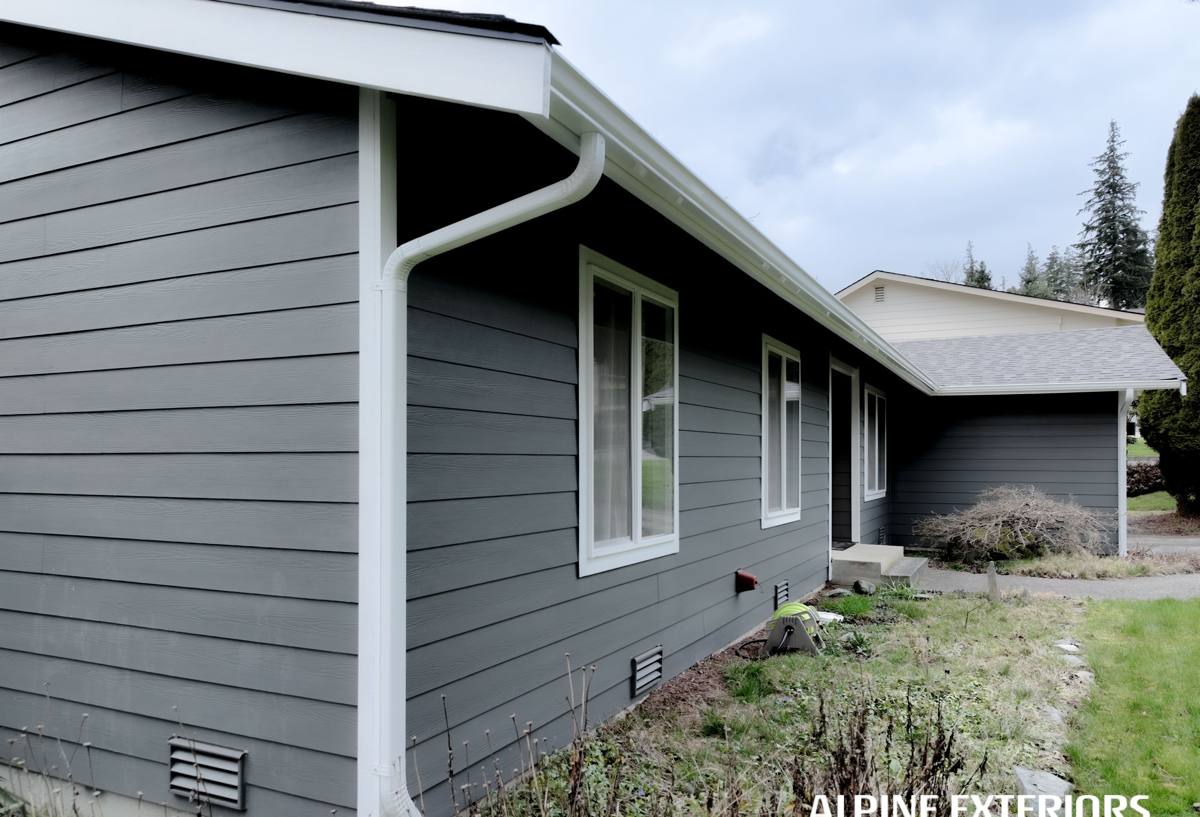
What Primed Spruce Siding Actually Is
Primed spruce siding is solid wood — usually finger-jointed spruce or pine, milled into lap or bevel profiles, and coated at the factory (or in the field) with a primer coat before it's installed and painted. It's a real wood product, not an engineered composite, which is part of its appeal. Homeowners like the authentic wood grain, the way it takes paint, and the lower upfront material cost compared to fiber cement or premium wood species like cedar.
The finger-jointed version bonds shorter pieces of spruce end-to-end to make longer boards, which keeps costs down but also introduces more seams where moisture can find a way in over time. Solid-sawn boards avoid that particular issue but cost more and are harder to source in long, straight lengths.
Why It's Still Sold
- Lower material cost per square foot than fiber cement or cedar
- Lightweight and easy to cut, nail, and fit on site
- Familiar look — many older Birch Bay and Whatcom County homes were built with wood lap siding
- Readily available from regional lumber suppliers
Where Primed Spruce Runs Into Trouble on the Water
Birch Bay sits right on Puget Sound, and that proximity to salt water changes the math on wood siding. Salt-laden air is more corrosive to fasteners and more aggressive toward paint film than the drier air you'd get twenty miles inland. Add in Whatcom County's driving winter rain — often coming sideways off the water — and you've got a siding material that's constantly cycling between wet and dry, swelling and shrinking.
Spruce is a softwood with relatively low natural decay resistance compared to cedar or fiber cement. Once moisture gets past the paint film — through a nail hole, a cracked caulk joint, or a finger-joint seam — the wood underneath doesn't have much built-in defense. It starts absorbing water, and in our climate, it doesn't get a long dry season to fully recover before the next round of rain arrives.
The Moss Factor
Whatcom County's long moss season is its own specific problem for painted wood siding. Moss and algae thrive in the shaded, moisture-retentive conditions common on north-facing walls and anywhere tree cover blocks direct sun. On primed spruce, moss growth isn't just cosmetic — it holds moisture directly against the wood surface for extended periods, which accelerates paint breakdown and, eventually, wood decay underneath. Keeping painted wood siding moss-free near Birch Bay requires regular washing and vigilance that most homeowners don't sign up for when they choose a "low-maintenance" siding option.
The Maintenance Reality
Every primed wood siding product needs field paint, and that paint is doing real structural work — it's the primary barrier keeping water out of the wood. That means repainting isn't optional or purely cosmetic; it's maintenance the siding depends on to survive.
| Maintenance Task | Typical Frequency Near Salt Air | Why It Matters |
|---|---|---|
| Repainting / recoating | Every 5-8 years | Paint film degrades faster in salt air and UV; bare spots let water into the wood |
| Caulk joint inspection | Annually | Cracked caulk at seams and trim is the most common entry point for moisture |
| Moss and algae washing | 1-2 times per year | Reduces moisture retention against the wood surface |
| Spot repair of soft/rotted boards | As discovered | Rot spreads to adjacent boards if not caught early |
None of this is unusual for wood siding — it's simply what wood requires. The issue is that a lot of homeowners choose primed spruce expecting vinyl-like low maintenance and get a product that actually needs more attention than most other options on the market, particularly this close to the Sound.
Installation Sensitivity We Can't Overlook
Wood siding is far less forgiving of installation shortcuts than people assume. Every cut end, every nail penetration, and every butt joint is a place where the factory primer no longer protects the wood — it has to be field-primed or sealed on site, every single time, or that spot becomes the first place rot starts. On a full house, that's dozens or hundreds of exposed cut ends that all depend on a crew being disciplined enough to seal each one before installation continues.
Back-priming — coating the backside of each board before it goes on the wall — is another step that's easy to skip and impossible to verify once the siding is up. Skipped back-priming is one of the most common reasons we see premature wood siding failure on inspections: the front looks fine, but the backside has been absorbing moisture from behind for years.
Common Installation Failure Points
- Unsealed cut ends at corners, windows, and doors
- Missing or inadequate back-priming before installation
- Nail heads not properly set and sealed, allowing water entry
- Insufficient clearance between siding and grade, decks, or roof lines
- Caulk used as a substitute for proper flashing at penetrations
These aren't defects in the spruce itself — they're installation-quality issues. But they're also issues that are far more consequential with wood siding than with a factory-finished, moisture-resistant product, because wood has so little margin for error once water gets past the surface.
What Happens When It's Neglected
We've inspected enough older homes in Whatcom County to see the pattern: primed spruce siding that was installed correctly and maintained on schedule can last decades. Primed spruce siding that missed even a few repaint cycles, or that sat under moss for a few too many winters, starts showing soft spots, cupping boards, and paint that won't hold a new coat because the wood underneath is already compromised. At that point, the fix usually isn't a fresh coat of paint — it's replacing boards, and sometimes sheathing behind them.
That's the core problem with wood siding as a long-term investment: its performance is entirely dependent on a maintenance schedule that has to be kept up indefinitely, by every owner the house ever has, without exception.
Why We Standardized on James Hardie Fiber Cement
We made the decision to stop installing primed spruce (and other painted wood siding) for the same reasons outlined above: in a marine climate with heavy rain and a long moss season, wood siding asks a lot of homeowners in ongoing upkeep, and the consequences of falling behind are expensive. James Hardie fiber cement addresses the specific failure points we kept running into with wood.
- Non-combustible material — fiber cement doesn't burn, which matters for wildfire-adjacent risk and general fire safety
- ColorPlus factory finish — baked-on color that resists fading and doesn't depend on field painting to stay protected
- HZ5 and climate-engineered product lines — formulated for moisture and freeze-thaw performance in Pacific Northwest conditions
- Dimensionally stable — fiber cement doesn't swell, cup, or warp with moisture cycling the way solid wood does
- Strong transferable warranty — backed by the manufacturer, not dependent on the original owner maintaining a paint schedule
Fiber cement isn't maintenance-free — no exterior product truly is — but it removes the specific vulnerability that makes wood siding risky near the water: a thin paint film standing between the material and constant moisture exposure.
A Fair Comparison
| Factor | Primed Spruce Siding | James Hardie Fiber Cement |
|---|---|---|
| Upfront material cost | Lower | Moderate to higher |
| Moisture resistance | Dependent on paint film integrity | Engineered for moisture cycling |
| Repainting needed | Every 5-8 years, structurally necessary | Factory finish; repainting is cosmetic choice, much longer intervals |
| Salt air performance | Accelerated paint and fastener wear | Formulated to resist coastal conditions |
| Fire resistance | Combustible | Non-combustible |
| Warranty structure | Limited, often paint-manufacturer only | Manufacturer-backed, transferable |
If You Already Have Primed Spruce Siding
We're not suggesting every home with existing wood siding needs to panic or replace it immediately. If your siding is on a reasonable repaint schedule and the boards are sound, there's no urgency. What we'd encourage is an honest inspection before your next repaint cycle — particularly on north-facing walls, areas with moss buildup, and anywhere the siding sits close to grade or roof lines. Catching soft boards or failed caulk joints early is far cheaper than discovering them after they've spread.
Signs Worth Getting Checked
- Paint that's peeling, bubbling, or won't hold a fresh coat
- Boards that feel soft or spongy when pressed
- Visible cupping, warping, or gaps opening at seams
- Persistent moss or dark staining that keeps returning after cleaning
- Cracked or missing caulk at trim, corners, and window edges
Our Bottom Line
Primed spruce siding isn't a bad product when it's installed with full back-priming, sealed cut ends, and kept on a strict repaint schedule for the life of the home. But that's a demanding standard to hold for decades, especially on a home exposed to Birch Bay's salt air and Whatcom County's wet, moss-prone winters. We'd rather put a material on your home that doesn't put that much weight on future maintenance — which is why James Hardie fiber cement is the only siding system we install.
If you're weighing your siding options for a home in Birch Bay or elsewhere in Whatcom County, we're happy to walk your property, talk through what we're seeing, and give you a straight answer — not a sales pitch. Reach out for a free, no-pressure estimate using the form below.