 Birch Bay Siding
 Terrell Creek's Climate Is Harder on Siding Than Most Homeowners Realize
Terrell Creek sits in the drainage that runs down toward Birch Bay, tucked into the mix of low-lying wetland, second-growth forest, and residential streets that defines this corner of Whatcom County. It's a beautiful place to own a home, but it's not an easy place to own exterior building materials. The same features that make the area appealing — proximity to saltwater, tree cover, and a marine climate that keeps things green most of the year — are exactly what wears down siding, trim, roofing, and decking faster than homeowners expect.
Three things define the exterior workload here. First, salt air drifting in off Birch Bay and the broader Strait of Georgia settles on painted and unpainted surfaces alike, accelerating corrosion on fasteners and finishes that weren't built to handle it. Second, driving rain off winter storms doesn't just fall straight down — wind-driven moisture gets pushed sideways into seams, laps, and trim joints, which is where most siding failures actually start. Third, the long moss season — realistically eight or nine months of the year in a shaded, damp lot — keeps organic growth active on roofs, north-facing walls, and anywhere sunlight and airflow are limited.
None of that is unique to Terrell Creek specifically, but it's more pronounced here than in drier inland parts of Whatcom County because of how close the neighborhood sits to the bay and how much tree canopy shades many of the lots. Siding that would hold up fine forty miles east can fail early here if it wasn't engineered for a marine environment.
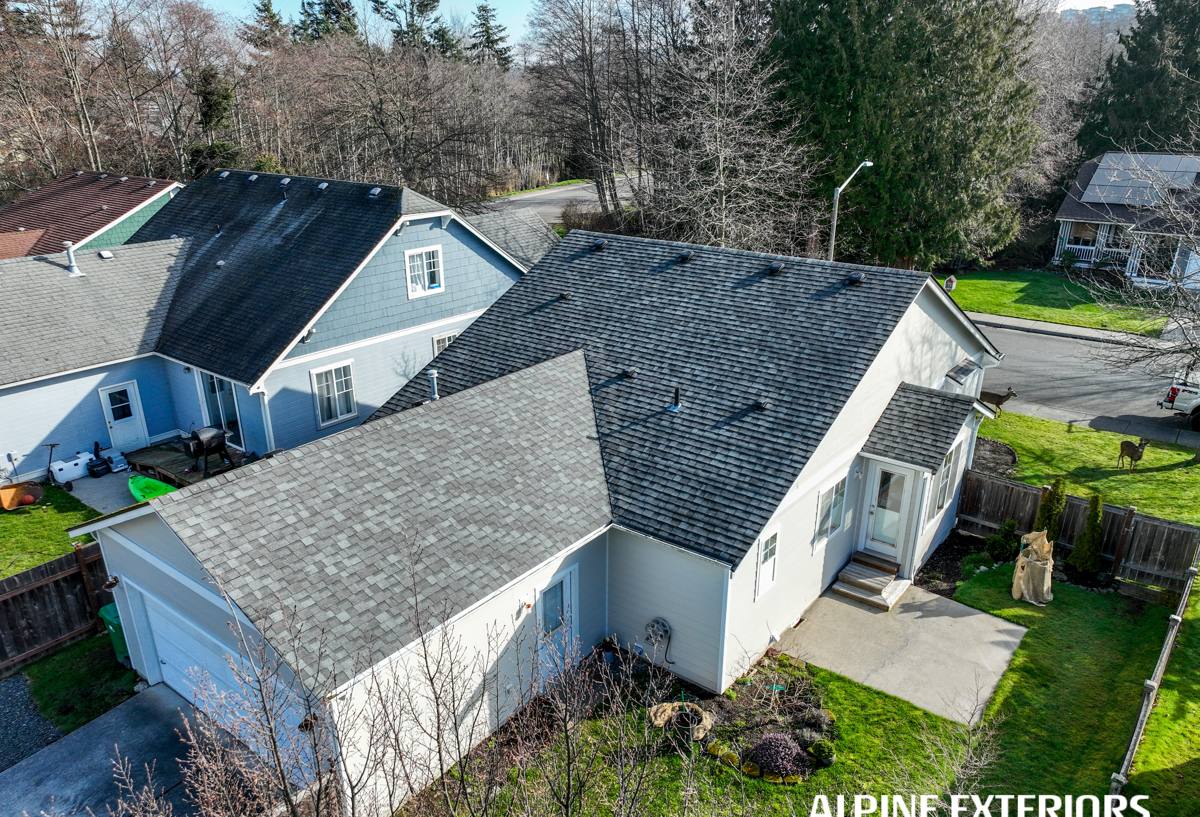
Why We Only Install James Hardie Fiber Cement Siding
We get asked regularly why we don't offer vinyl, LP SmartSide, or one of the other fiber cement brands on the market. The honest answer is that we made a standardization decision after years of doing repair and replacement work up and down the Whatcom County coastline, and James Hardie is what consistently performs in this climate when installed correctly.
What Rules Out the Alternatives, Honestly
Vinyl siding is inexpensive and low-maintenance in mild climates, but it's a poor match for driving rain and salt air. It expands and contracts significantly with temperature swings, its seams are a common entry point for wind-driven moisture, and impact damage (branches, hail, debris) cracks it in a way that's hard to repair invisibly. Engineered wood products like LP SmartSide use a wood-strand substrate that, while treated, is still an organic material at its core — in a region with this much sustained moisture and moss pressure, that's a maintenance liability we don't want to hand a homeowner. Other fiber cement brands (Cemplank, Allura) are chemically similar to Hardie, but we don't stock or install them because we've standardized our crews, flashing details, and warranty process around one system rather than juggling several.
We also don't install primed spruce or cedar siding. Real wood can look excellent, but it demands a repainting and caulking cycle that most homeowners underestimate, and in a moss-heavy, high-moisture pocket like Terrell Creek, that maintenance burden compounds fast.
What James Hardie Gets Right
James Hardie fiber cement is non-combustible, dimensionally stable, and manufactured in regional product lines (the HZ5 line is engineered for climates like ours — freeze-thaw cycling combined with sustained moisture). It holds a factory-applied ColorPlus finish that resists fading and doesn't require repainting on the same schedule as wood, and it carries a strong transferable limited warranty when installed to Hardie's published specifications. It isn't immune to problems — no siding is — but the failure modes we see with Hardie almost always trace back to installation shortcuts (wrong nailing pattern, missing flashing, insufficient clearance at grade), not the material itself. That's exactly why we control installation quality closely rather than leaving it to whichever crew is available that week.
| Material | Moisture Behavior in a Marine Climate | Maintenance Burden | Why We Do or Don't Install It |
|---|---|---|---|
| James Hardie fiber cement | Dimensionally stable, engineered HZ5 line for this region | Low; factory finish, occasional wash | What we install |
| Vinyl | Seams vulnerable to wind-driven rain; warps with heat | Low, but impact damage is hard to repair | Not offered |
| LP SmartSide | Wood-strand substrate, moisture-sensitive at cut edges | Moderate; edge sealing is critical | Not offered |
| Primed spruce / cedar | Organic material, absorbs moisture without upkeep | High; repaint and caulk cycle | Not offered |
Roofing, Windows, and Decks: The Full Exterior in Terrell Creek
Siding rarely fails in isolation. In our experience working this area, a home with moss-choked roofing usually has moisture problems trending toward the wall assembly too, and old windows are often the weak point that lets bulk water in behind otherwise sound siding. We handle all four exterior trades — siding, roofing, windows, and decks — because they're mechanically connected, and inspecting only one usually means missing the real source of a problem.
- Roofing: Moss removal, flashing repair, and full replacement, with attention to the valleys and north-facing slopes where moss and moisture linger longest.
- Windows: Replacement units with modern flashing and sealing details that integrate properly with new siding, closing off a common leak path around old frames.
- Decks: Framing, decking, and railing work built to handle year-round exposure to rain and standing moisture, not just summer use.
- Siding: James Hardie systems installed with correct clearances, fastening, and flashing at every penetration and transition.
What a Local Crew Actually Means for a Terrell Creek Project
There's a real difference between a crew that works Whatcom County's coastline regularly and one that doesn't. Flashing details around window and door openings, the ground clearance needed at the base of a wall, the way trim gets sealed at butt joints — all of it needs to account for sustained wet weather and salt exposure, not just the manufacturer's minimum spec. A crew that mostly works drier inland regions can install Hardie correctly on paper and still leave a home vulnerable to the specific conditions this area throws at it.
Working locally also means we're realistic about scheduling around the wet season, we know which lots tend to hold shade and moisture longer, and we're around after the job is done if a warranty question comes up down the road.
How a Siding Replacement Typically Goes
- On-site assessment — we look at the existing siding, sheathing condition where accessible, moss and moisture patterns, and window/door flashing.
- Scope and estimate — a written plan covering material, any necessary repairs to sheathing or trim, and a realistic timeline.
- Prep and tear-off — removal of old siding, inspection of the water-resistive barrier and sheathing, repair of anything compromised.
- Installation — James Hardie panels or lap siding installed to manufacturer spec, with correct fastening, clearances, and flashing at every penetration.
- Final walkthrough — review of the finished work and warranty paperwork before we consider the job done.
What Drives Cost on a Siding Project Here
| Factor | Why It Matters in Terrell Creek |
|---|---|
| Extent of moisture damage found at tear-off | Coastal exposure means underlying sheathing repair is more common than in drier areas |
| Home access and lot layout | Wooded or sloped lots common in the area can affect staging and scaffolding needs |
| Siding profile (lap vs. panel vs. shingle) | Affects material and labor time; profile choice also affects how well an area sheds wind-driven rain |
| Trim and flashing detail work | More critical, and more labor-intensive, in a high-rain, high-salt environment |
| Number of window and door openings | Each opening is a flashing detail that takes time to get right |
Signs Your Terrell Creek Home May Need Siding Attention
- Moss or dark streaking building up on north- or shade-facing walls
- Soft spots, bubbling, or visible warping in existing siding
- Paint that's failing faster than it should, especially near ground level or window trim
- Gaps or separation at seams and corner boards
- Musty smell or visible staining on interior walls that share an exterior wall
- Siding older than 20–25 years that hasn't been inspected recently
Moss and Moisture Maintenance Between Projects
Even good siding benefits from basic upkeep in a climate like this. Keeping gutters clear so water isn't overflowing onto wall surfaces, trimming back vegetation that shades and dampens exterior walls, and having roofing and siding looked at every few years for early moss growth all go a long way toward getting the full lifespan out of whatever's on your home. If you're already noticing moss creeping onto siding or trim, that's usually a sign moisture is lingering longer than it should — worth a look before it becomes a bigger repair.
Let's Take a Look at Your Home
If you're in Terrell Creek and dealing with aging siding, moss buildup, roofing wear, or windows that aren't sealing the way they used to, we're happy to come take a look. The estimate is free, there's no pressure, and you'll get a straight answer about what your home actually needs versus what can wait. Use the form below to get started.