 Birch Bay Siding
 Sandy Point Sits Right at the Edge of the Weather
Sandy Point is one of the more exposed residential pockets along the Birch Bay shoreline in Whatcom County. Homes here sit close to open water, which means they take the full brunt of what comes off the Strait of Georgia and the Salish Sea: salt-laden air, wind-driven rain that hits siding sideways instead of falling straight down, and a damp, low-light winter that can stretch on for months. Add in a shoreline setting that stays shaded and moist longer than homes set back in the trees or up on higher ground, and you have a recipe for a long moss and algae season that inland Whatcom County homes simply don't deal with to the same degree.
None of that is a reason to avoid living here — it's one of the best parts of Birch Bay. But it does mean the exterior of a Sandy Point home works harder than the exterior of a house a few miles inland. Siding, roofing, windows, and decks all take more abuse from moisture cycling, salt exposure, and organic growth, and the materials and installation details that hold up fine elsewhere can fail faster right on the water.
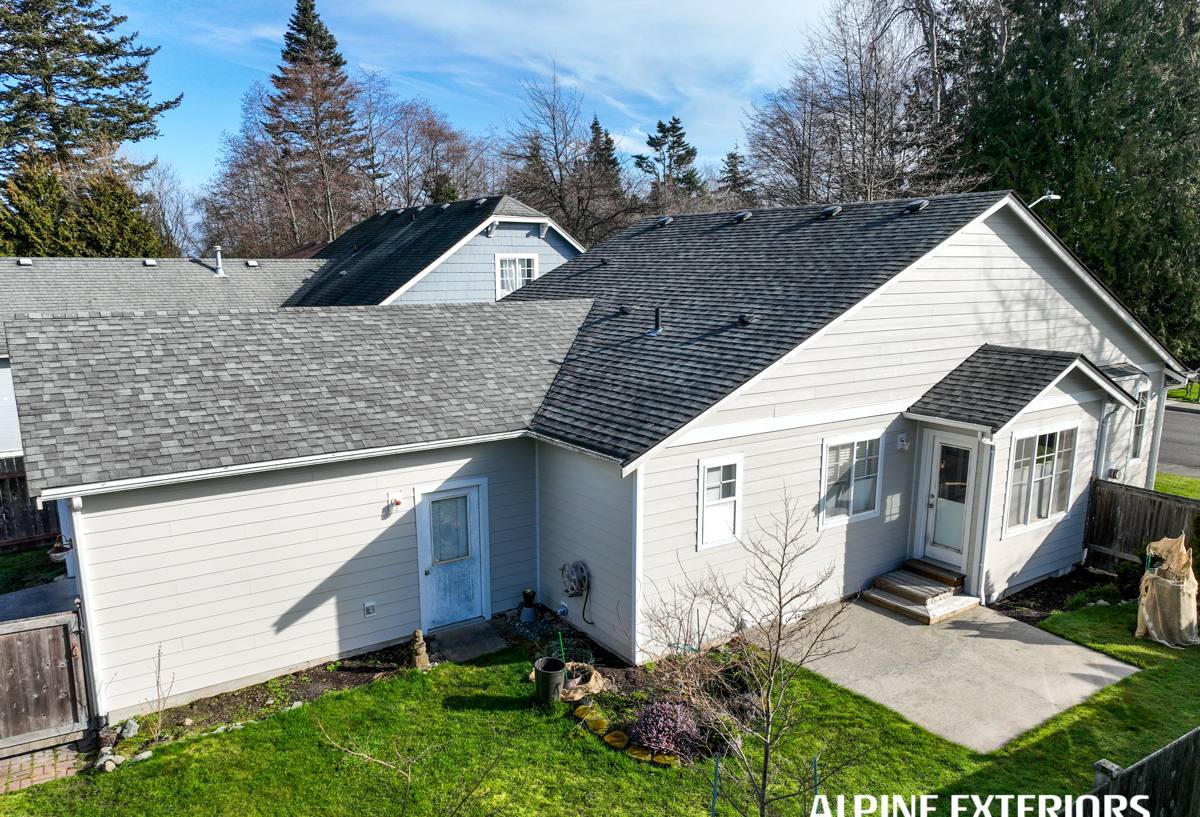
What Salt Air and Constant Moisture Actually Do to a Home's Exterior
It helps to understand the specific mechanisms at work, because they explain why we make the material choices we do.
Salt air
Airborne salt is corrosive to exposed metal fasteners, flashing, and hardware, and it accelerates the breakdown of some coatings and sealants. It also holds moisture against surfaces longer than dry inland air does, which keeps siding and trim damp for more hours out of the day.
Driving rain
Wind off the water doesn't just fall on a roof — it drives rain horizontally into wall assemblies, seams, and butt joints that were designed with gentler weather in mind. Any gap in flashing, caulking, or lap coverage becomes a path for water intrusion.
Moss and algae
Shaded, damp, cool surfaces are exactly what moss and algae need to establish themselves. On roofs, moss lifts and traps moisture under shingles. On siding, algae staining and moss growth in laps and trim joints hold water against the substrate and, on the wrong materials, feed rot or delamination.
Why We Only Install James Hardie Fiber Cement Siding
Our company made a deliberate decision to install James Hardie fiber cement siding exclusively — not vinyl, not LP SmartSide, not Cemplank or Allura, not primed spruce or cedar. That's not a marketing position; it's a response to what we've seen happen to other materials on homes in exactly this kind of coastal, wet climate.
Vinyl siding
Vinyl is inexpensive and easy to install, and it holds up reasonably well in mild, dry climates. In a salt-air, high-wind coastal setting, though, vinyl panels can become brittle over time from UV and temperature cycling, and wind-driven rain can find its way behind loosely lapped panels at seams. Vinyl also isn't a fire-resistant material, which matters more every year as wildfire smoke and ember exposure become a bigger part of Pacific Northwest summers.
LP SmartSide and other engineered wood products
Engineered wood siding is wood-based, and wood-based products are fundamentally more vulnerable to sustained moisture than fiber cement is. In a climate with a long wet season and constant humidity off the water, any breach in the factory coating — a scuff, a poorly sealed cut edge, a nail that wasn't set right — gives moisture a foothold, and wood-based substrates can swell, delaminate, or begin to break down from that point.
Cedar and primed spruce
Real wood siding can look beautiful, but it demands an ongoing maintenance commitment — re-staining or repainting on a cycle, monitoring for checking and rot, and vigilance about moss and mildew — that most homeowners underestimate until they're a few years in. On a shoreline lot like Sandy Point, that maintenance burden is higher than almost anywhere else in the county.
Cemplank and Allura
These are also fiber cement products, and fiber cement as a category is the right call for this climate. Our reason for standardizing on James Hardie specifically comes down to manufacturing consistency, the ColorPlus factory finish, the climate-engineered HZ5 formulation built for wetter regions, and a transferable warranty structure we're comfortable standing behind on every job.
What James Hardie Gets Right for a Home Like Yours
James Hardie fiber cement is a cement, sand, and cellulose fiber composite. It doesn't feed mold or rot the way wood-based products can, and it's non-combustible, which matters for both insurance considerations and simple peace of mind. Hardie's HZ5 product line is specifically engineered for climates like ours — cold, wet, and humid for much of the year — with a moisture and freeze-thaw resistance formulation suited to exactly the conditions Sandy Point sees.
The ColorPlus factory finish is baked on in a controlled environment rather than field-painted, which gives a more consistent, longer-lasting color and reduces the number of exposed seams and touch-up points where moisture could otherwise get a start. Hardie backs its products with a strong, transferable limited warranty, which also carries real weight if you ever sell the home.
None of this means Hardie is maintenance-free. It still needs to be installed correctly, caulked and painted at cut edges per manufacturer spec, and kept clear of soil and mulch contact. But compared to the alternatives, it's the material that gives a Sandy Point home the best odds of looking right and performing well ten and twenty years out.
Siding, Roofing, Windows, and Decks — One Crew, One Standard
Siding doesn't perform in isolation. On a shoreline home, siding, roofing, windows, and decks are all fighting the same battle against wind-driven moisture and salt exposure, and they need to work together as a system.
Roofing
A roof in a moss-prone environment needs proper ventilation, ice-and-water protection at vulnerable areas, and materials chosen with algae and moss resistance in mind. Roof and wall drainage planes need to coordinate — flashing details where a roof meets a wall are one of the most common points of water intrusion on coastal homes.
Windows
Window flashing and integration with the siding's weather-resistive barrier is critical in a driving-rain climate. A window that's beautifully installed on its own but poorly flashed into the wall assembly around it is a leak waiting to happen.
Decks
Outdoor living structures on the water take direct weather exposure with no overhang protection in many cases. Fastener choice, ledger flashing, and framing materials all need to account for the same salt-air corrosion and moisture cycling that affects the rest of the exterior.
Having one crew handle all four means the flashing, drainage, and material decisions are coordinated from the start, instead of four separate contractors each optimizing their own piece and leaving the transitions between them as weak points.
What Correct Installation Actually Involves
Fiber cement siding is only as good as its installation, and in a high-exposure coastal setting the installation details matter even more than usual.
- A drainage plane or rainscreen gap behind the siding so any moisture that does get past the surface can drain and dry rather than sitting against the wall sheathing
- Correct fastener type, spacing, and embedment per Hardie's published installation specs — under- or over-driven nails are a common source of early failure
- Properly lapped and flashed housewrap or weather-resistive barrier at every penetration, window, and door
- Factory-cut edges caulked and field-painted per manufacturer requirements before they're exposed to weather
- Minimum clearance maintained between the bottom of the siding and grade, roofing, decks, and hardscape
- Corrosion-resistant flashing and fasteners appropriate for a salt-air environment
Skipping any one of these doesn't necessarily show up right away. It shows up in year five or year ten, as staining, soft spots, or paint failure at the exact points where a shortcut was taken. This is a big part of why we prefer local crews who install to spec on every job rather than crews chasing volume across a wide territory.
Comparing Siding Materials for a Coastal Whatcom County Home
| Factor | James Hardie Fiber Cement | Vinyl | LP SmartSide / Engineered Wood | Cedar / Primed Spruce |
|---|---|---|---|---|
| Fire resistance | Non-combustible | Combustible | Combustible | Combustible |
| Moisture behavior | Does not rot; engineered for wet climates (HZ5) | Doesn't rot but seams can admit driving rain | Wood-based; vulnerable if coating is breached | Wood; requires ongoing sealing/staining |
| Salt-air durability | Strong, with correct fasteners/flashing | Can become brittle over time | Moderate; sensitive to sustained moisture | Requires frequent maintenance to keep up |
| Maintenance | Low; periodic wash and caulk check | Low, but limited repairability | Moderate; monitor coating integrity | High; re-stain/repaint cycle |
| Warranty | Strong, transferable | Varies by manufacturer | Varies by manufacturer | Typically none beyond installer |
Living With a Moss-Prone, Salt-Air Climate: Ongoing Care
Even the right material benefits from basic upkeep. A yearly rinse to knock salt residue and organic buildup off siding, roofing, and decking goes a long way. Keep gutters clear so water isn't overflowing and running down siding it wasn't meant to see. Trim back vegetation that keeps walls shaded and damp longer than necessary — that shade is exactly what moss and algae are looking for. Check caulking at trim and window edges annually, since it's the first line of defense against driving rain and the first thing to fail if it's going to.
None of this is heavy lifting, but it's the kind of maintenance that's easy to skip until a small problem becomes an expensive one. A material like Hardie fiber cement gives you a longer runway before neglect turns into real damage, but it doesn't eliminate the need for basic care in a climate this demanding.
Choosing a Contractor for a Sandy Point Project
Because Sandy Point homes face tougher conditions than most, the contractor you choose matters more here than it would inland. A crew that's never worked a shoreline job may not think twice about rainscreen gaps, fastener corrosion resistance, or flashing sequencing — details that don't show up as problems until years later.
- Confirm the contractor is licensed, bonded, and insured in Washington State
- Ask whether they're a certified installer for the specific siding product they're proposing
- Ask how they detail rainscreen/drainage planes and flashing at windows, doors, and roof-wall intersections
- Ask for a written scope that specifies fastener type, caulking, and paint touch-up per manufacturer spec
- Ask how they coordinate siding work with roofing, window, and deck work if more than one is happening
- Get references from other projects in Birch Bay or similar coastal settings, not just inland jobs
A local crew that works this stretch of coastline regularly has already seen what does and doesn't hold up here. That experience is worth more than a low bid from a crew unfamiliar with what salt air and driving rain do to an exterior over time.
Get a Straight Answer for Your Home
Every Sandy Point property is a little different — orientation to the water, tree cover, age of the existing siding, and roof condition all factor into what a project actually needs. We're glad to walk your property, take an honest look at what's going on with your siding, roofing, windows, or deck, and give you a clear, no-pressure estimate along with the reasoning behind our recommendations. Reach out below to get started.