 Birch Bay Siding
 Siding That Holds Up in Nooksack's Climate
Nooksack sits inland from the salt water that shapes so much of Whatcom County's weather, but the same weather patterns still reach it: long stretches of driving rain off the Pacific, damp air that lingers in the valley, and a moss season that can run from early fall through late spring. Homes here don't get hit by surf spray the way a beachfront property might, but they take on moisture in a different way — through saturated ground, shaded rooflines, and siding that rarely gets a full day of direct sun to dry out between storms.
That combination is hard on the wrong siding material. Wood and wood-based composite products absorb water at cut edges and fastener points, then swell, crack, or delaminate over a few winters. Vinyl can hold up structurally but tends to look tired fast in a climate this damp, with algae and grime building up in the low-sun months. We install James Hardie fiber cement siding exclusively, because it's engineered to shed water rather than absorb it, and it doesn't feed the moss and mildew that thrive in this kind of environment.
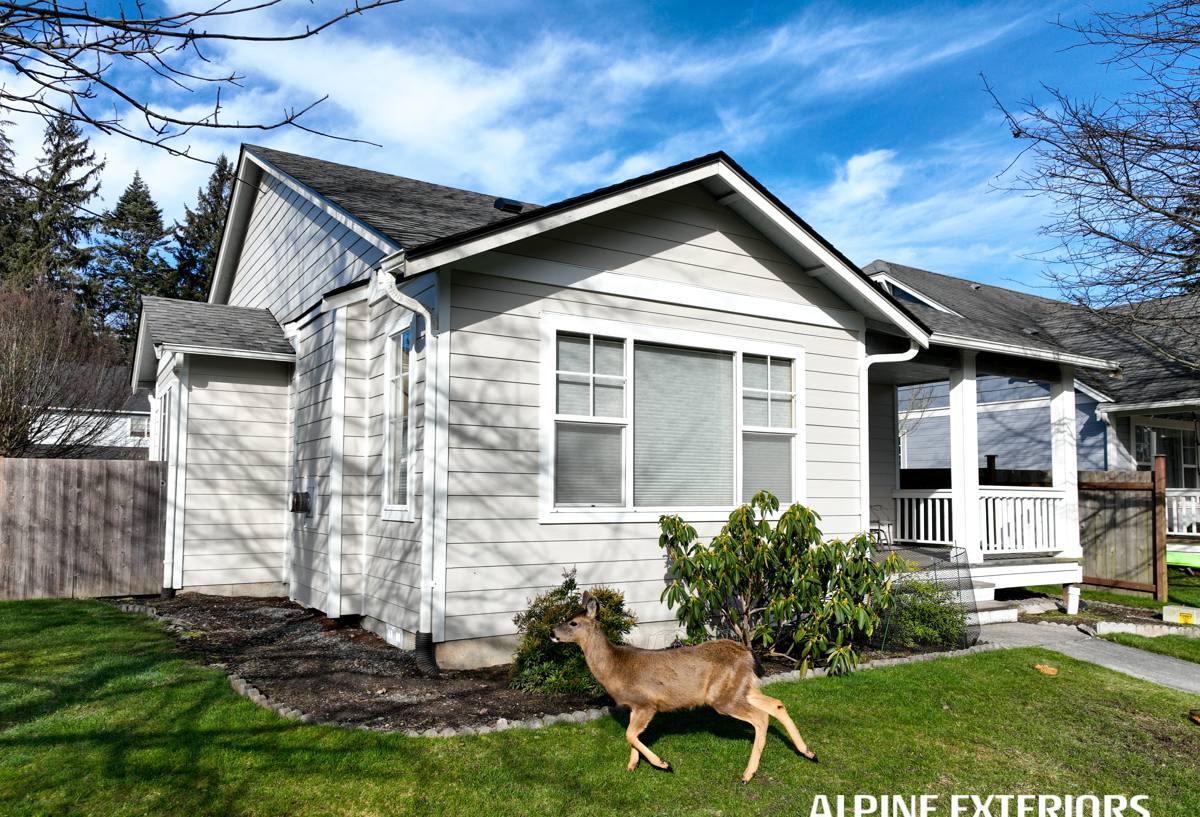
What Nooksack Homes Are Up Against
Persistent Moisture
Whatcom County gets a long wet season, and Nooksack's inland location doesn't spare it from that — if anything, valley humidity and slower air movement compared to more exposed coastal spots can mean siding stays damp longer after a storm passes. Any product with wood fiber in it needs regular sealing and paint maintenance to keep water out of the substrate. Skip a maintenance cycle and you're looking at soft spots, bubbling paint, or rot at the bottom courses within a few years.
Moss and Organic Growth
Shaded north sides of homes, roof valleys, and siding under overhangs are prone to moss and green algae staining in this region. Moss doesn't just look bad — it holds moisture against the siding surface, which accelerates whatever underlying damage the material is already prone to. A dense, factory-finished fiber cement surface is far less hospitable to that growth than a porous or textured wood-fiber product.
Temperature Swings and UV Fading
Whatcom County doesn't get brutal heat, but siding still goes through freeze-thaw cycles in winter and gets real UV exposure whenever the sun does come out. Paint-grade siding and cheaper composite products fade unevenly and need repainting on a schedule. Factory-applied finishes are formulated to hold color and resist UV breakdown far longer than a field-applied coat.
Why We Install Only James Hardie Fiber Cement
We made a decision years ago to stop installing every product a supplier offered and instead commit to one system we could stand behind on every job. James Hardie fiber cement is a mix of cement, sand, and cellulose fiber, which makes it non-combustible and dimensionally stable — it doesn't swell, crack, or delaminate the way wood and wood-composite sidings can when they take on water repeatedly, which is exactly the kind of exposure Nooksack homes see for months at a time.
Hardie's ColorPlus factory finish is baked on under controlled conditions, not brushed on at the jobsite. That finish is formulated to resist fading and chipping, and it holds up to repeated wet-dry cycling far better than field-applied paint. Hardie also builds region-specific product lines (HZ5 and HZ10) engineered for the moisture and freeze-thaw conditions found in the Pacific Northwest, which matters more here than in a drier climate where any siding product would perform reasonably well.
We also stand behind the installation itself. Fiber cement is unforgiving of shortcuts — improper fastening, wrong nail placement, or skipped flashing details will cause problems no matter how good the material is. Our crews install to Hardie's published specifications, which is also what keeps the manufacturer's warranty valid.
Why We Don't Install Other Siding Products
We get asked about vinyl, LP SmartSide, and other composite or wood options fairly often, and we're upfront about why we don't offer them.
- Vinyl siding is affordable and low-maintenance in mild climates, but it's a petroleum-based product that can warp in temperature extremes and tends to look dated faster in a climate as damp and shaded as Whatcom County's. It also lacks the impact resistance and fire rating that fiber cement offers.
- LP SmartSide and similar wood-strand composites use engineered wood treated with resins to resist moisture, and the technology has improved over the years. But it's still wood at its core, meaning cut edges, seams, and fastener penetrations are vulnerable points if caulking and paint maintenance ever lapse — a real risk in a region that gets this much sustained rain.
- Primed spruce and cedar are attractive traditional options, but both require diligent, ongoing maintenance (repainting, caulking, moisture monitoring) to perform in a wet climate, and both are combustible in a way fiber cement is not.
None of these are bad products in every application. We simply found that for the climate we work in, committing to one material we can install, warranty, and maintain consistently gives homeowners a better long-term outcome than offering a menu of options with different failure modes.
Our Siding Installation Process
Every project starts with an on-site assessment of the existing siding, sheathing, and moisture barrier. In a lot of older Nooksack homes, we find hidden moisture damage behind the existing siding that isn't visible until it's removed — something worth planning for rather than being surprised by.
- Remove existing siding and inspect sheathing for rot or moisture damage
- Repair or replace any compromised sheathing before moving forward
- Install a weather-resistant barrier and proper flashing at all windows, doors, and penetrations
- Install James Hardie panels or planks per manufacturer fastening specifications
- Seal and finish trim, corners, and transitions to shed water correctly
- Final walkthrough to confirm fit, finish, and proper drainage details
Cost Factors for Siding Replacement
Every home is different, but the same handful of factors drive most of the cost variation we see on siding jobs in this area.
| Factor | Why It Matters |
|---|---|
| Home size and wall complexity | More square footage and more corners, gables, and dormers mean more material and labor time |
| Existing sheathing condition | Hidden rot found during tear-off adds repair scope that can't always be quoted in advance |
| Siding profile chosen | Lap siding, shingle-style panels, and board-and-batten all have different material and labor costs |
| Trim and accessory work | Fascia, soffit, and trim replacement alongside siding affects total project scope |
| Access and site conditions | Multi-story sections, tight lot access, or landscaping to protect can add labor time |
We won't quote a number here that means nothing without seeing your home, but we can say that fiber cement is a mid-to-upper range investment upfront compared to vinyl, offset by a much longer service life and less recurring maintenance cost.
More Than Siding — A Full Exterior Approach
Siding doesn't work in isolation. We also handle roofing, windows, and decks, because a home's exterior only performs as well as its weakest connection point. Failing flashing at a roofline, an old window that's letting moisture behind the wall, or a deck ledger that's rotted can undermine even a perfect siding installation. When we're on-site for a siding project, we're looking at the whole envelope, not just the wall cladding, and we'll flag anything else that needs attention before it becomes a bigger problem.
Why Homeowners Choose a Local Crew
A crew that works Whatcom County regularly understands things a traveling contractor won't pick up from a spec sheet — how moss actually behaves on north-facing walls in this valley, which detailing choices hold up through a normal wet season here, and how local permitting and inspection processes work. We're not guessing at how our work will perform in this climate; we see the results on homes across the area year after year.
Maintenance Tips for Nooksack Homeowners
- Rinse siding annually to remove pollen, dust, and early moss growth before it takes hold
- Keep gutters clear so overflow doesn't run down and saturate siding repeatedly
- Trim back vegetation and tree branches that keep siding shaded and damp longer than necessary
- Inspect caulking around windows and trim each fall before the wet season sets in
- Address any small paint chips or panel damage promptly rather than letting moisture find a way in
If your siding is showing moss staining, soft spots, peeling paint, or you're just planning ahead for a wet Whatcom County winter, we'd be glad to take a look. Reach out for a free, no-pressure estimate using the form below.