 Birch Bay Siding
 Why Bellingham's Climate Is Hard on a Roof
Bellingham sits close enough to Bellingham Bay and the Salish Sea that salt-laden air is a real factor in how a roof ages, not just a coastal talking point. Add in Whatcom County's long wet season, where roofs can stay damp for weeks at a stretch, and a moss season that runs longer here than it does east of the mountains, and you've got three separate stresses working on a roof at the same time: corrosion, water intrusion, and organic growth that holds moisture against the surface. A roof spec'd for a dry inland climate simply doesn't hold up the same way here. Metal roofing done right handles all three, but "done right" is doing a lot of work in that sentence — the metal, the fasteners, the flashing details, and the slope all have to be matched to this specific environment.
Salt Air and Driving Rain, Together
On their own, either condition is manageable. Together, they're what actually causes premature failure. Wind-driven rain off the bay pushes water sideways into laps, seams, and fastener penetrations that would stay dry in a calmer climate. If there's any weakness in a coating or a seam, salt-bearing moisture finds it faster and does more damage once it's in. That's why the fastener and flashing details matter more here than in a lot of other parts of the state.
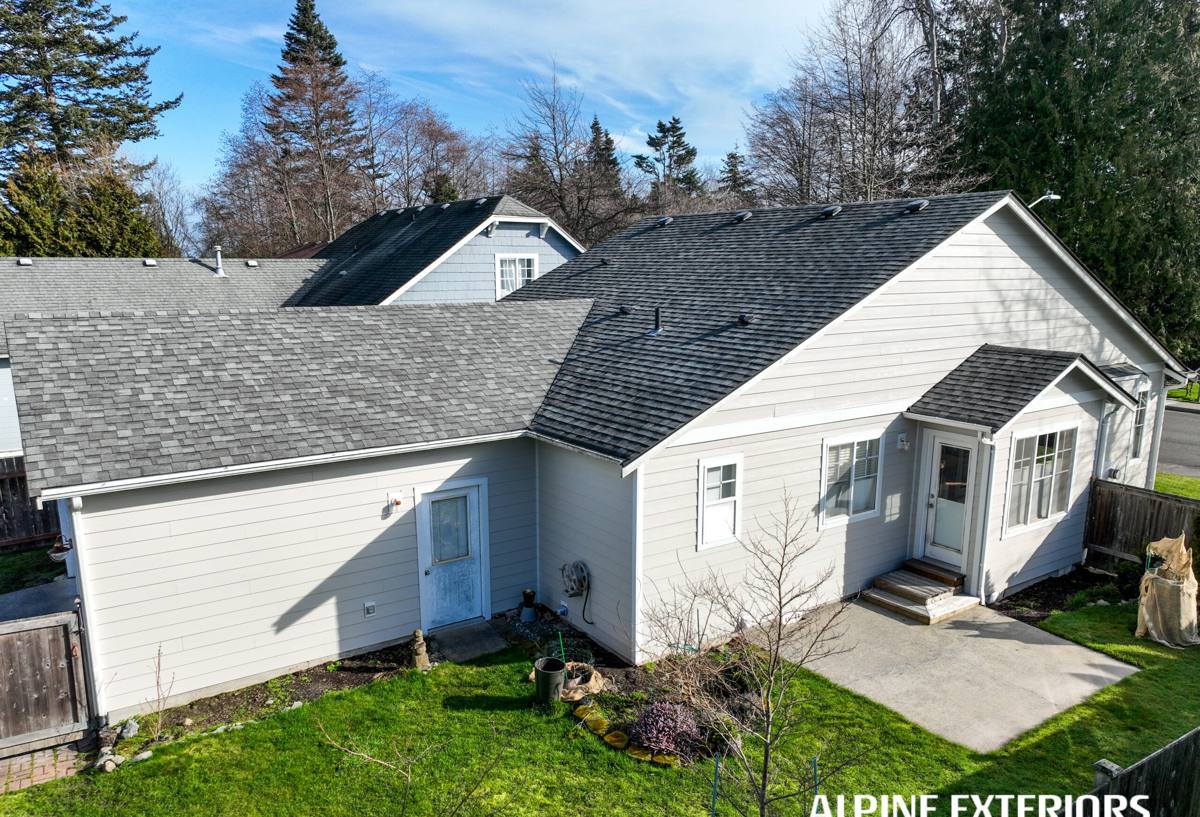
What a Correct Metal Roof Installation Actually Involves
Metal roofing looks simple from the ground — long panels, clean lines — but a correct install is a stack of decisions that each affect how the roof performs over 30-50 years, not just how it looks on day one.
- Underlayment: A high-temp synthetic or self-adhered underlayment, not felt, especially at eaves and valleys where wind-driven rain is most likely to get pushed uphill under a panel lap.
- Fastener selection: Fasteners have to be compatible with the panel metal to avoid galvanic corrosion — mixing metals at the fastener is one of the most common causes of early rust staining and leaks we see on coastal re-roofs.
- Panel attachment method: Concealed-fastener (standing seam) versus exposed-fastener systems handle thermal movement and long-term watertightness differently — more on that below.
- Flashing at every penetration: Vents, chimneys, skylights, and valleys each need flashing detailed for the specific panel profile, not a generic bent-metal patch.
- Ventilation: A metal roof over an under-ventilated attic can trap moisture underneath the deck, which defeats the purpose of putting a durable metal surface on top.
Choosing a Panel System for a Bellingham Roof
There isn't one "best" metal roof — there's a best fit for the house, the roof slope, and the budget. For Whatcom County's climate, the two systems homeowners in and around Bellingham most often compare are standing seam and exposed-fastener (screw-down) panels.
| Factor | Standing Seam (Concealed Fastener) | Exposed-Fastener Panel |
|---|---|---|
| Water resistance | Fasteners hidden under the seam, so no exposed penetrations for wind-driven rain to work at | Screws penetrate the panel face; gaskets wear over time and need eventual re-torquing or replacement |
| Coastal durability | Better long-term performance where salt air accelerates fastener corrosion | Can perform well if fasteners are matched to the metal and inspected periodically |
| Upfront cost | Higher material and labor cost | Lower upfront cost |
| Maintenance | Minimal — mainly seam and flashing checks | Periodic fastener inspection recommended, especially after major wind events |
| Best fit | Primary residences, longer ownership horizon, low-slope sections | Outbuildings, shops, budget-driven projects |
We'll talk through both honestly during an estimate rather than steering every job toward the higher-cost option — the right call depends on the roof's slope, exposure, and how long you plan to own the home.
Corrosion Control: The Detail That Gets Skipped
Galvanic corrosion happens when two dissimilar metals are in contact with moisture between them — one metal essentially sacrifices itself to protect the other, and on a roof that means the fastener, the flashing, or the panel edge slowly deteriorates. Near the water, with salt air accelerating the reaction, this shows up faster than most homeowners expect. Correct practice is straightforward but easy to cut corners on: match fastener metal to panel metal, use factory-matched flashing wherever possible, and avoid direct contact between the panel and untreated dissimilar metals like copper vents or old galvanized fixtures unless they're properly isolated. This is one of the reasons we don't mix generic hardware-store fasteners into a coastal metal roof — the upfront savings gets erased by an early leak repair.
Moss, Algae, and Roof Slope
Whatcom County's moss season is longer than most of the state's, and it's driven by shade, moisture, and slope as much as tree cover. Metal roofing resists moss far better than composition shingle because there's no granular surface for spores to root into, but moss and organic debris can still build up in valleys, at panel laps on low-slope sections, and anywhere debris collects against a wall or chimney. Left alone, that buildup holds moisture against the panel and can accelerate coating wear at the contact point. A metal roof drastically reduces moss problems compared to a shingle roof, but it doesn't eliminate the need for occasional debris clearing, especially under fir or cedar cover common around Birch Bay and greater Bellingham.
Our Process for a Bellingham Metal Roof
- On-site assessment: We look at slope, exposure to prevailing wind and rain direction, existing ventilation, and any moss or moisture staining already present.
- System recommendation: We walk through panel type, gauge, and finish options suited to the roof's exposure — not a one-size answer for every house.
- Tear-off and deck inspection: Old roofing comes off and the deck gets checked for rot or soft spots before anything new goes down — a common find on older Whatcom County homes with a history of slow leaks.
- Underlayment and flashing installation: High-temp synthetic or self-adhered underlayment at eaves, valleys, and penetrations, with flashing detailed to the specific panel profile.
- Panel installation: Panels run and fastened per manufacturer spec, with attention to matched hardware and correct overlap for the roof's slope and prevailing wind direction.
- Final walk-through: We check seams, flashing, and fastener torque before calling the job done, and go over basic maintenance with the homeowner.
Maintenance: What Actually Keeps a Metal Roof Performing
Metal roofing is low-maintenance, not no-maintenance. A short annual checklist goes a long way in this climate:
- Clear debris and moss from valleys and low-slope sections, especially under overhanging trees
- Check exposed fasteners for backing-out or gasket wear if the roof is a screw-down system
- Look at flashing around chimneys, vents, and skylights for any sign of lifting or sealant failure
- Confirm gutters and downspouts are clear so water isn't backing up under the eave edge during heavy rain
- After any major windstorm off the bay, do a quick visual check for lifted panels or displaced flashing
Cost Factors Worth Understanding
Metal roofing costs more upfront than composition shingle, and the range on any given house depends on more than just square footage.
| Factor | Why It Moves the Price |
|---|---|
| Panel system | Standing seam runs higher than exposed-fastener panel due to material and labor |
| Roof complexity | Valleys, dormers, and multiple penetrations add flashing labor |
| Tear-off scope | Removing old roofing and any deck repair adds cost versus a straightforward install |
| Metal gauge and coating | Heavier gauge and higher-grade coatings cost more but last longer in salt air |
| Roof access and pitch | Steep or hard-to-access roofs take longer to work safely |
We give straight, itemized numbers during the estimate rather than a vague ballpark — a metal roof is a long-term investment, and you should know what you're paying for and why.
Why It Matters That We Already Work in This Area
A crew that already works Bellingham and the surrounding Birch Bay area knows the local building department's expectations, has already seen how the prevailing wind off the water affects panel and flashing performance on real roofs in the county, and isn't guessing at fastener choices for the first time on your house. That local track record shows up in details a newcomer to the area might miss — which slopes need extra attention to moss and debris, which exposures need heavier corrosion protection, and how the wet season timeline affects scheduling a tear-off safely. It's not a marketing line, it's the difference between a roof that's designed for this climate and one that's designed for climate in general.
If you're weighing metal roofing for a home in Bellingham or anywhere around Birch Bay, we're happy to walk the roof with you and give a straightforward, no-pressure estimate — use the form below to get started.