 Birch Bay Siding
 Roof Replacement in Terrell Creek: A Different Set of Conditions
Terrell Creek sits in a stretch of Birch Bay where wooded lots, shoreline exposure, and low afternoon sun overlap in ways that are hard on a roof. Homes tucked back under fir and cedar canopy fight moss and standing shade most of the year. Homes closer to the water fight salt-laden wind and driving rain off the Strait. A lot of Terrell Creek roofs deal with some combination of both. That mix is exactly why a roof replacement here shouldn't be treated the same way you'd treat one in a dry, open subdivision inland.
We're not talking about exotic engineering — a correctly built roof handles Whatcom County weather fine for decades. The issue is that a roof built to a generic spec, or repaired one patch at a time by whoever's cheapest that year, tends to fail early in exactly the spots this climate targets: valleys, low-slope transitions, north-facing planes that never fully dry out, and any flashing that was undersized or fastened with the wrong hardware.
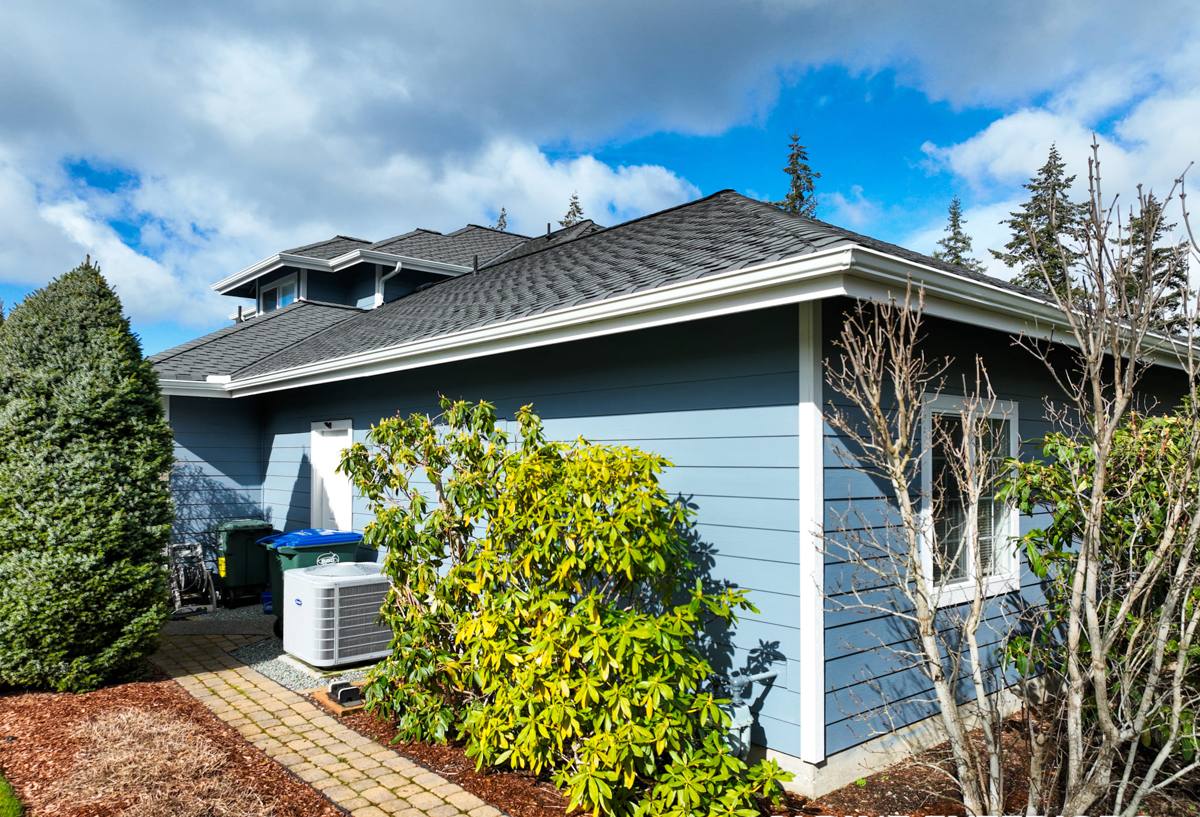
What Salt Air, Rain, and Moss Actually Do to a Roof
Salt Air and Metal Components
Being close to Birch Bay's shoreline means airborne salt settles on everything, including your roof's metal parts. Standard steel fasteners, uncoated flashing, and bargain-grade drip edge corrode faster here than they would ten or fifteen miles inland. Once a fastener head rusts through or a flashing seam starts to pit, water finds a path long before the shingles themselves look worn.
Driving Rain and Wind-Driven Water
Birch Bay gets rain that doesn't just fall straight down — wind off the water pushes it sideways and under things. Roofs that rely on shingles alone to shed water, without proper underlayment and flashing detail at every penetration and edge, will eventually let wind-driven rain work its way backward under the shingle course. This shows up as slow leaks that are hard to trace, sometimes appearing in a completely different spot than the actual entry point.
Moss, Shade, and Underlayment Fatigue
Tree cover common around Terrell Creek keeps roof surfaces damp longer after every rain, and that moisture plus organic debris is exactly what moss needs to take hold. Moss isn't just cosmetic — it lifts shingle edges, holds water against the roof deck, and breaks down asphalt granules faster than sun exposure alone would. A roof that's been fighting moss for years often has underlayment and decking in worse shape than the shingle age would suggest.
What a Correct Roof Replacement Actually Involves
A roof replacement is more than swapping old shingles for new ones. Done right, here's what should happen on every Terrell Creek project:
- Full tear-off to bare decking — never a layover on top of old material, which traps moisture and hides deck damage
- Deck inspection and repair of any soft, delaminated, or water-stained plywood/sheathing before anything new goes down
- Ice-and-water shield or equivalent self-adhered membrane at eaves, valleys, and any low-slope transition — the areas driving rain and moss target hardest
- Synthetic or felt underlayment rated for the exposure, installed with correct overlap and fastening
- Corrosion-resistant flashing and fasteners at every chimney, vent pipe, skylight, and wall intersection
- Balanced intake and exhaust ventilation so the attic can actually dry out between rain events, not just after replacement day
- Manufacturer-matched starter strip, hip, and ridge components — mismatched parts are a common source of early failure
Skipping any one of these to save a day of labor is how a "new roof" ends up with a moss problem or a leak inside five years instead of fifteen.
Choosing a Roofing Material for a Terrell Creek Home
Most Terrell Creek homes land on one of a few material choices. There's no single right answer — it depends on your roof's pitch, how much shade it sits under, and how long you plan to own the home. Here's an honest comparison based on how each performs in this specific climate:
| Material | Typical Lifespan | Moss & Moisture Behavior | Salt-Air / Coastal Notes | Relative Cost |
|---|---|---|---|---|
| Standard 3-tab asphalt shingle | 15–20 years | Prone to moss growth in shaded areas; granules erode faster once moss takes hold | Fasteners and flashing still need corrosion-resistant hardware | Lowest |
| Architectural / dimensional shingle | 25–30 years | Heavier profile sheds water better and resists moss slightly longer than 3-tab | Performs well with proper flashing; most common choice in this area | Moderate |
| Standing-seam metal | 40–50+ years | Sheds moss and debris well due to smooth, steep-shed surface; minimal organic buildup | Needs marine-grade or coated fasteners/panels near the shoreline to avoid pitting | Highest |
| Synthetic/composite shingle | 30–50 years | Resists moisture absorption; some products include algae/moss-resistant treatments | Good coastal durability; product quality varies by manufacturer | Moderate–High |
We don't push one product on every job. A shaded, low-slope roof under heavy tree cover is a different conversation than an open, wind-exposed roof closer to the water, and we'll tell you honestly which option fits your specific situation rather than whatever earns the highest margin.
Signs a Terrell Creek Roof Needs Replacing, Not Just Patching
Not every roof problem means starting over. But a few signs point toward replacement rather than another round of repairs:
- Moss coverage across more than a small section, especially if it's returned after a previous cleaning
- Granule loss heavy enough that shingles look bald or patchy in valleys and south-facing slopes
- Soft spots or visible sagging when walked, which usually means the decking underneath has taken on water
- Repeated leaks in different spots after each storm, rather than one isolated failure point
- Rusted or lifting flashing around chimneys, vents, or skylights
- Shingles curling, cracking, or losing their seal along edges and ridges
- The roof is 20+ years old and has never had a full tear-off replacement
If you're only seeing one or two of these, a targeted repair may still make sense. We'll say so — we don't sell full replacements to homeowners who don't need one yet.
Our Process for a Terrell Creek Roof Replacement
The work itself follows the same order on every project, adjusted for your roof's specifics:
- On-site inspection — we walk the roof, check the attic from inside for moisture and ventilation issues, and look at how tree cover, drainage, and wind exposure affect your particular lot
- Written estimate — material options, scope, and a clear cost breakdown, with no vague allowances buried in the fine print
- Scheduling around weather — we plan tear-off days around Whatcom County's forecast windows so your roof deck isn't left exposed longer than necessary
- Tear-off and deck repair — old material removed, decking inspected board by board, any damage repaired before moving forward
- Underlayment, flashing, and material installation — built to the specification we quoted, not a stripped-down version of it
- Site cleanup and final walkthrough — including a magnetic sweep for stray fasteners, since a missed nail in the yard is a bad way to end a project
Why a Crew That Already Works Terrell Creek Matters
A roofing crew that's worked other homes in this specific pocket of Birch Bay already knows which roof planes tend to hold moss, how the local drainage and tree cover behave through the wet season, and which flashing and fastener grades actually hold up this close to the water. That's not something you can fully substitute with a generic spec sheet. It means fewer surprises during tear-off, a more accurate estimate up front, and a roof detailed for the conditions it will actually face rather than a one-size-fits-all install.
Cost Factors for a Terrell Creek Roof Replacement
Every roof is priced individually, but the same handful of factors drive most of the variation we see on Terrell Creek homes:
| Factor | Why It Affects Cost |
|---|---|
| Roof size and pitch | More surface area and steeper pitches take longer and require more safety setup |
| Number of existing layers | Tear-off of multiple old layers takes more labor and disposal than a single-layer roof |
| Decking condition | Rotted or delaminated sheathing found during tear-off requires replacement before new roofing goes on |
| Material choice | Asphalt, metal, and synthetic products carry different material and labor costs |
| Ventilation upgrades | Adding proper intake/exhaust venting where none existed adds work but prevents future moisture problems |
| Roof access and tree cover | Tight lots or heavy canopy near the roofline can slow staging and material handling |
After Your New Roof: Keeping Moss and Moisture From Coming Back
A new roof still needs basic upkeep in this climate. Keeping gutters and downspouts clear matters more here than in drier regions, since Terrell Creek's watershed setting means a lot of properties already deal with wet ground and slow-draining soil — the last thing a home needs is water backing up at the roofline too. A yearly check for early moss growth, especially on shaded north-facing slopes, catches problems while they're still a simple treatment instead of a shingle replacement. Trimming back branches that overhang the roof also cuts down on the debris and shade that feed moss growth in the first place.
If you're seeing moss, granule loss, or recurring leaks on a Terrell Creek roof, we're happy to take a look and give you a straight answer on whether it's a repair or a replacement situation — no pressure, no inflated scope. Reach out using the form below for a free estimate.