 Birch Bay Siding
 Why Sumas Homes Need Siding Built for This Climate
Whatcom County asks a lot of exterior siding. Between the wind-driven rain that rolls in off the Salish Sea, the damp shoulder seasons that never seem to end, and the moss that finds a foothold on anything that stays wet more than a few days, this is not an easy climate on a house. Homes closer to the shoreline in Birch Bay pick up salt-laden air on top of that, while homes further inland near Sumas deal with the same wet weather systems and long moss season without the direct salt exposure. Either way, siding here has to shed water fast, resist rot where it's held wet against trim and corners, and hold its finish through months of gray, damp weather every year.
That's the backdrop for every siding decision we make. We install fiber cement — specifically James Hardie — because it's built for exactly this kind of exposure, and we install it to a standard that accounts for how water actually moves across a wall in this region, not just how it looks on installation day.
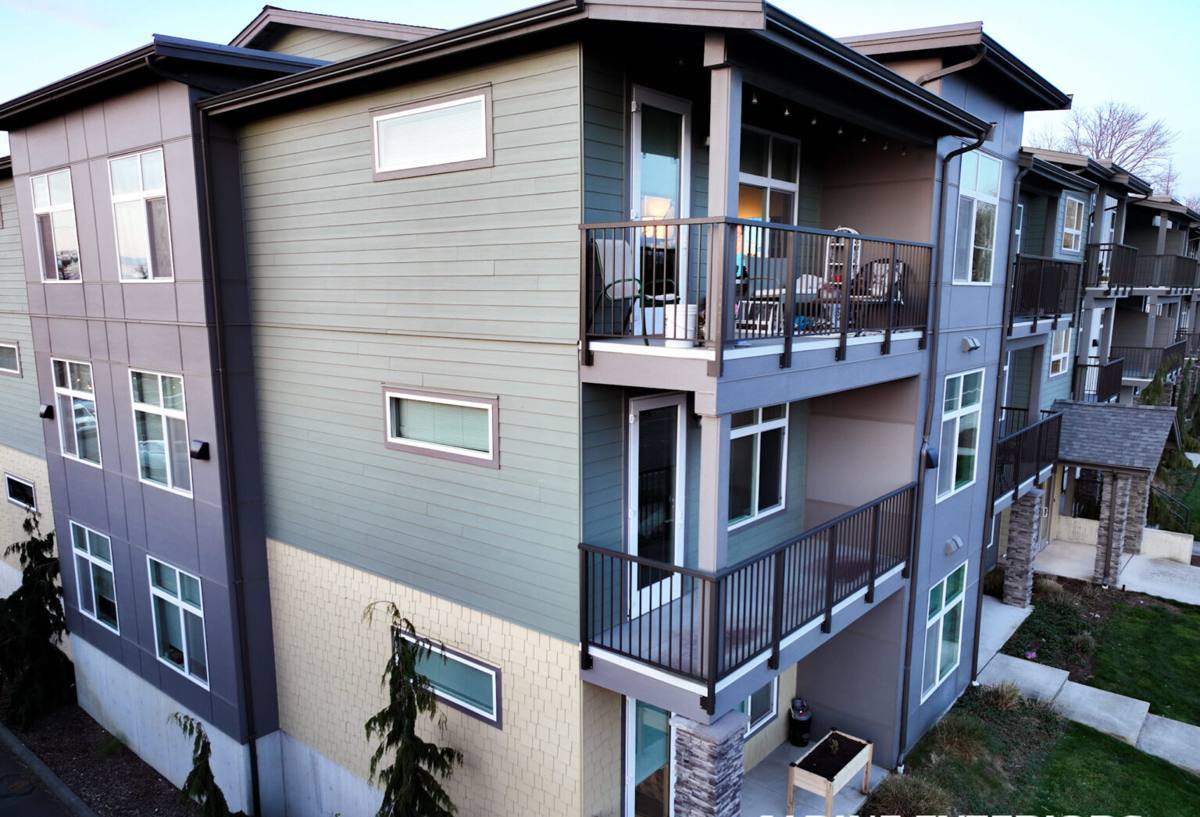
What Driving Rain, Moss, and Marine Air Actually Do to Siding Over Time
Most siding failures we see aren't dramatic. They're slow. A few things happen consistently in this climate that homeowners don't always connect back to the siding until there's a problem:
- Wind-driven rain finds gaps. Rain here doesn't just fall straight down — sustained wind pushes it sideways into joints, corners, and butt seams that would stay dry in a calmer climate.
- Moss and algae take hold on anything that stays damp. North-facing walls, areas under tree cover, and surfaces with a soft or absorbent finish are the first to show green and black staining.
- Wood-based products swell and shrink with moisture cycles. Repeated wetting and drying is what eventually opens up caulk lines, cracks paint film, and lets water behind the siding.
- Salt air accelerates finish breakdown on homes closer to the water, particularly on cheaper coatings and unfinished or field-primed products.
None of this is unique to any one house — it's the baseline condition for exterior materials anywhere in this part of Whatcom County. The material and the installation both have to be chosen with that baseline in mind, not against a mild-climate assumption.
Why Fiber Cement Is the Right Material for This Area
We get asked fairly often why we don't offer vinyl, LP SmartSide, or a cheaper fiber cement alternative alongside James Hardie. The honest answer is that we looked at how each of these products actually performs over 15-20 years in a wet, marine-influenced climate, and only one of them held up consistently without turning into a maintenance project.
| Material | Moisture Behavior Here | Long-Term Look | Our Take |
|---|---|---|---|
| Vinyl | Doesn't rot, but expands/contracts with temperature swings and can warp or gap over time | Fades, especially darker colors, and can't be repainted easily | Cheap upfront, but not what we put on a home we're standing behind |
| Engineered wood (LP SmartSide) | Wood-based core is more moisture-sensitive than fiber cement; edge sealing and caulking upkeep matters a lot in wet climates | Good when new, but performance depends heavily on maintenance discipline | We don't install it — the moisture tolerance margin is thinner than we're comfortable with here |
| Budget fiber cement (unbranded/Cemplank-type) | Similar base material to Hardie, but factory finish and engineering vary by product line | Inconsistent — depends heavily on the specific product and finish | We standardized on one system rather than mixing suppliers |
| James Hardie fiber cement | Non-combustible cement composite, engineered specifically for wet/marine climates (HZ5 line) | ColorPlus factory finish resists fading and doesn't need repainting on the same schedule as field-painted products | What we install on every job |
The short version: fiber cement as a category resists moisture and pests better than wood-based siding, and doesn't have the expansion/contraction issues vinyl has. James Hardie specifically engineers products for regional climate zones, and their HZ5 line is built for exactly the wet, temperate exposure Whatcom County sees.
The James Hardie System We Install — and Why Only This One
James Hardie is the only siding manufacturer we install, on every job, in every part of our service area including Sumas and Birch Bay. A few reasons that's a standard rather than a preference:
- Non-combustible core. Fiber cement doesn't feed a fire the way wood-based or vinyl products can.
- ColorPlus factory finish. Baked-on color with a stronger fade and chip warranty than field-applied paint, which matters in a climate that gets a lot of gray, wet weather that's hard on painted finishes.
- Climate-engineered product lines. Hardie makes region-specific formulations (HZ5 for this part of the Pacific Northwest) rather than a single one-size-fits-all board.
- Transferable warranty backed by a large, established manufacturer — worth more at resale than a warranty tied to a smaller or newer supplier.
We'd rather do one thing — Hardie, installed correctly — than offer five siding options and let installation quality vary by which one a homeowner picks on price. That's the whole reason this business only installs one product.
What a Correct Fiber Cement Installation Actually Involves
Fiber cement siding fails early almost exclusively because of installation mistakes, not the material itself. In a wet climate like this, the margin for error is smaller. A correct job includes:
Water Management Details
- Proper weather-resistive barrier and flashing at every window, door, and penetration — this is where wind-driven rain actually gets in
- Correct clearances between siding and grade, roofing, decks, and other horizontal surfaces so water has somewhere to go besides behind the board
- Kick-out flashing at roof-to-wall intersections, which is one of the most commonly skipped details on re-siding jobs
Fastening and Fit
- Manufacturer-specified fastener type, spacing, and depth — over-driven or under-driven nails are a common source of early cracking
- Correct panel gaps and caulking at butt joints, sized for the expansion behavior of the specific product
- Field-cut edges sealed per Hardie's specifications so raw cut edges aren't left exposed to moisture
None of this is visible once the job is finished, which is exactly why it matters who does the install. Two houses can look identical with fiber cement siding on day one and perform completely differently ten years later based on whether these details were followed.
Our Process, Start to Finish
- Walk-through and assessment. We look at the existing siding, trim, flashing, and any moisture or moss issues already showing up on the house.
- Written estimate that specifies the Hardie product line, color, and scope — no vague allowances.
- Tear-off and inspection of the wall assembly once old siding is off, since this is often the first real look at sheathing condition and existing water damage.
- Weather barrier and flashing installed or corrected before a single piece of siding goes up.
- Hardie installation to manufacturer spec, with attention to the clearances and fastening details above.
- Final walk-through with the homeowner before we consider the job done.
Cost Factors for a Sumas-Area Fiber Cement Project
| Factor | Why It Affects Cost |
|---|---|
| Home size and wall complexity | More corners, gables, and trim detail mean more cutting and labor time |
| Condition of existing sheathing | Rot or water damage found during tear-off adds repair scope before new siding can go on |
| Siding profile and Hardie product line | Lap siding, shingle-style panels, and board-and-batten all price differently |
| Trim and accessory work | Fascia, soffit, and trim replacement alongside siding is common and adds scope |
| Access and site conditions | Multi-story sections, tight lot lines, or landscaping obstacles affect labor time |
We don't quote a number without seeing the house — anyone who does hasn't actually looked at your walls yet.
Maintenance Checklist for Fiber Cement Siding in This Climate
Fiber cement is genuinely low-maintenance compared to wood or field-painted products, but "low-maintenance" isn't "no-maintenance" in a climate this wet. A short annual routine goes a long way:
- Rinse siding annually, especially shaded or north-facing walls where moss and algae take hold first
- Check caulking at trim, windows, and butt joints for cracking or separation
- Look at kick-out flashing and roof-to-wall intersections after major storms
- Keep gutters clear so overflow isn't running down the siding face repeatedly
- Trim back vegetation that's keeping any section of wall shaded and damp longer than the rest of the house
Why a Crew That Already Works This Area Matters
Siding installation isn't the same job everywhere. A crew used to a dry climate will make decisions — on flashing, clearances, caulking schedules — that don't hold up against sustained coastal wind and rain. Working across Whatcom County, from the Birch Bay shoreline to inland communities like Sumas, means seeing the same failure patterns repeat on houses that weren't detailed for this weather, and building every install around avoiding them. That's a difference you feel in year eight or ten, not on install day.
If you're weighing a siding replacement in Sumas or anywhere else in the Birch Bay area, we're happy to come take a look and give you a straight, no-pressure estimate — no obligation, just an honest read on your walls and what they need.