 Birch Bay Siding
 Why Siding Fails Faster Near Cherry Point
Cherry Point sits on the exposed stretch of Whatcom County shoreline just north of Birch Bay, and that location comes with a specific set of weather problems that inland Washington homes never have to deal with. Wind off the water carries salt, rain arrives sideways more often than straight down, and the gray months stretch long enough that moss doesn't just grow on the roof — it colonizes siding, trim, and anything else that stays damp for days at a time. A siding replacement out here isn't the same job as one ten miles inland, and it shouldn't be priced, planned, or installed like one.
Salt Air and Corrosion
Airborne salt accelerates corrosion on anything metal — nail heads, flashing, fasteners, trim caps. On a lot of older homes in the Cherry Point area, the siding itself may still look serviceable from the street while the fasteners and flashing behind it have already started failing. That mismatch is exactly why a proper inspection has to go past a visual check of the panels and look at what's actually holding them on.
Driving Rain and Wind-Driven Moisture
Rain that comes in almost horizontally during winter storms gets forced into laps, seams, and butt joints that would stay dry in a calmer climate. Siding systems that depend on paint film or caulk alone to keep water out tend to show it first at Cherry Point — swelling at the bottom edges, staining below joints, or soft spots where water has been finding a way in for years before anyone notices from the ground.
A Moss Season That Barely Ends
Whatcom County's wet season runs long, and shaded, north-facing, or wind-sheltered walls near Cherry Point can stay damp for weeks. Moss and algae don't just look bad — they hold moisture against the siding surface and, on materials that aren't dimensionally stable, that constant dampness is what shortens service life. Siding that can tolerate being wet without swelling, cupping, or rotting has a real advantage here that it wouldn't get credit for in a drier climate.
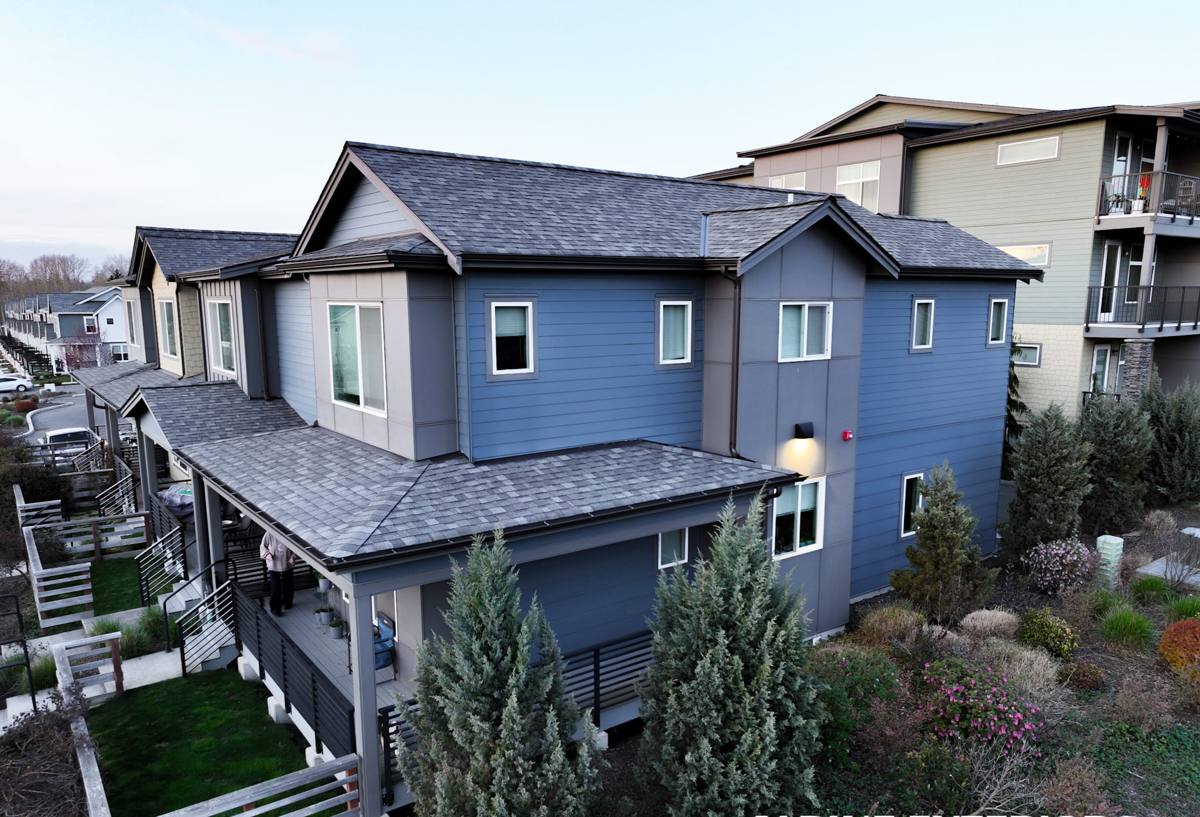
Signs Your Siding Has Reached the End of Its Service Life
Homeowners often wait too long to replace siding because the damage that matters is happening behind the surface, not on it. These are the signs worth acting on before they become a sheathing or framing repair instead of a siding job:
- Panels or boards that feel soft, spongy, or flex when pressed near the bottom edge
- Paint that's failing repeatedly in the same spots no matter how often it's redone
- Persistent moss, algae, or dark staining that comes back within a season of cleaning
- Visible gaps, warping, or cupping at seams and butt joints
- Rising energy bills with no other explanation, suggesting the wall assembly is no longer sealing properly
- Siding that's original to a home more than 20-25 years old, especially wood or older composite products
- Interior signs — musty smell, peeling interior paint, or damp drywall on an exterior wall
What a Correct Siding Replacement Actually Involves
Replacing siding well is mostly about what happens before the new siding ever goes up. In a climate like this one, cutting corners at the tear-off and prep stage is how a ten-year problem becomes a two-year problem.
Tear-Off and What's Underneath
Full tear-off is the only way to actually see the condition of the sheathing underneath. On coastal properties, it's common to find sections of sheathing that have absorbed moisture over the years, even when the old siding still looked fine. Any soft or water-damaged sheathing gets identified and replaced before anything new is installed — patching over a compromised substrate just relocates the problem.
Water-Resistive Barrier and Flashing
A weather-resistive barrier and correctly lapped, sealed flashing at every window, door, and penetration is what actually keeps wind-driven rain out of the wall assembly — the siding itself is the second line of defense, not the first. Given how much rain Cherry Point gets driven sideways off the water, flashing details at horizontal trim, window heads, and butt joints deserve more attention here than they would on a sheltered inland lot.
Fastening for Coastal Wind Exposure
Fastener type, length, and spacing all matter more on an exposed coastal property than a protected one. Under-fastened siding on a wind-exposed wall works itself loose over time, and the wrong fastener material corrodes faster in salt air. This is a detail that's easy to get away with skipping on a calm, sheltered site and much harder to get away with skipping near open water.
Why We Install Only James Hardie Fiber Cement
We install one siding system, and that's James Hardie fiber cement. We don't offer vinyl, LP SmartSide, cedar, primed spruce, or other fiber cement brands, and that's a deliberate standard, not a lack of options. Given what this climate does to a wall over a few decades, we'd rather stand behind one product we trust completely than offer several and let cost be the deciding factor.
Built to Handle Moisture, Not Just Resist It
Fiber cement is dimensionally stable in a way that wood-based and vinyl products aren't — it doesn't swell, cup, or rot when it stays wet, and it won't soften at the bottom edge the way engineered wood products can if water gets past a joint. In a place where siding can stay damp for stretches of the year, that stability is the single biggest reason it holds up longer.
A Factory Finish That Doesn't Rely on Field Painting
James Hardie's ColorPlus finish is baked on at the factory under controlled conditions, not brushed or sprayed on-site in whatever weather happens to show up that week. It resists fading and chipping better than field-applied paint and comes with its own finish warranty, which matters on a coastline where sun, salt, and moisture all work against a paint job at the same time.
Engineered for This Climate Zone
James Hardie makes different formulations for different climate zones, and western Washington falls under their HZ5 product line, engineered for regions with sustained moisture and temperate, freeze-thaw-prone winters rather than extreme heat or humidity. That's a meaningfully different product than what gets installed in the Southeast or Southwest, and it's part of why we don't treat siding as a one-size-fits-all material.
What Drives the Cost of a Cherry Point Siding Replacement
Every siding replacement is priced around the same handful of variables, but coastal exposure shifts some of them more than homeowners expect:
| Cost Factor | Why It Matters Here |
|---|---|
| Home size and wall complexity | More corners, gables, and trim details mean more cutting, flashing, and labor time |
| Condition of the sheathing underneath | Moisture-damaged sheathing found during tear-off adds repair cost but is far cheaper to fix now than later |
| Existing siding removal and disposal | Multiple layers or wood siding take longer to strip than a single layer of composite |
| Trim, fascia, and flashing scope | Coastal wind and rain exposure often justify replacing more flashing and trim than a sheltered inland home would need |
| Siding line and profile chosen | Lap width, texture, and accessory trim all affect material cost within the Hardie product family |
| Access and site conditions | Waterfront lots, slopes, and wind exposure can affect scaffolding, staging, and scheduling around weather windows |
Our Process, Start to Finish
- Free on-site inspection, including a check of trim, flashing, and any soft spots in the existing siding
- Written estimate that separates siding, trim, flashing, and any sheathing repair as line items, not a single lump number
- Full tear-off and inspection of the sheathing and water-resistive barrier before anything new goes up
- Repair or replacement of any compromised sheathing, found and priced honestly, not assumed away
- Installation of new water-resistive barrier, correctly lapped and sealed flashing, then James Hardie siding installed to manufacturer fastening specifications
- Final walkthrough covering warranty coverage and basic care so you know what to expect going forward
Before You Hire: A Local Track Record Matters
A crew that's already worked on Cherry Point and Birch Bay homes has seen how the wind sits on a given lot, where water tends to collect, and which details on a coastal property need more attention than the textbook minimum. That's not something a contractor who mostly works sheltered inland neighborhoods picks up quickly. A few things worth confirming before you hire anyone for a coastal siding job:
- Ask whether they've worked on other homes specifically in the Birch Bay or Cherry Point area, not just Whatcom County generally
- Ask how they handle sheathing repair if it's found during tear-off, and whether that's priced separately or hidden in a lump sum
- Ask for the manufacturer's fastening and flashing specifications they follow, not just "we do it the way we always do it"
- Confirm they're licensed and insured to work in Washington, and ask to see current proof
- Ask what warranty covers labor versus what the manufacturer covers on materials, and get it in writing
Living With Hardie Siding After Installation
Fiber cement siding is genuinely low-maintenance compared to what most Cherry Point homeowners are replacing, but "low-maintenance" isn't "no-maintenance" in this climate. An occasional soft wash to clear moss and algae buildup, especially on shaded or wind-sheltered walls, keeps the surface looking good and keeps organic growth from holding moisture against the finish. Checking caulking at trim joints every few years and keeping gutters clear so water isn't sheeting down the wall are both small habits that go a long way toward getting the full service life out of the material.
Ready for Siding That Can Actually Handle Cherry Point
If your siding is showing its age, or you just want an honest read on what's happening behind it, we'll come take a look and give you a straight answer — no pressure, no inflated scope. Use the form below to request a free estimate for your Cherry Point property.