 Birch Bay Siding
 Why Terrell Creek Siding Takes a Different Kind of Beating
Terrell Creek sits close enough to the water and the drainage corridor around it that homes in this part of Birch Bay deal with a specific combination of stressors: salt-laden air moving in off the Strait, wind-driven rain that gets pushed sideways into wall assemblies, and long stretches of shaded, damp weather that keep moss and algae established on north- and west-facing walls for months at a time. None of these is dramatic on its own. Together, over years, they're exactly what breaks siding down from the inside out.
A lot of siding repair calls we get from this neighborhood aren't about storm damage. They're about slow damage — caulk joints that opened up two summers ago and nobody noticed, a section of trim that's been wicking moisture since a gutter started overflowing, or panels that look fine from the driveway but are soft at the bottom edge where they've sat wet against grade or mulch. Whatcom County's climate rewards homes that get inspected and maintained on a schedule, and punishes the ones that don't.
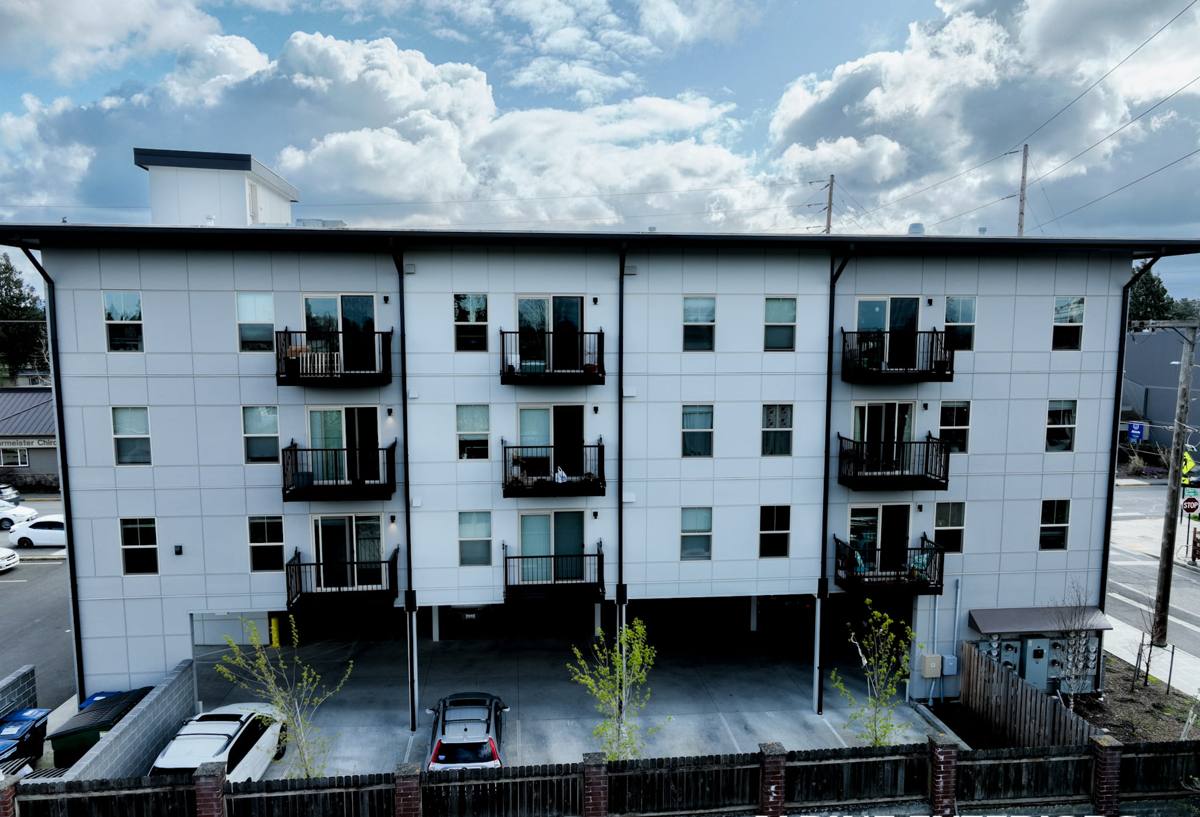
What Salt Air, Rain, and Moss Actually Do to Siding
Salt Air
Airborne salt doesn't rot wood or fiber cement directly, but it's corrosive to the metal components every siding system depends on — nailheads, flashing, fasteners, and trim connectors. Once those start to corrode, water finds a path behind the cladding that wasn't there when the house was built. Salt exposure also breaks down cheap paint films faster than inland areas, which is one reason we care about the difference between a factory-baked finish and a site-applied paint job.
Driving Rain
Birch Bay gets rain that doesn't just fall — it's pushed horizontally into walls during winter storms. Siding systems are designed to shed water down and out, not to be watertight against sideways-driven moisture indefinitely. Any gap, any failed caulk joint, any place where flashing was skipped or under-lapped becomes an entry point. Once water gets behind siding in a home exposed to this pattern, it can travel and cause damage well beyond the visible entry point.
Moss and Algae
Shade, moisture, and mild temperatures are a moss factory. On siding, moss and algae growth isn't just cosmetic — sustained organic growth holds moisture against the surface far longer than open air would, softening caulk, degrading paint, and in wood-based products, feeding rot directly. A wall that stays green and damp for four months of the year ages faster than the same wall in full sun, regardless of what it's clad in.
What a Correct Siding Repair Actually Involves
"Siding repair" gets treated as a simple patch job more often than it should be. Done right, it's a diagnostic process first and a repair second. Here's what we actually check and do:
- Find the real source — the damaged panel is often not where the water is getting in; we trace it back to the actual entry point (flashing, a caulk joint, a penetration, grade contact) before touching anything
- Check what's behind the siding — house wrap, sheathing, and framing get inspected wherever siding is removed, because siding-level damage almost always means checking what's underneath
- Match or replace intelligently — if the existing siding is aging out overall, a patch may not be worth doing; we'll tell you honestly when repair is a stopgap versus a real fix
- Correct the underlying cause — reflash, re-caulk, re-grade, or address the gutter or drainage issue that caused the damage, not just replace the panel
- Restore the water-shedding detail — laps, kick-outs, and drip edges get rebuilt to spec, not eyeballed
A repair that skips the diagnostic step and just swaps a damaged board is a repair that fails again — often in the same spot, often within a couple of seasons.
Signs a Terrell Creek Home Needs Siding Repair Now
- Soft or spongy spots when you press on siding, especially near the bottom courses or around windows
- Paint that's bubbling, peeling, or chalking unevenly in patches rather than uniformly across a wall
- Visible gaps at seams, corners, or trim where caulk has shrunk, cracked, or pulled away
- Persistent moss or dark streaking on shaded walls that doesn't wash off easily
- Warping, buckling, or panels that look wavy rather than flat
- Musty smell or visible staining on interior walls that back up to exterior siding
- Rising utility bills with no other explanation — a sign moisture-compromised siding may be affecting insulation performance
Any one of these on its own might be minor. Two or three together, especially on the weather-facing side of the house, usually means water has already gotten past the surface.
Why Repair Material Choice Matters More Here Than Inland
Whatever gets used to repair or replace a damaged section needs to survive the same salt, rain, and moss exposure that damaged the original siding — otherwise you're just buying a few more years before the same call. This is a big part of why we standardized on James Hardie fiber cement rather than offering a mix of products.
| Factor | What It Means for Terrell Creek |
|---|---|
| Moisture behavior | Fiber cement doesn't swell, rot, or delaminate from sustained dampness the way wood-based products can |
| Finish durability | ColorPlus factory-applied finish resists fading and chalking better than field-applied paint exposed to salt air |
| Combustibility | Non-combustible material, relevant given regional wildfire smoke and ember exposure in dry summer stretches |
| Moss/algae resistance | Dense fiber cement surface doesn't feed organic growth the way some wood substrates do |
| Repair matching | HZ5 product line is engineered for wet, moderate climates like ours, so repairs age consistently with the rest of the wall |
We don't install LP SmartSide, vinyl, Cemplank, Allura, primed spruce, or cedar. Each has legitimate uses elsewhere, but for the moisture and salt exposure this neighborhood sees, we've made fiber cement — specifically Hardie's climate-engineered HZ5 line — our standard, and we stand behind that choice with every repair and install we do.
When a Patch Repair Makes Sense vs. When It Doesn't
Not every damaged section needs a full re-side. A localized repair is usually the right call when damage is isolated, the rest of the siding is structurally sound, and the cause has been identified and fixed. A repair stops being the right call when damage shows up in multiple unrelated areas, when the original installation had systemic flashing or gap problems, or when the siding is old enough that matching color and profile isn't realistic. We'll tell you straight which situation you're in — we're not trying to upsell a repair into a full job, or patch something that needs to be replaced.
Our Process for Terrell Creek Siding Repairs
- On-site inspection — we look at the damaged area and the surrounding siding, not just the spot you called about
- Diagnose the cause — trace the water path, check flashing, grading, gutters, and caulk joints
- Written scope and honest recommendation — repair, or repair plus a heads-up on what's coming next, in plain language
- Correct the source, then the surface — fix flashing/drainage issues first so the repair actually holds
- Match materials and finish — Hardie ColorPlus panels and trim matched as closely as the existing siding allows
- Final check — water-shedding details (laps, caulk lines, drip edges) verified before we call it done
What Repair Costs Depend On
| Cost Factor | Why It Matters |
|---|---|
| Size of damaged area | A single panel is a different scope than a full wall section |
| Underlying cause | A flashing or sheathing fix adds labor beyond swapping siding |
| Access | Second-story or tight-clearance areas near fences and landscaping take longer |
| Color/profile match | Older siding runs may need trim adjustments to blend a repair cleanly |
| Extent of hidden damage | Sheathing or framing repair, if needed, is the biggest cost swing |
We give straightforward, itemized estimates before work starts — no surprise scope changes without a conversation first.
Why a Crew That Already Works Terrell Creek Matters
Siding repair in this part of Whatcom County isn't the same job as siding repair in a dry inland climate, and a crew that mostly works elsewhere will often under-diagnose the moisture side of the problem. Working this specific stretch of Birch Bay repeatedly means we already know which orientations take the worst wind-driven rain, which types of original installations in this area tend to have flashing shortcuts, and how aggressively moss establishes on shaded walls near the creek corridor. That local pattern recognition shortens the diagnostic phase and reduces the odds of missing a second problem while fixing the first one.
It also means we're not guessing at what survives here — we've seen how different products and repair approaches hold up in this exact climate over multiple seasons, which is exactly the kind of feedback loop that led us to standardize on Hardie fiber cement in the first place.
Get a Free, No-Pressure Estimate
If you're seeing soft spots, peeling paint, open seams, or stubborn moss on your Terrell Creek home's siding, it's worth getting an honest look before the damage spreads further. Fill out the form below for a free estimate — no pressure, no obligation, just a straight assessment of what's going on and what it'll take to fix it right.