 Birch Bay Siding
 Marietta's Climate Puts Real Stress on Siding
Marietta sits low and close to the water in Whatcom County, and that location shapes what a house needs from its exterior. Homes here deal with a steady mix of salt-laden air off Bellingham Bay, wind-driven rain that comes in sideways during winter storms, and long stretches of gray, damp weather that keep surfaces wet for days at a time. Add in the shade from mature evergreens common on many lots in this part of the county, and you get one of the more demanding environments in the Pacific Northwest for exterior materials.
None of this is exotic weather. It's the ordinary rhythm of a Whatcom County winter and spring. But "ordinary" here means siding is wet more often than dry for months on end, salt air slowly works on fasteners and finishes, and north-facing or shaded walls stay damp long enough for moss and algae to take hold. A siding installation that would hold up fine in a drier inland climate can fail early in Marietta if it isn't built for these specific conditions.
What "Moss Season" Actually Does to a House
Moss doesn't just look bad. When it establishes on siding, it holds moisture directly against the surface, keeps that section of wall cooler and wetter than the surrounding area, and — depending on the material — can start to break down finishes or create conditions for rot underneath. Shaded, north- and west-facing walls are the usual starting points. A siding system and installation detail that sheds water quickly and dries out between rain events resists this far better than one that stays saturated.
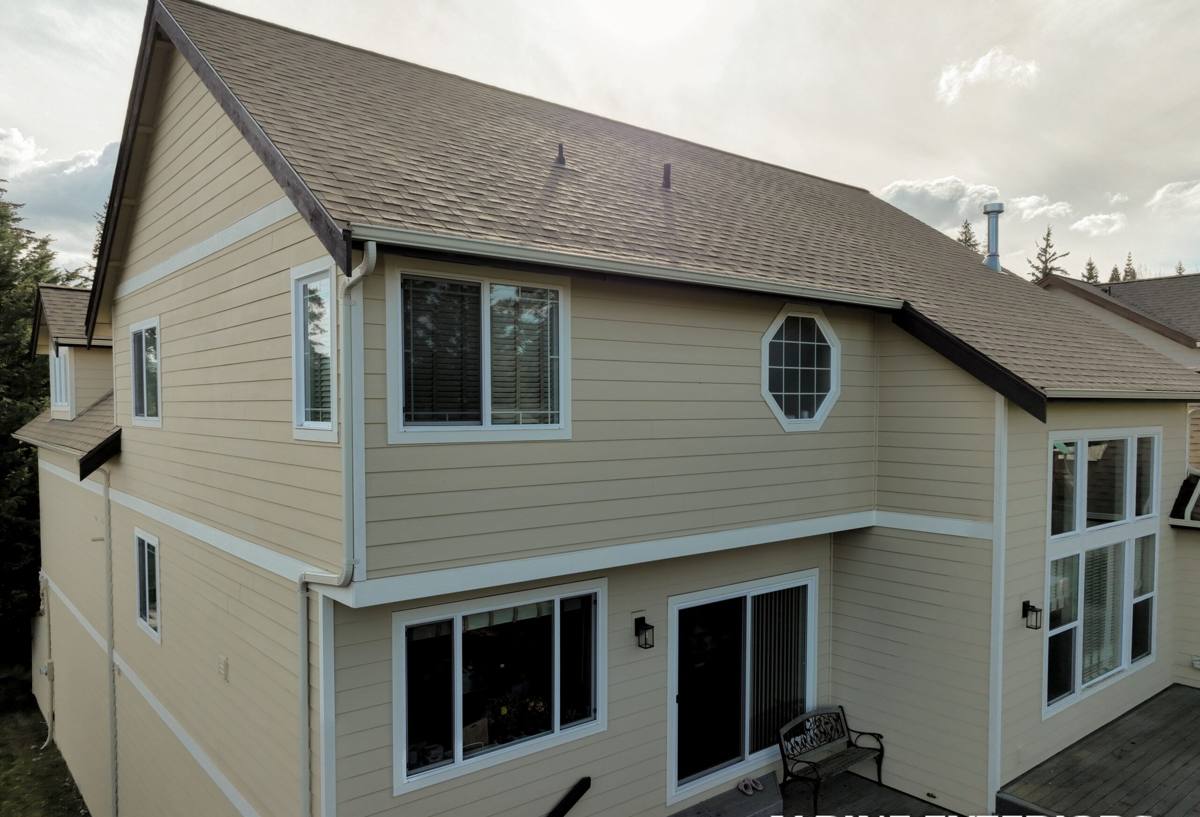
What Correct Siding Installation Actually Involves
Siding installation is often talked about like it's just cladding a wall, but the material you see is the last layer of a system. In a climate like Marietta's, the layers underneath matter just as much as the boards themselves.
- Weather-resistive barrier: A continuous, properly lapped house wrap or building paper behind the siding, with no gaps, tears, or reversed laps that let water track inward.
- Flashing at every penetration: Windows, doors, hose bibs, vents, and any other wall penetration need flashing installed so water is directed out and down, never trapped behind the siding.
- Proper clearances: Siding held above grade, decks, patios, and roof lines by the manufacturer's specified gap so water can't wick up from below or pool at transitions.
- Correct fastening: Fastener type, spacing, and depth matched to the product and substrate — over-driven or under-driven fasteners are one of the most common causes of early siding failure.
- Sealed and caulked joints done right: Not every joint should be caulked — some are designed to be left open for drainage. Knowing the difference is part of doing the job correctly.
Skip or rush any one of these steps and the siding may look fine for a year or two while moisture works its way in behind it, unseen, until the damage shows up as staining, soft trim, or a wall assembly that needs to be opened up and rebuilt.
Why We Install Only James Hardie Fiber Cement
We made a decision to install one siding system: James Hardie fiber cement. That's not brand loyalty — it's a standard we hold because of how this specific climate treats exterior materials over decades, not just the first few years.
Fiber cement is non-combustible, which matters in a region where wildfire smoke and ember exposure have become a more regular late-summer concern even in western Washington. It doesn't feed insects or fungus the way wood-based products can, which is a real advantage during a long, damp moss season. Hardie's ColorPlus factory finish is baked on under controlled conditions, so the color holds up against UV and salt air better than field-applied paint typically does over the same span of years. And Hardie engineers specific product lines — including HZ5 formulations — for climate zones like ours, where a wetter, more variable exterior environment is the norm rather than the exception.
We also value the warranty structure: it's a real, transferable manufacturer warranty backed by a large company that's been making this product for decades, not a shorter or narrower warranty tied to a smaller or newer manufacturer. When a homeowner in Marietta is planning to be in the house for years, or planning to sell, that warranty carries real weight.
What We Don't Install, and Why
We don't install vinyl, LP SmartSide, Cemplank, Allura, or primed wood siding. Each of those products has legitimate uses and each has honest trade-offs — vinyl can crack in cold snaps and fade unevenly in strong UV, engineered wood siding relies heavily on perfect installation and ongoing maintenance to keep moisture out of its wood-strand core, and primed wood needs a repaint cycle that most homeowners underestimate. Rather than install a product family-by-family and manage those different maintenance realities across our whole customer base, we standardized on one system we can install to spec every time and stand behind with confidence.
Our Installation Process for Marietta Homes
| Stage | What Happens |
|---|---|
| Site evaluation | We walk the property, check current siding and sheathing condition, note shaded and exposed walls, and identify problem areas like poor drainage or existing moisture damage. |
| Tear-off and inspection | Old siding comes off and we inspect the sheathing underneath for rot or soft spots before anything new goes up — this is often where hidden problems from a previous installation surface. |
| Weather barrier and flashing | A new, continuous weather-resistive barrier goes on along with flashing at every window, door, and penetration, detailed for proper drainage. |
| Hardie installation | Panels or planks are installed to James Hardie's published specifications for fastening, clearance, and joint treatment — not generic siding practice. |
| Trim, caulking, and finish details | Trim is fitted, joints that should be sealed are sealed, and joints designed to drain are left open as intended. |
| Final walkthrough | We review the finished work with the homeowner and confirm everything meets both our standard and the manufacturer's installation requirements. |
Comparing Siding Options in This Climate
Homeowners often ask us to compare Hardie against the alternatives directly. Here's an honest look at how the categories typically stack up in a wet, salt-influenced coastal climate like Marietta's:
| Factor | James Hardie Fiber Cement | Vinyl | Engineered Wood (e.g., LP SmartSide) | Primed Wood/Cedar |
|---|---|---|---|---|
| Moisture tolerance | Excellent — cement-based, doesn't swell or rot | Good, but seams can allow water intrusion | Moderate — wood-strand core vulnerable if moisture reaches it | Poor to moderate — requires diligent maintenance |
| Moss/algae resistance | Strong; factory finish resists staining | Moderate; surface can host growth in shaded areas | Moderate; coating wears over time | Weak; organic material feeds growth |
| Fire rating | Non-combustible | Combustible | Combustible | Combustible |
| Maintenance | Low — occasional wash | Low, but repairs are visible/hard to match | Moderate — caulk and coating checks matter | High — regular repainting/staining |
| Expected lifespan (installed to spec) | 30+ years | 20-30 years | 20-30 years with upkeep | 15-25 years with upkeep |
These are general tendencies, not guarantees — installation quality affects every product in this table more than the marketing materials ever admit. A poorly installed Hardie job will underperform a well-installed alternative, and vice versa. But when installation is done right on both sides, fiber cement's advantages in a climate like this are real and consistent.
What Affects Siding Installation Cost
Every Marietta project is different, but the same factors tend to move the price up or down:
| Factor | Why It Matters |
|---|---|
| Home size and wall complexity | More corners, gables, and dormers mean more cutting, flashing, and labor time. |
| Condition of existing sheathing | Rot or water damage found during tear-off adds repair work before new siding can go on. |
| Product line and profile | Lap width, panel style, and trim choices within the Hardie lineup carry different material costs. |
| Accessibility | Tight lots, steep grades, or limited staging area near the water can add time and equipment needs. |
| Scope of trim and detail work | Full trim replacement, window flashing upgrades, and custom details add labor beyond the field siding itself. |
We give homeowners a real number after a walkthrough, not a phone-quote guess — too many of these variables are only visible in person.
Why Hiring a Crew That Already Works This Area Matters
A contractor who regularly works Birch Bay, Marietta, and the surrounding Whatcom County shoreline communities already knows which details matter most here: how much clearance to leave given local rain patterns, which walls on a typical lot orientation tend to hold moisture longest, and how salt air affects fastener and finish choices over time. That's different knowledge than a crew that mostly works drier, inland projects and treats every coastal job as a one-off.
It also matters for follow-up. A local crew is reachable if a question comes up after the job is done, and stands behind work on a house they can drive back to easily rather than one three counties away.
Questions Worth Asking Any Contractor Before You Hire
- Are you a certified or factory-trained installer for the specific siding product you're proposing?
- Will you inspect the sheathing before installing new siding, and what happens if you find damage?
- What weather-resistive barrier and flashing details will you use, specifically?
- Is the manufacturer's warranty transferable, and what voids it?
- Can you provide a written scope of work, not just a total price?
Living With Hardie Siding in Marietta
Once installed correctly, Hardie siding in this climate needs relatively little from a homeowner: an occasional gentle wash to knock off surface grime or early moss growth on shaded walls, a periodic look at caulked joints and trim, and prompt attention if a joint or flashing detail is ever visibly damaged. It doesn't need repainting on the cycle wood or wood-composite siding does, and it won't develop the moisture-related soft spots that show up in engineered wood products when a seal fails and goes unnoticed.
That lower-maintenance reality is worth more in a place like Marietta than it would be in a drier climate, simply because there are more months of the year when moisture is working against your siding than months when it isn't.
If you're planning a siding project for a Marietta home, we're happy to walk the property, look at what's there now, and talk through what correct installation would involve for your specific house — no pressure, no obligation. Reach out using the form below for a free estimate.