 Birch Bay Siding
 Why Semiahmoo Homes Ask Different Questions About Siding
Semiahmoo sits close enough to the water that its houses live with a different set of stresses than homes a few miles inland in Whatcom County. Salt-laden air moves off the bay and settles on exterior surfaces almost daily. Wind-driven rain doesn't just fall straight down here — it gets pushed sideways into wall assemblies, siding laps, and trim joints. And for a good stretch of the year, shaded north- and west-facing walls stay damp long enough for moss and algae to take hold. None of this is exotic or rare; it's just the normal cost of living near Birch Bay. But it means siding that performs fine in a drier, more sheltered part of the state can fail early here if it isn't matched to the environment and installed correctly.
This page is specifically about fiber cement siding for Semiahmoo properties — what the climate actually asks of a siding system, what a correct installation involves, and why we install James Hardie fiber cement exclusively rather than the wider range of siding products on the market.
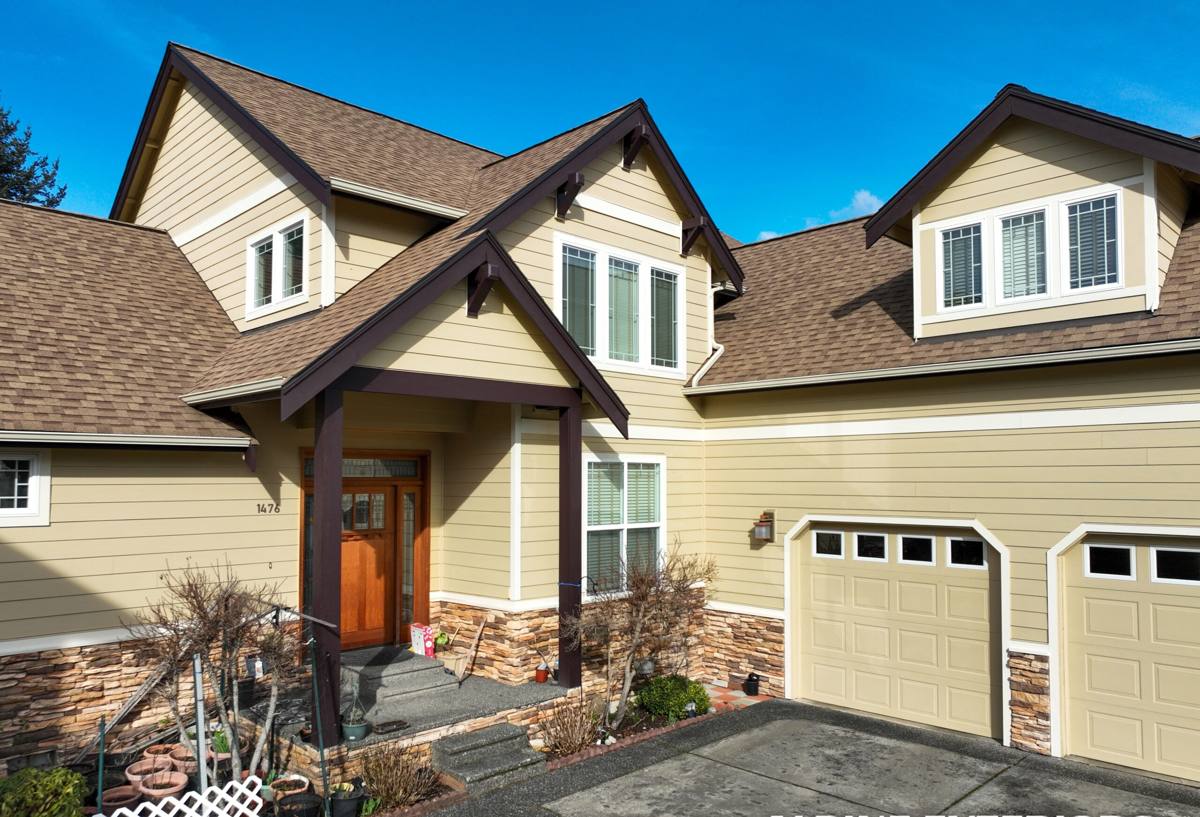
What Salt Air, Driving Rain, and Moss Season Do to Siding
Salt Air
Airborne salt is corrosive to metal fasteners, flashing, and trim hardware, and it accelerates the breakdown of lower-quality paint films and coatings. Over years, siding material and finishes that aren't built to resist salt exposure tend to chalk, fade, or degrade faster on Semiahmoo homes than the same products would inland.
Driving Rain
Wind off the bay pushes rain into laps, seams, and penetrations — around windows, doors, hose bibs, and light fixtures — rather than letting it simply sheet off the wall. Any weak point in the water-shedding system (a poorly lapped joint, a missing flashing, a gap in caulking) becomes a real entry point for moisture, not a theoretical one.
Moss and Algae Season
Whatcom County's wet, mild winters and shaded exposures give moss and algae a long window to establish themselves on north-facing and tree-shaded walls. Siding that stays damp for extended periods, or that has a porous or absorbent surface, gives moss more to grip onto and speeds up staining and surface breakdown.
Why Fiber Cement Is the Right Material Class for This Environment
Fiber cement is a mix of cement, sand, and cellulose fibers, engineered to be dimensionally stable and resistant to moisture-driven swelling, warping, and rot. That matters directly in Semiahmoo:
- It doesn't absorb and release water the way wood does, so it's far less prone to the cupping, splitting, and rot that plague wood and wood-composite sidings in wet coastal climates.
- It's non-combustible, which is a genuine safety advantage regardless of coastal exposure.
- It holds a factory finish far more consistently than field-applied paint on wood, which matters when salt air is working against that finish year-round.
- It's heavy and rigid enough to resist the wind loading that comes with driving rain events, instead of flexing at laps and opening gaps over time.
That's why fiber cement, not vinyl and not wood-based products, is the material class we recommend for homes in this part of Birch Bay. Vinyl can warp and become brittle with temperature swings and doesn't hold up structurally the way fiber cement does under wind-driven rain. Wood and engineered wood products require more diligent, more frequent maintenance to keep moisture out — maintenance that's harder to keep up with in a climate that gives you fewer dry days to do it.
Why We Install Only James Hardie, Not Other Fiber Cement Brands
Fiber cement as a material class is sound, but not all fiber cement products are engineered, finished, or backed the same way. We standardized our company on James Hardie products specifically, and we don't install LP SmartSide, vinyl, Cemplank, Allura, primed spruce, or cedar. That's a deliberate professional standard, not a marketing preference, and here's the reasoning behind it as it applies to a place like Semiahmoo:
Climate-Engineered Product Lines
James Hardie manufactures regionally engineered HZ product lines built for specific climate zones, including formulations meant to handle high-moisture, marine-influenced environments like the Pacific Northwest coast. That's directly relevant to a bay-adjacent property dealing with salt air and sustained damp conditions.
ColorPlus Factory Finish
Rather than relying on job-site paint alone, Hardie's ColorPlus finish is baked on in a controlled factory environment, which produces a more even, more durable, more UV- and weather-resistant coating than most field-applied paint jobs achieve — an advantage that compounds over years of salt exposure and rain.
Warranty Structure
Hardie backs its siding with a strong, transferable limited warranty, which matters both for long-term homeowners and for resale value on a coastal property, where potential buyers will ask pointed questions about how the exterior has held up.
We're not claiming other fiber cement brands are unusable — some are reasonable products. We've simply chosen to build our installation expertise, our fastening and flashing details, and our warranty conversations around one system we trust completely, rather than splitting our crew's knowledge across several. For a coastal community like Semiahmoo, that consistency is worth more than product variety.
What a Correct Installation Actually Involves Here
Fiber cement siding is only as good as the assembly behind it. In a driving-rain, salt-air environment, the details that get skipped on an easier job are exactly the details that cause problems within a few wet seasons on a Semiahmoo home.
Water Management Behind the Siding
Correct installation starts with a weather-resistant barrier, properly lapped and taped, with flashing integrated at every penetration — windows, doors, hose bibs, vents, and horizontal trim. The goal is a drainage plane that lets any water that gets past the siding find its way back out, rather than trapping it against the wall sheathing.
Clearances and Gaps
Hardie's specifications call for specific clearances from grade, roof lines, decks, and horizontal surfaces, along with gapping at butt joints and trim to allow for expansion and drainage. Skipping these clearances is one of the most common causes of moisture intrusion and premature paint failure we see on older installs in wet coastal areas.
Fastening
Corrosion-resistant fasteners, placed at the manufacturer's specified pattern and depth, matter more here than in a drier inland climate — salt air will find and exploit poor-quality or improperly seated hardware faster than fresh water alone would.
Caulking and Sealant Practice
Sealant is used at specific joints, not as a blanket fix for gaps that should have been flashed instead. Overuse of caulk in place of proper flashing tends to fail first in a driving-rain climate, because it's asked to do a job it was never designed to do alone.
| Detail | Why It Matters in Semiahmoo |
|---|---|
| Weather-resistant barrier & flashing | Manages wind-driven rain that gets past the siding surface |
| Manufacturer clearances at grade & trim | Prevents standing moisture and wicking during wet winters |
| Corrosion-resistant fasteners | Resists salt-air corrosion over decades, not just years |
| Factory ColorPlus finish | Holds color and protection better than field paint under salt exposure |
| Proper joint gapping | Allows drainage and material movement instead of trapping water |
Our Process for a Semiahmoo Project
Assessment
We start by walking the property and evaluating exposure — which walls take the most driving rain, which stay shaded and damp longest, and where the existing siding or sheathing is already showing wear. That shapes decisions on product line, trim details, and flashing priorities before any material is ordered.
Removal and Sheathing Check
Old siding comes off and we inspect the sheathing underneath. In a marine climate, this step matters — hidden moisture damage behind failed siding is common, and it needs to be addressed before new siding goes on, not covered over.
Weather Barrier and Flashing
We install and properly lap the weather-resistant barrier, then integrate flashing at every window, door, and penetration before the first piece of siding goes up.
Installation to Spec
Hardie siding, trim, and accessories go on following manufacturer clearance, fastening, and gapping specifications — not shortcuts that might work in a milder climate but won't hold up here.
Final Inspection
We walk the finished job checking caulking, flashing, fastener seating, and clearances before calling it complete, because a small missed detail is a much bigger problem after a winter of driving rain than it is on install day.
Living With Fiber Cement Siding in a Moss-Prone Climate
Even the right material and a correct installation still benefit from basic seasonal upkeep in this climate. A simple maintenance rhythm goes a long way toward protecting the investment:
- Rinse siding annually, especially shaded north- and west-facing walls where moss and algae are most likely to establish.
- Trim back vegetation and tree branches that keep walls shaded and slow to dry after rain.
- Check and refresh caulking at trim and penetration points every few years — sealant is a maintenance item, not a permanent fix.
- Keep gutters and downspouts clear so runoff isn't dumping extra water directly onto siding or foundation areas.
- Watch for any bubbling, staining, or soft spots after major storms, and address them early rather than waiting.
None of this is heavy labor, but skipping it in a climate like Semiahmoo's shortens the life of any siding system, including a well-installed one.
Why Local Installation Experience Matters Here
A crew that hasn't worked bay-adjacent, wind-exposed properties before will often default to generic installation practices that are fine in a sheltered inland neighborhood but undersized for what Semiahmoo actually throws at a wall assembly. Knowing which elevations need extra flashing attention, how much clearance really matters this close to the water, and how Whatcom County's wet-winter rhythm affects scheduling and drying time all come from having done the work here before — not from a manufacturer's install manual alone. That local judgment is part of what you're paying for when you hire a contractor who already works this area, not just someone willing to drive out for the job.
Get a Straight Answer for Your Property
Every Semiahmoo property faces the bay a little differently, and the right approach depends on your home's exposure, existing siding condition, and trim details. If you'd like a straightforward, no-pressure look at what your home needs, request a free estimate using the form below — we'll walk the property and give you an honest read on the work involved.