 Birch Bay Siding
 Why Sandy Point Siding Wears Differently Than Inland Homes
Sandy Point sits right on the water in Whatcom County, and that waterfront position changes the math on siding maintenance. Homes just a few miles inland in Birch Bay or Blaine deal with a milder version of the same weather. Out at Sandy Point, the wind comes off open water with fewer trees and structures to break it up, which means rain doesn't just fall on the siding — it gets driven into it, sideways, under trim and around openings that would stay dry on a more sheltered lot.
Add in the salt content of that air and you get a slower, quieter form of damage: fastener corrosion, finish breakdown, and caulk that fails years before it would on a house set back from the shoreline. None of this means a home at Sandy Point is doomed to constant repair. It means the siding, the flashing details, and the maintenance schedule all need to be matched to the actual exposure, not to a generic Whatcom County average.
The Moss Factor
Whatcom County's long wet season already favors moss and algae growth on north- and west-facing walls that don't get much sun. Combine that with the extra moisture load from wind-driven rain at Sandy Point, and you get organic growth establishing itself faster and holding moisture against the siding surface longer. Left alone, that moisture cycle is what eventually breaks down caulk joints, paint film, and — on the wrong materials — the substrate underneath.
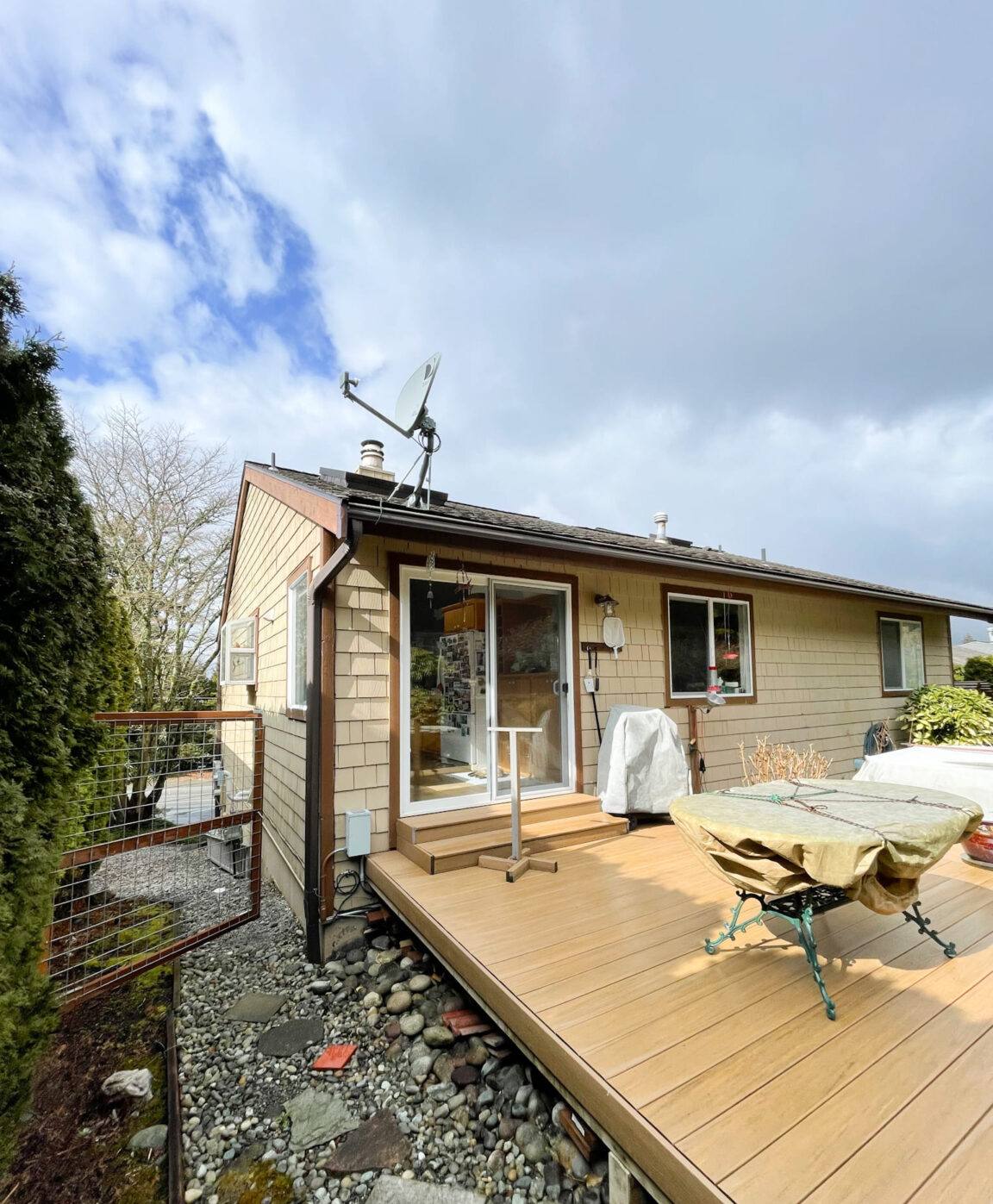
Signs Your Siding Needs Repair, Not Just a Fresh Coat of Paint
A lot of homeowners call about a paint problem and end up with a repair scope, because the paint failure was a symptom, not the actual issue. Here's how to tell the difference before you call anyone.
Cosmetic vs. Structural
Chalking, mild fading, and thin hairline checking in old paint are cosmetic and don't require board-level repair. Soft spots, visible swelling, boards that have separated from the wall plane, or dark staining that keeps coming back through fresh paint are structural signs — they mean moisture has already gotten past the surface and into the material or the wall assembly behind it.
Where to Look First
Most repair calls trace back to a handful of predictable spots: inside corners, butt joints between siding boards, the bottom courses closest to grade or a deck, and anywhere trim meets siding without adequate flashing. On a waterfront lot like Sandy Point, we also pay close attention to the wall faces that take the most direct wind — those boards are doing more work than the rest of the house.
What Actually Causes Most Repair Calls Here
In our experience working this stretch of Whatcom County, the damage we're called out for almost always comes down to one of a few root causes, not bad luck:
- Caulk and sealant joints that reached the end of their service life years before anyone noticed
- Missing or undersized flashing above windows, doors, and trim boards
- Fasteners that have corroded or backed out, letting water track behind the siding
- Siding installed too close to grade, a deck, or a roofline, with no drainage gap
- Original material — vinyl, primed wood, or older fiber cement — that was never rated for this level of coastal exposure
Notice that only one of those five is really about the siding material itself. The other four are installation and maintenance issues that will eventually cause problems on any siding product, which is why a repair that just patches the visible damage without addressing the cause tends to fail again within a season or two.
What a Correct Siding Repair Actually Involves
Diagnosis Before Demolition
Before any board comes off, a proper repair starts with figuring out how water got in, not just where it's showing up. That means checking the flashing detail, the condition of the house wrap or building paper behind the siding, and whether the damage is isolated or has spread along a seam. Pulling one damaged board and finding dry, sound sheathing behind it is a very different job than pulling that board and finding soft framing.
Matching Material and Finish
We only install James Hardie fiber cement siding, and that consistency actually makes repair work cleaner for our own installs — we know the exact plank profile, exposure, and ColorPlus finish that's already on the wall, so a repaired section blends in rather than becoming a visible patch. When we're called to a home with a different original siding material, we're upfront that an exact-match repair may not be realistic long-term, and we'll walk through whether a targeted repair or a broader re-siding plan makes more sense for that section of the house.
Fixing the Cause, Not Just the Symptom
Every repair we do includes correcting whatever let the water in — new flashing, proper caulk joints rated for this climate, corrected clearances at grade or roof lines, and fastener patterns that meet manufacturer spec. A repair that skips this step is really just a temporary cosmetic fix.
Our Process for a Sandy Point Repair Call
- Inspection: We walk the exterior, focusing on the wind- and rain-exposed elevations first, and document every area of concern — not just the spot you called about.
- Diagnosis: We identify the actual moisture path, checking flashing, seams, fastener condition, and clearances, before quoting any work.
- Written scope: You get a clear explanation of what's damaged, why, and what fixing it correctly requires — no vague line items.
- Repair: We remove only what needs to come off, correct the underlying cause, and install matching material and finish where possible.
- Follow-up guidance: We tell you what to watch for afterward and what routine maintenance will keep the rest of the siding ahead of this same problem.
Repair or Replace? A Straight Answer
Not every damaged area needs a full re-side, and not every repair is worth doing in isolation. Here's the general framework we use when we're standing in front of a Sandy Point home:
| Factor | Leans Toward Repair | Leans Toward Replacement |
|---|---|---|
| Extent of damage | Isolated to one or two wall sections | Recurring across multiple elevations |
| Underlying material | Sound James Hardie or comparable fiber cement | Original vinyl, primed wood, or failing older product |
| Cause identified | Fixable flashing/caulk/fastener issue | Systemic moisture intrusion behind large areas |
| Age of siding | Well within expected service life | Near or past the finish and material's realistic lifespan |
| Cost over time | One-time fix resolves the issue | Repeated repairs likely on remaining old material |
When the honest answer is "repair," that's what we'll recommend and quote. We're not trying to sell a full re-side on a house that doesn't need one — but we'll also tell you plainly if a section of siding is past the point where another patch makes financial sense.
Why Hiring a Crew That Already Works This Area Matters
Siding repair on a waterfront lot isn't quite the same job as siding repair three miles inland. A crew that hasn't worked this specific stretch of coastline can under-scope the flashing detail, use a caulk or sealant that isn't rated for constant salt exposure, or miss that a wall face facing open water needs a different level of attention than the sheltered side of the same house. We've done enough repair work along this part of Whatcom County to know which wall orientations fail first, which trim details tend to be the weak point, and what a repair actually needs to hold up through another wet season — not just look fixed on the day we leave.
There's also a practical logistics side to working a shoreline community: material staging, access, and weather windows all take a bit more planning than a typical inland job. A crew that's already familiar with those realities gets in, does the work correctly, and gets out without the learning curve costing you time or money.
Keeping Siding Ahead of the Damage: A Homeowner Checklist
Most of the repair calls we get could have been smaller — or avoided — with a bit of routine attention. A few times a year, especially after the wetter months, it's worth walking your own exterior and checking for:
- Caulk joints that have cracked, shrunk, or pulled away from the siding
- Dark streaking or persistent staining that returns after cleaning
- Soft spots or slight give when you press gently on lower courses near grade
- Moss or algae buildup on shaded or wind-sheltered wall sections
- Paint that's peeling or bubbling in one specific area rather than uniformly across the wall
- Gaps or gutter overflow directing water directly onto a siding wall
Catching any of these early usually means a small repair instead of a bigger one. If you're not sure whether something you're seeing is cosmetic or worth a closer look, that's exactly the kind of question worth asking before it turns into a bigger project.
Where James Hardie Fits Into a Repair-Minded Approach
We install James Hardie fiber cement exclusively, and on a site like Sandy Point that choice is about long-term repair math as much as anything else. Fiber cement doesn't absorb water the way wood-based products can, it's non-combustible, and Hardie's ColorPlus factory finish is built to hold up under UV and moisture exposure longer than field-applied paint. That doesn't mean a Hardie installation is repair-proof — flashing still fails if it's installed wrong, and caulk still needs periodic attention — but when repairs are needed, they tend to be smaller, more isolated, and less likely to point to a failure of the material itself.
If you're seeing damage, staining, or paint failure on your Sandy Point home and want a straight opinion on what it actually needs, we're happy to take a look. The estimate is free, there's no pressure to do more work than the house actually calls for, and you'll get a clear explanation of what we find either way.