 Birch Bay Siding
 Roofs in Point Whitehorn Take a Different Kind of Beating
Point Whitehorn sits close enough to the water that salt-laden air is a constant, not an occasional visitor. Add in the driving, sideways rain that comes off the Strait during fall and winter storms, plus a moss season that in Whatcom County can realistically run eight or nine months out of the year, and you've got a roofing environment that's noticeably harder on materials than what you'd see twenty miles inland. Fasteners corrode faster. Shaded, tree-lined lots stay damp longer after every rain. Wind-driven water finds its way under shingles that would hold up fine somewhere drier. None of this means a roof here is doomed to fail early — it means it has to be built correctly for the conditions it's actually going to face, not for a textbook climate.
We work on homes throughout Birch Bay and the surrounding Whatcom County shoreline, and Point Whitehorn's mix of wooded lots and open bluff-facing exposure is a pattern we see often. A roof replacement done right here accounts for both — the wind and salt exposure on the water side, and the moisture and moss pressure on the shaded side.
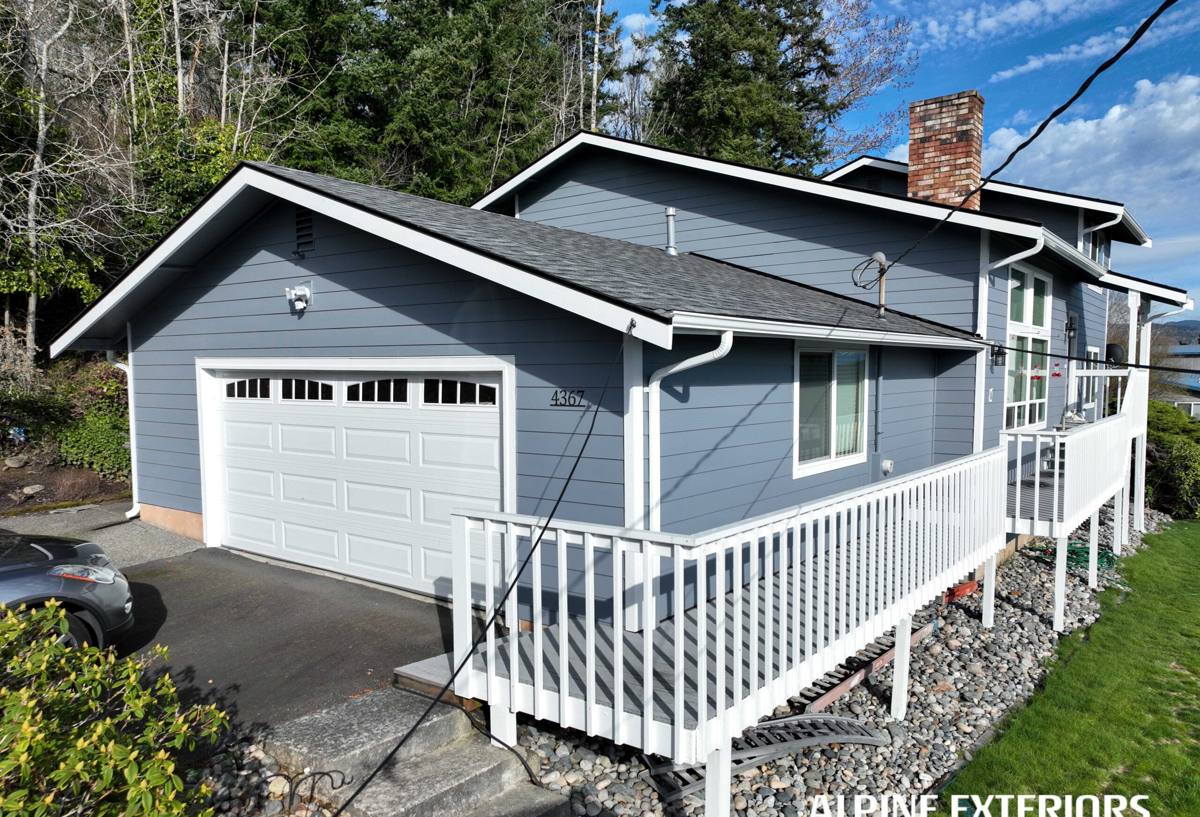
How to Tell a Roof Needs Replacing, Not Just Patching
Not every roofing problem in Point Whitehorn calls for a full tear-off. But there's a point where repairs stop being cost-effective and start just delaying the inevitable — usually while quietly letting moisture into the decking underneath.
Signs worth taking seriously
- Granule loss heavy enough that you're finding grit in gutters and downspouts every time it rains
- Shingles that are cupping, curling at the edges, or cracking — especially on slopes that catch the most wind and salt spray
- Moss or algae staining that keeps coming back within months of being cleaned, a sign the roof is holding moisture longer than it should
- Soft spots or sagging when walked on, which usually means the decking underneath has already taken on water damage
- Rusted or failing flashing around chimneys, vent pipes, and valleys — often the first thing salt air compromises
- Daylight visible through the roof deck from the attic, or insulation that's damp or matted
- A roof that's simply reached the end of its rated service life, even if it looks okay from the ground
If you're only seeing one or two of these and the roof is under fifteen years old, a repair may well be the honest answer. We'll tell you that if it's true — a roof replacement is a real investment, and we'd rather earn the job on a house that actually needs one.
What a Correct Roof Replacement Involves Here
A roof replacement is more than swapping old shingles for new ones. In a coastal, high-moss environment like Point Whitehorn, the details that don't show up in a driveway estimate are usually the ones that determine whether the roof lasts fifteen years or thirty.
Tear-off and deck inspection
We remove the old roofing down to the deck rather than layering over it. That's the only way to actually see the plywood or plank decking underneath — and on homes near the water, it's common to find soft or delaminated sections around old flashing points that a surface-level look would miss. Any damaged decking gets replaced before anything new goes down.
Underlayment built for wind-driven rain
Standard felt underlayment can be adequate in calmer climates, but with the wind patterns Point Whitehorn gets off the water, we lean toward synthetic underlayment with better wind and moisture resistance, plus self-adhering ice-and-water shield membrane at eaves, valleys, and around every roof penetration — the spots where wind-driven rain is most likely to work its way backward under the shingles.
Ventilation that actually moves air
A roof that traps moist attic air is a roof that grows moss and rots decking from underneath, regardless of how good the shingles are. We check intake at the soffits and exhaust at the ridge as part of every replacement, and correct it when the existing setup is undersized or blocked — a common issue on older homes in wooded areas where soffit vents get painted over or clogged with debris.
Flashing and fastener choice
Salt air is hard on standard fasteners and thin flashing. We use corrosion-resistant fasteners and properly formed step and counter-flashing at every wall, chimney, and dormer intersection — the places where most roof leaks actually originate, regardless of how new the shingles are.
Choosing the Right Roofing Material for This Location
There's no single "best" roofing material — there's the best fit for a given roof's exposure, the home's style, and the owner's tolerance for maintenance. Here's how the common options actually perform in a Point Whitehorn setting.
| Material | Moisture & moss behavior | Salt air durability | Typical lifespan |
|---|---|---|---|
| Architectural asphalt shingle | Good when algae-resistant granules are used; still needs periodic moss removal on shaded slopes | Solid — a common, cost-effective choice for coastal homes | 25–30 years |
| Standing seam metal | Sheds moisture and moss very well due to smooth, steep-shedding surface | Excellent with a marine-grade coated panel and correct fasteners | 40–50+ years |
| Cedar shake | Attractive but holds moisture in a wet, shaded climate; needs real upkeep to avoid rot and moss buildup | Moderate — untreated wood is more sensitive to salt and moisture cycling | 20–25 years with diligent maintenance |
| Composite/synthetic shingle | Good moisture resistance, low moss retention on most profiles | Good | 30–40 years |
We don't push cedar shake as a default choice for shaded, damp lots near the water — not because it's a bad product, but because it demands a level of ongoing maintenance that most homeowners underestimate until moss and moisture start working into the wood grain. If you love the look, we'll talk through what it actually takes to keep it healthy long-term rather than talk you out of it outright.
Our Roof Replacement Process
- On-site inspection — we get on the roof (not just look from the ground), check the decking where accessible, examine flashing, ventilation, and note the specific wind/moss exposure of each slope
- Written estimate — a clear scope covering materials, underlayment, flashing, ventilation corrections, tear-off, and disposal, with no vague allowances
- Scheduling around weather — we plan tear-off days around dry weather windows, since an open roof deck and Whatcom County rain don't mix
- Tear-off and deck repair — old roofing removed, decking inspected and replaced where needed
- Dry-in — underlayment and ice-and-water shield installed the same day the deck is exposed, so the house is never left vulnerable overnight
- Installation — new roofing, flashing, and ventilation components installed to manufacturer specification
- Cleanup and magnetic sweep — job site cleared of debris and nails
- Final walkthrough — we go over the finished roof with you before calling the job done
Why It Matters to Hire a Crew That Already Works Point Whitehorn
Roofing crews that mostly work drier, inland areas don't always think in terms of wind-driven rain or year-round moss pressure — because they don't have to. A crew that regularly works Birch Bay and the surrounding Whatcom County shoreline already knows to detail flashing and underlayment for that reality instead of treating it as an afterthought.
There's also the practical side: familiarity with Whatcom County permitting requirements, an understanding of how tree cover and lot access affect staging and disposal logistics, and knowing which roofing profiles genuinely hold up on wind-exposed, water-facing slopes versus which ones just look fine on paper. None of that shows up in a bid line item, but it shows up in how long the roof lasts.
What Affects the Cost of a Roof Replacement
| Factor | Why it matters |
|---|---|
| Roof size and pitch | More square footage and steeper slopes mean more material and labor time |
| Number of layers to remove | Tear-off of multiple old layers adds disposal cost and labor |
| Decking condition | Rotted or soft decking sections need replacement before new roofing goes on |
| Material choice | Asphalt, metal, and composite options carry different material and installation costs |
| Ventilation and flashing corrections | Fixing undersized ventilation or old flashing adds work but prevents future leaks and moss buildup |
| Roof complexity | Valleys, dormers, chimneys, and skylights all add labor and flashing detail |
| Access and staging | Wooded lots or tight access can affect equipment staging and disposal logistics |
Because of these variables, honest roof replacement pricing in this area typically spans a wide range depending on size and material — which is exactly why we walk the roof in person before giving a number, rather than quoting off a phone call.
Protecting the Roof After Replacement
A new roof still needs a little attention, especially given the moss season here.
- Have moss removed gently (not power-washed) before it establishes a thick mat, generally once a year on shaded slopes
- Keep gutters clear of needles and debris from surrounding trees so water actually drains instead of backing up under the roof edge
- Trim back overhanging branches to reduce shade, debris, and physical abrasion on the roofing surface
- Have flashing and sealant points checked every couple of years, since these are the first things salt air and weather cycling tend to affect
- Address any new leak signs quickly — a small flashing fix now is far cheaper than deck repair later
Let's Take a Look at Your Roof
If you're weighing a repair against a full replacement, or you just want an honest read on how much roof life you have left, we're happy to come out, walk the roof, and give you a straight answer — no pressure, no hard sell. Use the form below to request a free estimate for your Point Whitehorn home.