 Birch Bay Siding
 Deck Replacement Built for Blaine's Coastal Climate
Blaine sits at the northern edge of Whatcom County, right on the water, and that location works against a wood deck in ways inland homes never deal with. Salt-laden air off the strait corrodes fasteners, hangers, and hardware faster than most manufacturer ratings assume. Driving rain finds every gap in flashing and decking boards. And the long run of grey, damp months each year keeps moss and algae growing on horizontal surfaces for much of the year, which traps moisture against wood long after a storm has passed. A deck that would hold up for two decades in a dry inland climate can start failing structurally in half that time here if it wasn't built with this environment in mind.
That's not a hypothetical -- it's the pattern we see on nearly every deck replacement we're called to in Blaine: framing that's soft under decking that still looks fine on top, corroded hardware, and ledger boards that have been quietly rotting behind the siding for years before anyone noticed.
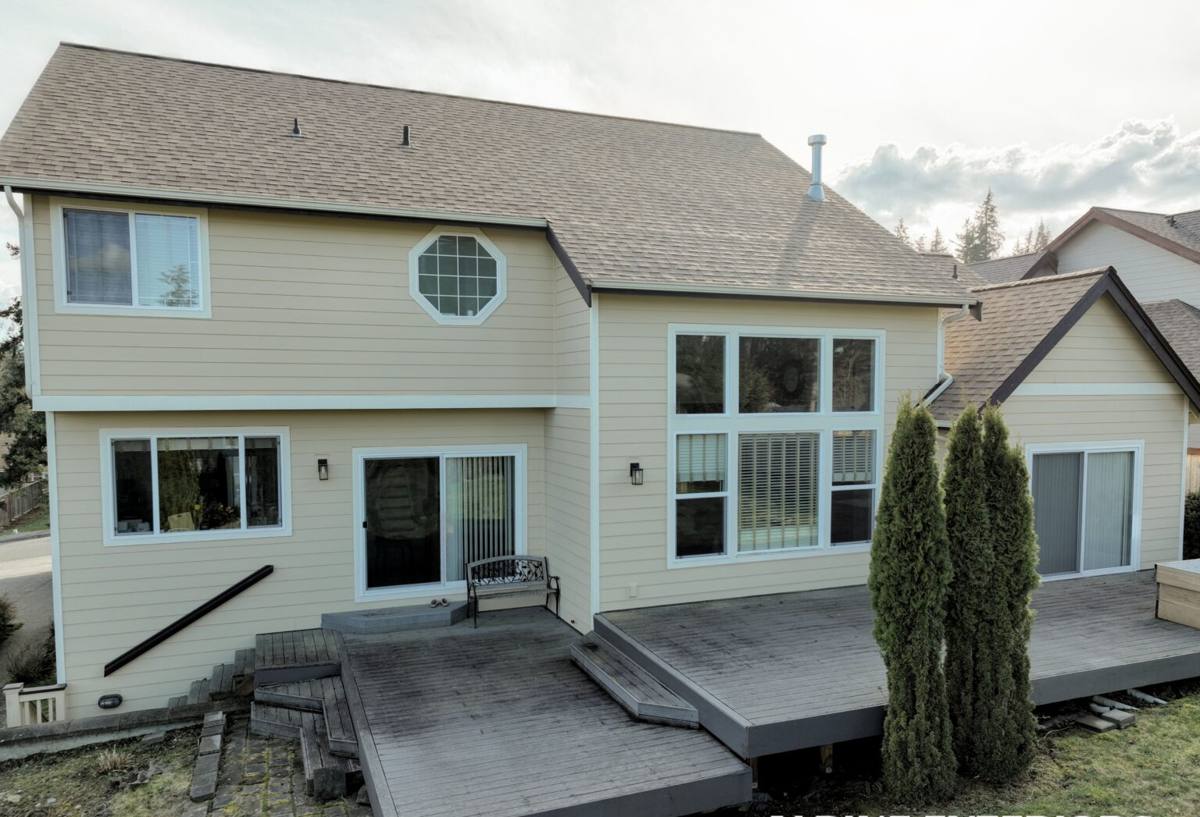
Signs a Blaine Deck Needs Replacement, Not Just Repair
Repair makes sense when the problem is isolated -- a few damaged boards, a loose railing, a section of flashing that failed. Replacement is the honest call once the damage has reached the structure itself, because no amount of surface patching fixes framing that's already lost its strength. Deciding which situation you're in usually comes down to a hands-on inspection, but there are signs a homeowner can spot before calling anyone out.
- Soft or spongy spots underfoot, especially near the house or along the outer rim joist
- Rust streaks or crumbling around fastener heads and joist hangers
- Gaps or dark staining where the deck meets the house, which usually means the ledger connection is compromised
- Boards that stay wet or grow moss long after the rest of the deck has dried
- Railings or stair stringers that feel loose or flex under normal weight
- A deck more than 15-20 years old that has never had the substructure inspected
If more than one of these shows up at once, it's usually cheaper in the long run to replace than to keep chasing repairs on a structure that's already compromised.
What a Correct Deck Replacement Actually Involves
Ledger Board and Flashing
The ledger -- the board that attaches the deck to the house -- is the single most common failure point we find, and it's almost always a flashing problem, not a lumber problem. Water gets behind the ledger, can't escape, and rots both the ledger and the house framing behind it. A correct replacement means proper flashing that sheds water away from the house, not just a board bolted back in the same spot.
Framing and Joists
Everything under the decking boards needs to be sized correctly for the span and load, spaced to code, and treated for exterior exposure. This is also where we catch problems from the original build -- undersized joists, missing blocking, or framing that was never rated for a wet coastal climate in the first place.
Fasteners and Hardware
In a salt-air environment, hardware quality is not a place to cut corners. Standard galvanized fasteners corrode faster here than they would ten miles inland, and once a fastener starts rusting it weakens the connection it's supposed to hold. We use fasteners and joist hangers rated for coastal and treated-lumber exposure, because replacing hardware later means tearing up decking to get at it.
Decking Surface and Drainage
The visible decking is the last thing installed, but it only performs well if what's underneath drains properly. Gaps between boards, slope away from the house, and airflow underneath the deck all matter more here than in a dry climate, since anything that traps water speeds up rot and feeds the moss and algae that Blaine's damp stretches are known for.
Choosing a Decking Material for Blaine's Salt Air
There's no single right answer for every homeowner -- it depends on budget, how the deck gets used, and how much upkeep you want to take on. Here's how the common options actually hold up in this climate.
| Material | How It Handles Salt Air & Rain | Maintenance |
|---|---|---|
| Pressure-treated wood | Affordable and strong, but needs consistent sealing to resist moisture and moss; end grain and fastener holes are the weak points | Annual cleaning and re-sealing recommended |
| Cedar | Naturally rot-resistant and handles moisture better than most softwoods, but still needs protection from constant damp exposure | Periodic cleaning and oil or sealer every 1-2 years |
| Composite (capped) | Resists moisture absorption and won't rot, though lower-quality boards can still trap surface moss if drainage underneath is poor | Occasional washing, no sealing or staining |
| PVC decking | Fully synthetic, essentially immune to rot and moisture damage, best long-term option for a wet, salty environment | Lowest maintenance of the group |
We'll walk through these trade-offs during your estimate rather than push one product -- the right call depends on what the deck is for and how long you plan to be in the house.
Our Deck Replacement Process
- Inspection: We check the substructure, ledger connection, and framing before quoting anything, not just the surface boards.
- Scope and estimate: You get a clear, written breakdown of what's being replaced and why, with material options explained honestly.
- Demolition: Full removal of the old decking and any compromised framing, checking what's behind the ledger as we go.
- Framing and flashing: New or reinforced substructure, correctly sized and fastened, with proper flashing at the house connection.
- Decking installation: Boards installed with correct spacing and drainage for wet-climate performance.
- Final walkthrough: We go over the finished deck with you and explain what maintenance, if any, it needs going forward.
Permits and Whatcom County Considerations
Most full deck replacements in Blaine require a building permit, particularly when framing or the ledger connection is being rebuilt rather than just the surface boards. Requirements can depend on deck height, size, and proximity to property lines, and the City of Blaine's building department is the source for what applies to your specific property. We handle the permit process as part of the job rather than leaving it for the homeowner to sort out, since a deck built without the required permit can become a real problem at resale.
What Deck Replacement Costs in Blaine
Every deck is different, so we won't quote a number without seeing the site, but these are the factors that move the price up or down.
| Cost Factor | Why It Matters |
|---|---|
| Deck size and shape | Larger decks and multi-level or angled designs need more material and labor |
| Substructure condition | Rotted framing or a failed ledger connection adds work beyond the visible decking |
| Decking material | Pressure-treated, cedar, composite, and PVC all sit at different price points |
| Railing style | Basic wood rail versus composite, metal, or cable systems changes both cost and upkeep |
| Stairs and landings | Each set of stairs adds framing, decking, and railing work |
| Permits and inspections | Required for most full replacements and factored into the overall timeline and cost |
Broadly, a straightforward pressure-treated replacement sits well below a full composite or PVC rebuild with upgraded railing -- we'll give you real numbers for your deck once we've seen it in person.
Maintaining a New Deck Through Blaine's Moss Season
Even a well-built deck needs a little seasonal attention in this climate. The goal is keeping moisture from sitting on the surface long enough to feed moss and algae, which is what shortens the life of even good materials out here.
- Sweep off leaves, needles, and debris regularly, especially in fall
- Keep gutters and downspouts clear so water isn't dumping onto the deck
- Rinse off moss and algae before it gets established, rather than letting it build up over winter
- Check underneath the deck once a year for standing water or blocked drainage
- Re-seal wood decking on the schedule your material calls for -- don't wait until it's visibly weathered
- Watch fastener heads and hardware for early rust and address it before it spreads
Why Hire a Crew That Already Works in Blaine
A contractor who mostly builds decks somewhere dry and inland will default to specs that work fine there and fall short here. Framing sizing, fastener selection, flashing details, and drainage all need to account for salt air, driving rain, and a moss season that runs long -- and that only comes from having actually done the work in this specific stretch of Whatcom County, not from a generic build sheet. We build every deck replacement to hold up to Blaine's conditions specifically, not to a national average.
If your deck is showing its age, we're happy to take a look and give you a straight answer on repair versus replacement. Reach out for a free, no-pressure estimate using the form below.