 Birch Bay Siding
 Decking in Nooksack Has to Work Harder Than the Brochure Photos Suggest
Nooksack sits close enough to Birch Bay and the Strait of Georgia that homes here deal with a mix of conditions most decking products were never really tested for: salt-laden air blowing off the water, long stretches of driving rain through fall and winter, and a moss season that can run from October well into April. Add Whatcom County's humidity and the tree cover common on many Nooksack lots, and you've got a deck environment that punishes shortcuts fast. A deck that looks fine going in can show fading, staining, fastener corrosion, or slick moss growth within a couple of seasons if it wasn't built with this specific climate in mind.
This page is about composite decking specifically for Nooksack properties — what the climate demands, what a correctly built deck actually involves below the surface, and why hiring a crew that already works in this area matters more than picking a brand name off a shelf.
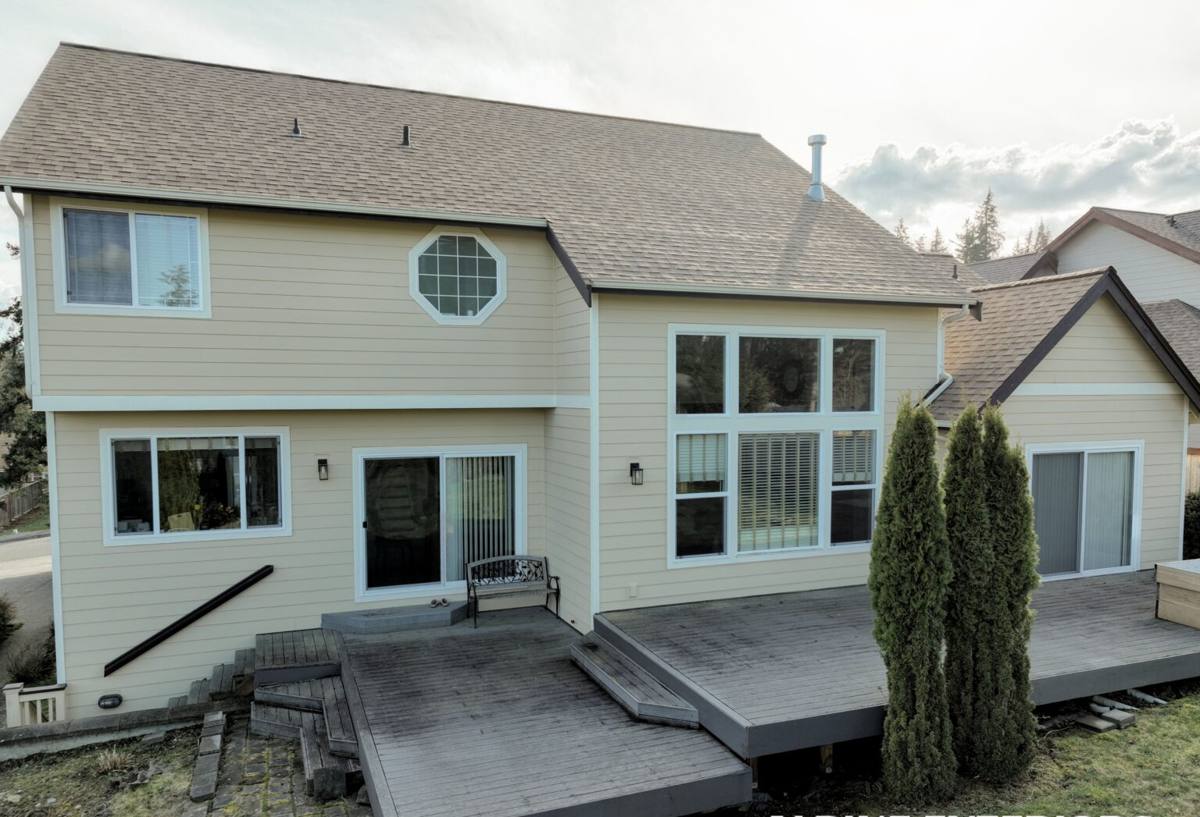
What Salt Air, Rain, and Moss Actually Do to a Deck
Salt Air
Even a few miles inland from Birch Bay, airborne salt settles on everything outdoors. It's not enough to see day to day, but it accelerates corrosion on exposed metal — screw heads, joist hangers, railing brackets — and it can dull or discolor lower-quality decking surfaces over time. Fasteners and hardware rated for coastal exposure aren't optional here; they're the difference between hardware that lasts and hardware that streaks rust down your boards in year three.
Driving Rain
Whatcom County rain doesn't just fall straight down — wind-driven rain gets under rail caps, into end grain, and behind fascia boards if those areas weren't detailed correctly. Composite boards themselves handle moisture well, but the framing underneath, the flashing where the deck meets the house, and the fastener penetrations are where water actually causes damage. Most deck failures we see aren't the decking material failing — they're water finding a path into wood framing that wasn't protected.
Moss and Algae
Shaded, damp decks in this region grow moss and algae readily, especially decks under tree cover or on the north side of a house. Moss holds moisture against the board surface, and on a slick day it's a genuine fall hazard. Board texture, ventilation underneath the deck, and drainage all affect how much moss you'll fight — and no composite board is fully moss-proof if airflow and drainage weren't designed in from the start.
What a Correctly Built Composite Deck Involves
The decking boards get most of the attention, but they're maybe a third of what determines whether a deck holds up in Nooksack. The rest is substructure work that doesn't show once the project is done — which is exactly why it's worth understanding before you hire anyone.
- Ledger flashing: where the deck attaches to the house needs proper flashing so wind-driven rain can't work its way behind the siding and into the wall assembly.
- Joist protection: joist tape or an equivalent moisture barrier over the top of each joist keeps rain from soaking into the wood every time it rains, which is most of the year here.
- Coastal-rated fasteners and hangers: stainless or heavily coated hardware resists the corrosion salt air accelerates. Standard hardware corrodes visibly faster this close to the water.
- Proper ventilation underneath: enough clearance and airflow below the deck so moisture doesn't sit trapped against the framing or the underside of the boards.
- Correct board spacing: gaps sized for composite's expansion and contraction, and to let water drain through rather than pool on the surface.
- Grading and drainage at ground level: water needs somewhere to go once it drains through the deck — pooling underneath undermines footings and posts over time.
Skip any one of these and the deck may still look right for a year or two. The problems that show up later — soft spots, rust streaks, rot at the ledger — almost always trace back to one of these steps being rushed or skipped.
Composite vs. Wood vs. PVC for a Nooksack Deck
Homeowners usually ask us to compare these three, so here's the honest breakdown for this specific climate rather than a generic sales pitch.
| Factor | Wood (cedar/pressure-treated) | Composite | PVC |
|---|---|---|---|
| Moisture behavior in wet climate | Absorbs water, needs annual sealing to resist rot | Won't rot, but board core can hold moisture if end cuts aren't capped | Fully moisture-resistant, doesn't absorb water |
| Salt air exposure | Fasteners and surface degrade faster near salt air | Surface holds up well; hardware still needs to be coastal-rated | Holds up well; hardware still needs to be coastal-rated |
| Moss/algae resistance | Grows moss readily, especially in shade | Textured surfaces can still grow moss without airflow/drainage | Smoother surface sheds moisture better, still needs ventilation |
| Maintenance | Annual staining/sealing, regular cleaning | Periodic washing, no staining or sealing | Lowest maintenance, occasional washing |
| Upfront cost | Lowest | Mid-range | Highest |
| Typical lifespan with proper install | 15-20 years with consistent upkeep | 25-30+ years | 25-30+ years |
We install composite for most Nooksack projects because it strikes the right balance for this climate — real resistance to rain and salt exposure without the upkeep wood demands, at a cost most homeowners are comfortable with. PVC is a legitimate option for homeowners who want the lowest possible maintenance and are comfortable with the higher cost; we're happy to walk through that trade-off honestly rather than push whichever product has the better margin.
How Our Process Works
1. On-Site Assessment
We walk the property, check existing framing if it's a rebuild, look at drainage and grading, and note sun/shade exposure since that affects moss risk and board color choice.
2. Substructure Evaluation and Repair
If we're building over existing footings or ledger connections, we check them for rot, corrosion, and code compliance before any decking goes down. Framing issues get addressed first — building nice boards on top of a compromised substructure just delays the same problem.
3. Moisture Management Details
Ledger flashing, joist tape, and drainage planning happen before a single composite board is installed. This is the stage that determines how the deck performs in year five and year fifteen, not just on installation day.
4. Board Installation
Boards are laid with correct spacing for expansion, fastened with coastal-rated hardware, and end-capped where cuts expose the board core, so moisture can't wick in from cut edges.
5. Railings and Finish Details
Rail posts get the same attention to flashing and fastener corrosion resistance as the deck itself, since railings take direct wind-driven rain and are often the first thing to show hardware corrosion.
6. Final Walkthrough
We go over care basics with the homeowner — cleaning frequency, what to watch for near tree cover, and what's still under warranty — before calling the job done.
Living With a Composite Deck Through a Whatcom County Winter
Composite decking is genuinely lower-maintenance than wood, but "low-maintenance" isn't "no-maintenance," especially with the moss season this area gets. A few habits keep a properly built deck performing the way it should:
- Sweep debris off the surface regularly in fall — wet leaves trapped against boards feed moss growth.
- Rinse or wash the deck a couple of times a year, more often in heavily shaded areas, using a soft-bristle brush and a composite-safe cleaner.
- Keep gutters and downspouts clear so runoff isn't dumping extra water directly onto or under the deck.
- Trim back overhanging branches where possible to cut down on both debris and shade that promotes moss.
- Check railing hardware annually for early signs of corrosion, especially on decks with more direct exposure toward the water.
- Confirm under-deck ventilation stays clear — stored items or overgrown landscaping underneath can block the airflow the deck was designed around.
What Affects Cost on a Nooksack Composite Deck
| Cost Factor | Why It Matters |
|---|---|
| Deck size and shape | Square footage and the number of angles, stairs, or level changes directly affect material and labor |
| Substructure condition | Rebuilding over failed footings or rotted framing adds cost but isn't optional if it's compromised |
| Board tier | Composite lines vary in cap-stock quality and color/fade warranty length |
| Railing style | Composite, aluminum, or cable railing all price differently and affect long-term corrosion resistance |
| Site access | Sloped or tree-covered Nooksack lots can affect equipment access and labor time |
| Drainage/grading work | Sites needing regrading or additional drainage under the deck add scope but prevent future problems |
We don't quote from a distance for this reason — two decks that look similar in square footage can price very differently depending on what's underneath and what the site requires. A walk-through gives an honest number instead of a rough guess that changes once work starts.
Why a Crew That Already Works Nooksack Matters
General contractors who work all over Western Washington aren't wrong for the region, but a crew that regularly builds decks specifically around Birch Bay and Nooksack has already seen how salt air, moss, and driving rain play out on real decks over years, not just on a spec sheet. That shows up in small decisions — which hardware grade we default to, how much ventilation clearance we build in under a shaded deck, where we add extra flashing attention on a west-facing ledger. None of those are dramatic upgrades, but they're the difference between a deck that needs attention in year four and one that's still solid at year fifteen.
It also matters for warranty follow-through. If a manufacturer issue or an installation question comes up years later, a local crew that's still working in the area is easier to reach than a company that moved on to other regions.
A Quick Checklist Before You Hire
- Ask specifically what fastener and hardware grade they use, and confirm it's rated for coastal/salt exposure.
- Ask how they handle ledger flashing and joist protection — not just what decking brand they install.
- Ask about under-deck ventilation planning if your lot has shade or tree cover.
- Get the manufacturer's written warranty terms, not just a verbal summary.
- Confirm they pull the required permits rather than skipping that step to save time.
- Ask for a written estimate that breaks out substructure work separately from decking material.
If you're weighing a new deck or a rebuild in Nooksack, we're glad to walk the property, look at what's actually there, and put together a straightforward, no-pressure estimate — just fill out the form below.