 Birch Bay Siding
 Why Birch Bay Village Roofs Wear Differently
A roof in Birch Bay Village works harder than a roof twenty miles inland. Sitting this close to the water in Whatcom County means the air itself is part of the problem: fine salt carried off Birch Bay and the Strait settles on every exposed surface, and over years it accelerates corrosion on anything metal — nail heads, flashing, gutter fasteners, ridge vents. Add driving rain that comes in sideways during winter storms, and you get wind-driven water finding its way under laps and around penetrations that would stay dry on a calmer, drier roof. Then there's the shade and moisture from the tree cover common in this area, which keeps north-facing slopes damp long after the rest of the roof has dried out, feeding a moss season that runs most of the year instead of a few weeks in spring.
None of this means a roof here can't last — it means the material, the flashing details, and the ventilation have to be chosen with this specific climate in mind, not a generic install pulled from a catalog. That's the difference between a roof that needs attention again in twelve years and one that goes the full distance.
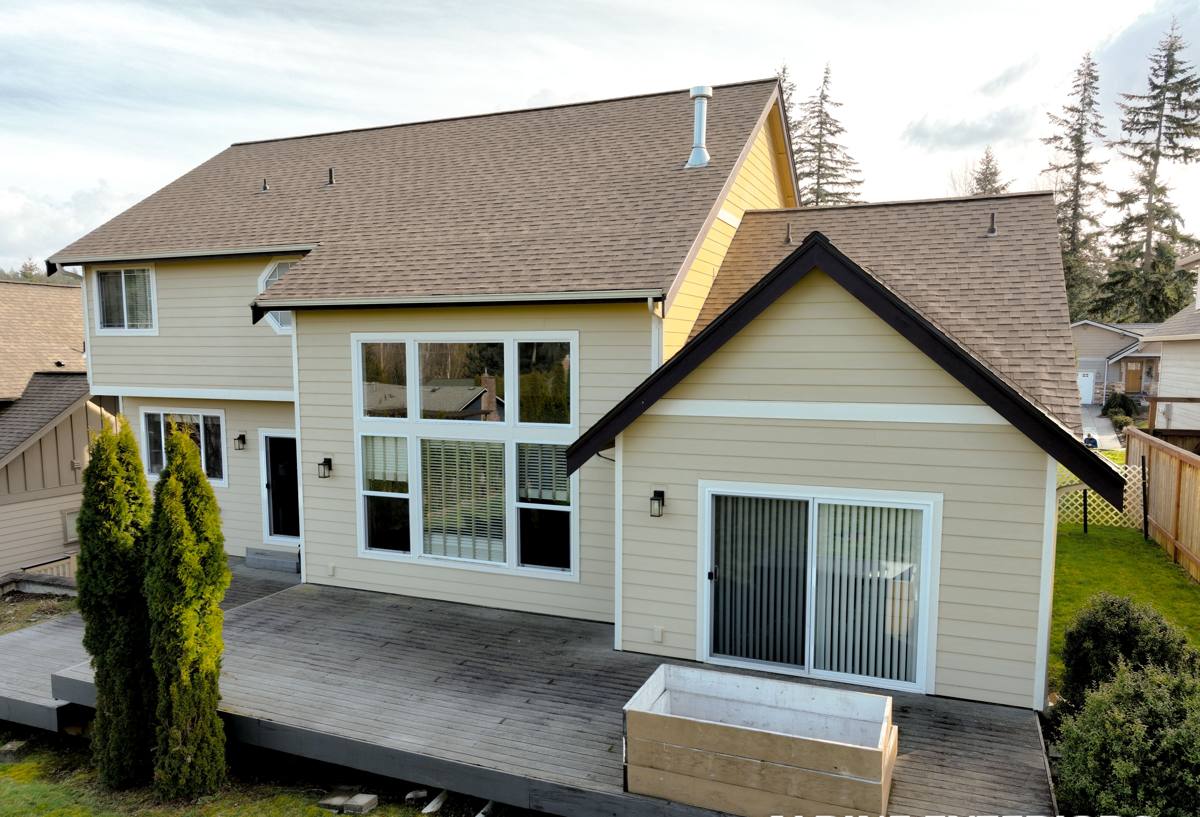
Signs a Birch Bay Village Roof Is Due for Replacement
What to look for from the ground and the attic
Most homeowners notice a roof problem well before it becomes an emergency, if they know what to check. Walk the property and look up, then take a flashlight into the attic on a dry day.
- Granules collecting in gutters or at downspout outlets — a sign the shingle surface is wearing thin
- Shingles that are curling at the edges, cupping in the middle, or visibly cracked
- Thick moss mats on shaded or north-facing slopes, especially where they've lifted shingle edges
- Dark streaking across the roof field (algae staining, not always a structural issue, but a sign the surface is aging)
- Rust staining below flashing, vents, or exposed fasteners
- Soft or spongy spots when walked (only a roofer should be walking the roof — this is something we check)
- Daylight visible through the roof deck from inside the attic, or damp insulation and sheathing
- A roof that's 20-25+ years old, even if it "looks fine" from the street
Any one of these on its own might just mean a repair. Several together, especially combined with age, usually means it's time to talk about replacement before a winter storm turns a maintenance issue into interior water damage.
Choosing a Roofing System Built for the Coast
Material options at a glance
| Material | Salt-air / corrosion resistance | Moss resistance | Typical lifespan here |
|---|---|---|---|
| Standard 3-tab asphalt | Fair — exposed fasteners corrode faster near the water | Low unless treated; needs regular cleaning | 15-20 years in this climate |
| Architectural (laminate) asphalt shingle | Good, especially with corrosion-resistant fasteners and flashing | Good with algae-resistant granules | 25-30 years with proper ventilation |
| Standing seam metal | Very good with the right coating and fastener spec | Very good — moss struggles to gain a foothold on smooth panel | 40-50+ years |
| Synthetic/composite shake | Good; doesn't absorb moisture like real wood shake | Good; won't rot or hold moss roots the way cedar can | 30-40 years |
What we typically recommend for this neighborhood
For most Birch Bay Village homes, a quality architectural asphalt shingle with algae-resistant granules and stainless or hot-dip galvanized fasteners hits the right balance of cost, appearance, and coastal durability. For homeowners planning to stay long-term or dealing with heavy shade and a north-facing roof plane, standing seam metal is worth the higher upfront cost — it sheds moss, holds up to wind-driven rain, and shrugs off salt air far longer than any asphalt product. We'll walk you through the real trade-offs for your specific roof rather than pushing one product for every house.
What a Correct Installation Actually Involves
Tear-off and deck inspection
We remove the old roofing down to the deck rather than layering over it. That's the only way to actually see what's underneath — soft or delaminated sheathing, hidden leaks around old flashing, or venting that was never installed correctly the first time. Any damaged decking gets replaced before anything new goes down; covering up a bad deck just guarantees problems under the new roof.
Underlayment and ice-and-water protection
Given how much driving rain this area sees, we don't treat underlayment as an afterthought. Self-adhered ice-and-water membrane goes at the eaves, valleys, and around every penetration — the spots where wind-driven water is most likely to force its way sideways under a lapped material. A synthetic underlayment covers the rest of the field, holding up better to wind and moisture exposure during installation than old-style felt.
Flashing and fasteners
This is where a lot of roofs near the water fail early, and it's rarely the shingles' fault. Standard fasteners and thin flashing corrode faster in salt air, so we spec corrosion-resistant fasteners and properly formed step flashing, counter-flashing, and kick-out flashing at every wall intersection, chimney, and skylight. A roof can have excellent shingles and still leak in five years if the flashing details were rushed.
Ventilation
Balanced intake and exhaust ventilation does two jobs here: it keeps the attic dry, which protects the deck and insulation, and it helps the roof surface dry out faster after rain, which slows how quickly moss re-establishes. A roof that can't breathe properly stays damp longer in this climate, and a damp roof is a roof that grows moss and ages faster than it should.
Moss: Prevention Built Into the Installation
Given how long moss season runs in this part of Whatcom County, we treat moss prevention as part of the install, not a separate service to sell later. Zinc or copper strips near the ridge release trace metal ions that wash down the roof with every rain and inhibit moss and algae growth over time. Algae-resistant granules built into modern architectural shingles do similar work at the surface level. None of this eliminates the need for occasional roof cleaning, especially on heavily shaded slopes, but it meaningfully slows how fast moss comes back after installation — and a roof that isn't fighting moss growth stays watertight longer.
Our Process for a Birch Bay Village Roof Replacement
- On-site inspection and a written estimate that explains exactly what we found and what we recommend
- Material selection — we walk you through the real trade-offs for your roof, not a one-size pitch
- Permitting handled through the appropriate local authority before work begins
- Scheduling built around realistic weather windows rather than rushing a job into a storm
- Tear-off, deck repair as needed, underlayment, flashing, and installation
- Daily jobsite cleanup and a magnetic sweep for stray nails before we leave each day
- Final walk-through with you and complete warranty paperwork
Cost Factors for a New Roof in Birch Bay Village
| Factor | Why it matters |
|---|---|
| Roof size and pitch | More surface area and steeper pitches mean more material and labor time |
| Material choice | Architectural asphalt, metal, and composite shake carry different material and install costs |
| Number of existing layers | Tearing off multiple old layers adds labor and disposal cost |
| Deck condition | Rotted or soft sheathing found during tear-off requires repair before install |
| Access and roof complexity | Valleys, dormers, chimneys, and skylights all add flashing detail and time |
| Ventilation upgrades | Bringing intake/exhaust balance up to spec can add modest cost but pays off in roof life |
Every one of these varies by house, which is why we give a written estimate after actually seeing the roof rather than a number over the phone.
Why Hire a Crew That Already Works Birch Bay Village
A crew that only occasionally works this close to the water treats every job as a standard install and hopes it holds up. A crew that works Birch Bay Village regularly already knows which fastener spec actually resists this air, which slopes in this neighborhood hold moss the longest, and how to time a tear-off around the rain patterns that roll in off the bay. That local familiarity shows up in fewer callbacks and a roof that's actually built for the conditions it has to survive, not just the conditions on a spec sheet.
If your roof is showing its age or you're planning ahead rather than waiting for a leak, we're glad to take a look and give you a straight answer about what your roof actually needs. Reach out for a free, no-pressure estimate using the form below.