 Birch Bay Siding
 Why Metal Roofing Behaves Differently in the Nooksack Climate
Homes in the Nooksack area sit inside the same weather pattern that shapes all of Whatcom County: wet Pacific systems moving in off the water, wind that carries salt-laden air well past the shoreline, and long stretches of the year where a roof simply doesn't get a chance to fully dry out. Even properties set back from Birch Bay itself still catch that same maritime moisture and salt exposure on the wind, especially during fall and winter storm cycles. A metal roof installed correctly for this climate will outlast almost anything else on the market. A metal roof installed with the wrong fasteners, the wrong underlayment, or the wrong panel profile will show corrosion, leaks, or lifting within a handful of years — often at the seams and penetrations first, since that's where water and salt find the weak points.
That's the real difference between a metal roof that lasts thirty-plus years here and one that becomes a maintenance headache: it's almost never the metal itself. It's the details underneath it and around it.
Salt Air Doesn't Stay at the Shoreline
Salt-bearing wind moves inland further than most homeowners expect, and it doesn't need direct ocean exposure to do damage — it settles on metal surfaces, fasteners, and flashing, and it accelerates corrosion wherever the protective coating is thin, scratched, or mismatched to the panel material. This is one of the most common oversights we see corrected on older metal roofs in this region: exposed steel screws or trim that were never rated for coastal-adjacent exposure.
Driving Rain Finds Every Gap
Storms here rarely come straight down. Wind-driven rain moves rain sideways and upward under lap joints, around chimneys, and into valleys — spots that a roof designed for a calmer climate can get away with cutting corners on. In Whatcom County, those same shortcuts show up as interior leaks within a season or two.
A Long Moss Season Changes Maintenance, Not Just Looks
Between tree cover, shorter winter daylight, and a climate that stays damp for months at a stretch, moss and algae growth is close to a year-round condition here rather than a seasonal nuisance. On a metal roof, moss itself isn't a structural threat the way it can be on shingles or wood shakes, but it holds moisture against fasteners and trim, and it's often a sign that debris is collecting somewhere it shouldn't be.
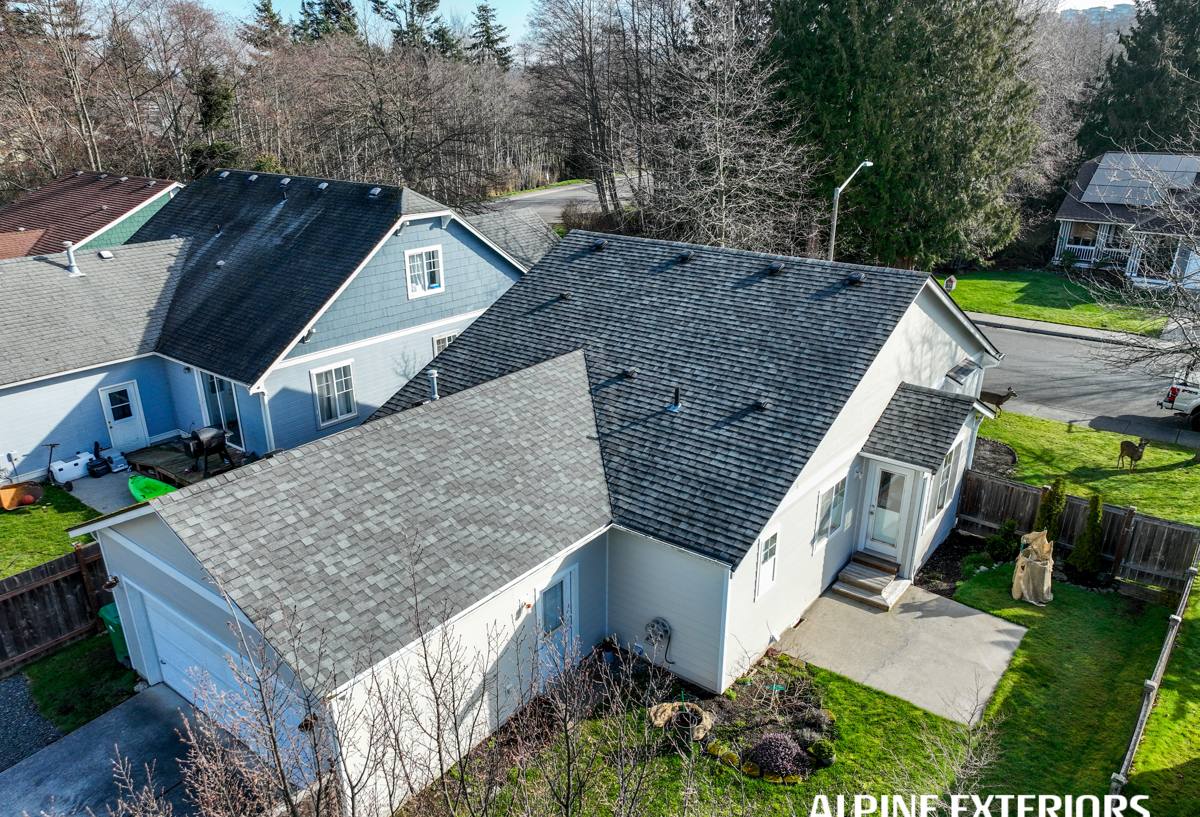
What a Correctly Installed Metal Roof Actually Involves
A metal roof is a system, not just a set of panels. Every layer underneath the visible metal is doing work, and in this climate none of it is optional.
Underlayment and Water Barrier
We install a high-temperature synthetic underlayment across the full roof, with self-adhered ice-and-water barrier at eaves, valleys, and any roof-to-wall transition. These are the areas where wind-driven rain is most likely to be pushed backward under the panels, and they're the areas that get skipped most often on rushed installs.
Fastener and Flashing Material
Fasteners, trim, and flashing need to be matched to the panel's metal type to avoid galvanic corrosion — mixing incompatible metals is one of the fastest ways to create rust streaks and premature failure at every seam. In a salt-influenced climate, we treat corrosion-resistant fastener and flashing selection as a baseline requirement, not an upgrade.
Panel Profile and Fastening Method
Standing seam panels use concealed clips with no exposed fasteners through the panel face, which is why they hold up so well long-term in wet, salt-influenced climates — there's simply nowhere for water to sit on a screw head and start working a hole. Exposed-fastener panels can still be a sound, more budget-friendly option when the fasteners are correctly spaced, torqued, and gasketed, and when the homeowner understands that those fasteners will need to be checked and occasionally re-sealed over the life of the roof.
Comparing Metal Roofing Panel Systems
Not every metal roof system makes sense for every home or budget. Here's how the main options compare for a Nooksack-area property:
| System | Fastener Exposure | Best Fit | Maintenance Load |
|---|---|---|---|
| Standing seam | Concealed clips, no face penetrations | Long-term, low-maintenance ownership | Low |
| Exposed-fastener panel | Screws through panel face | Budget-conscious projects, outbuildings, additions | Moderate — periodic fastener checks |
| Stone-coated steel | Concealed, shingle-style profile | Homeowners wanting a traditional roof look with metal durability | Low to moderate |
We'll walk through which of these actually fits your roof's slope, budget, and how long you plan to own the home — a system chosen for the wrong reasons is the most common cause of early problems we see.
Moss, Debris, and Maintenance in a Wet Maritime Climate
Metal roofing needs far less maintenance than shingles or wood, but "far less" isn't "none," especially with the moss season this area gets. Debris buildup in valleys and behind chimneys is the real issue — it holds water against the panel and trim long after the rest of the roof has dried.
A simple seasonal routine keeps a metal roof performing the way it should for decades:
- Clear needles, leaves, and moss buildup from valleys and behind roof penetrations each fall, before the heaviest rain arrives
- Check that gutters and downspouts are flowing freely — a metal roof sheds water fast, and a clogged gutter backs that water right up under the drip edge
- Look at exposed fasteners (if the roof has them) for early rust staining or loosening every year or two
- Trim back overhanging branches that keep sections of the roof shaded and damp longer than the rest
- Have flashing around chimneys, vents, and skylights inspected periodically — these penetrations are where the vast majority of metal roof leaks actually start
Our Process for a Nooksack Metal Roof Install
The process is straightforward, but each step matters more here than it would in a drier climate.
- On-site assessment — we look at slope, existing decking condition, tree cover, and how exposed the roof is to prevailing wind and rain direction.
- System recommendation — based on that assessment and your budget, we recommend a panel profile and fastening method, and explain the trade-offs honestly rather than upselling the most expensive option by default.
- Tear-off and deck inspection — if we're replacing an existing roof, we check the decking underneath for rot or moisture damage before anything new goes down. This step gets skipped far too often, and it's the one that causes callbacks later.
- Underlayment and water barrier installation — full synthetic underlayment plus ice-and-water barrier at every vulnerable transition point.
- Panel installation — installed to manufacturer spec for fastener spacing, panel overlap, and expansion allowance, since metal panels move with temperature swings and need room to do it without buckling.
- Flashing, trim, and detail work — the finishing details around chimneys, vents, and valleys, done correctly the first time.
- Final walkthrough — we go over the completed roof with you, including what maintenance to expect and when.
Why Local Experience in Whatcom County Matters
A crew that hasn't worked in this specific climate will often build a roof to a generic spec sheet — one that assumes drier weather, less wind-driven rain, and no salt exposure. That's how you end up with premature corrosion at fasteners, moss-driven moisture problems in valleys, or leaks at transitions that a roof in a different climate would never see.
A crew that already works the Nooksack area and the rest of Whatcom County knows which details can't be shortcut here: the underlayment coverage at eaves, the fastener and flashing material choice, and the panel profile decisions that actually hold up through a full Pacific Northwest winter. That local track record isn't a marketing line — it's the difference between a roof that needs attention in five years and one that doesn't need attention for thirty.
Cost Factors to Expect
Metal roofing costs more upfront than asphalt shingles, and the final number depends on more than square footage. Broadly, homeowners should expect a wide range depending on the factors below — we'll give you an exact number after seeing the roof in person.
| Factor | Why It Matters |
|---|---|
| Panel system chosen | Standing seam runs higher than exposed-fastener panel per square foot, largely due to labor and material |
| Roof complexity | Valleys, dormers, and multiple roof planes add labor time and flashing detail |
| Existing deck condition | Rot or moisture damage found during tear-off adds repair cost before new roofing goes on |
| Roof pitch and access | Steeper or harder-to-access roofs take longer and require more safety setup |
| Underlayment and detail work | Full ice-and-water coverage at vulnerable areas costs more than minimum-code coverage, and it's worth it here |
Metal Roofing vs. Asphalt Shingles for This Climate
Both are legitimate choices, and we install both — the honest answer depends on how long you plan to stay in the home and what you want to deal with over that time.
Asphalt shingles cost less upfront and are a familiar, well-understood product, but in this climate they tend to show moss growth faster, lose granules under sustained wind-driven rain over the years, and typically need replacement well before a metal roof would need any major work. Metal roofing costs more to install but sheds moisture faster, resists moss growth better since there's less texture for spores to root into, and holds up longer under the wind and salt exposure that's routine here. For homeowners planning to stay put for the long haul, or who are tired of dealing with moss treatments and shingle repairs every few years, metal is usually the better long-term value — but it's a real trade-off worth talking through, not an automatic answer for every roof or budget.
If you're weighing a metal roof for a home in the Nooksack area, we're happy to take a look and give you a straightforward, no-pressure estimate — what your roof actually needs, what it would cost, and how it fits your plans for the home. There's a form below to get started.