 Birch Bay Siding
 Why Siding Fails Faster in Marietta
Marietta sits close enough to the water that homes here deal with a different set of stresses than siding installed twenty miles inland. Salt-laden air corrodes fasteners and finishes over time. Wind-driven rain off the water doesn't just fall straight down — it gets pushed sideways into laps, seams, and trim joints that would stay dry on a more sheltered lot. And Whatcom County's long, gray, wet stretch of the year gives moss and algae months to colonize any surface that holds moisture, especially on north- and west-facing walls that don't get much sun to dry out between storms.
None of that is unique to any one house — it's the baseline for this stretch of Birch Bay and the surrounding Whatcom County shoreline. What it means practically is that siding choices and installation details that are "good enough" in a drier climate often aren't good enough here. Paint fails early. Caulk joints open up. Wood-based products swell, and if the moisture doesn't have a way out, it stays trapped behind the cladding where you can't see it until there's a real problem.
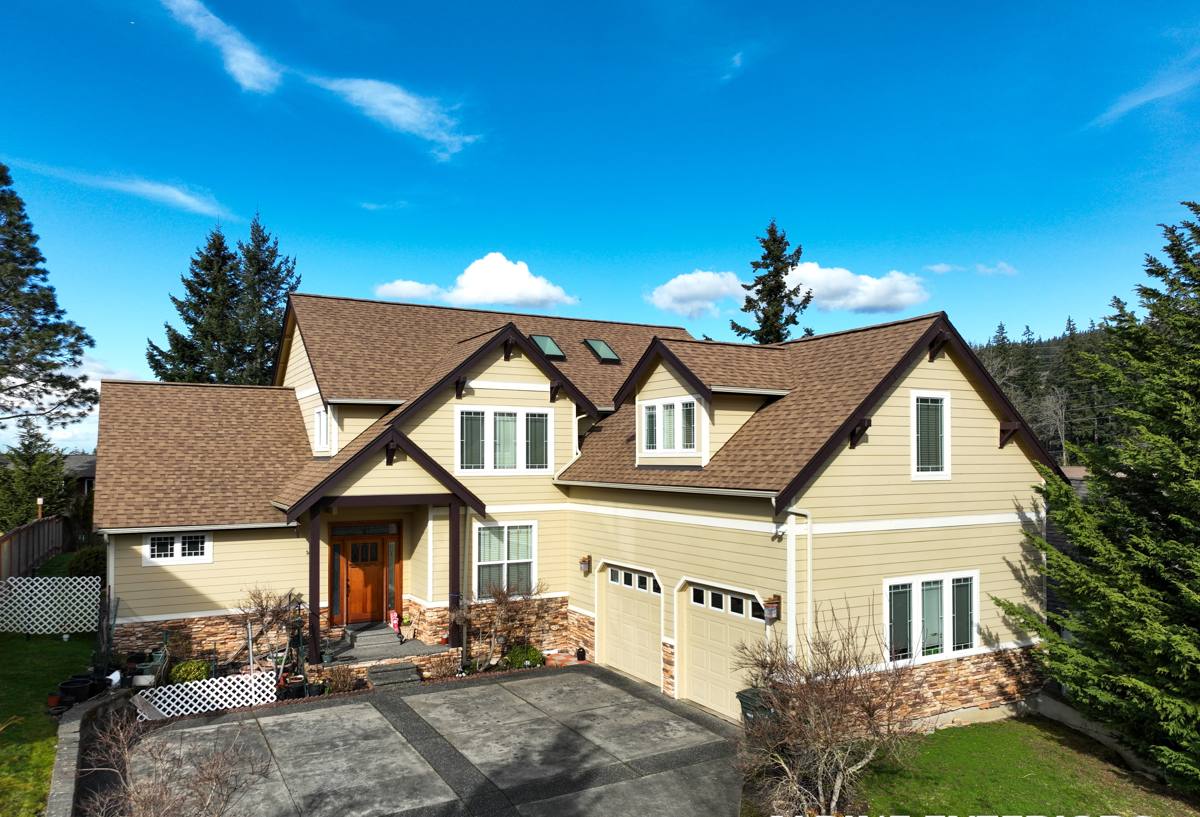
What a Correct Siding Replacement Actually Involves
Replacing siding isn't just swapping old boards for new ones. Done right, in an environment like Marietta's, it's a system:
- Full tear-off, not overlay. We remove the old siding down to the sheathing so we can actually see what's underneath — rot, soft spots, old damage hidden by the last layer.
- Sheathing repair. Any water-damaged sheathing or framing gets replaced before anything new goes up. Covering damage doesn't fix it.
- A correctly lapped weather-resistive barrier. This is the layer that actually keeps bulk water out of the wall assembly — it has to be installed shingle-style, top over bottom, with no reverse laps that funnel water inward.
- Proper flashing at every penetration. Windows, doors, hose bibs, light fixtures, deck ledgers — anywhere something breaks the plane of the wall is a spot water will find if flashing is missing or done wrong.
- A drainage plane or rainscreen where it's warranted. Giving water a path to drain and air a path to dry matters more here than in a drier climate, because the wall assembly gets tested by wind-driven rain more often.
- Correct fastening and clearances. Nailing patterns, gaps at trim, and ground clearance all affect how the assembly handles moisture over the long run.
Skip any one of these steps and the new siding can look great for a year or two while the underlying problem keeps developing behind it.
Why We Install Only James Hardie Fiber Cement
We don't install vinyl, LP SmartSide, primed spruce, cedar, or other fiber cement brands. That's a deliberate standard, not a lack of options. In a salt-air, high-moisture environment like Marietta's, the trade-offs of those alternatives show up faster and cost homeowners more over time:
Vinyl expands and contracts with temperature swings and can warp or crack in sustained wind exposure; its color is baked into thin plastic that fades and chalks, and it doesn't hold paint well if you ever want to change the look. Wood-based products — including engineered wood — depend on an intact factory coating and diligent caulking to keep moisture out; once that seal is compromised, wood substrates swell and deteriorate, and the constant damp of a Whatcom County winter doesn't give them much recovery time. Other fiber cement brands may look similar to James Hardie on a spec sheet, but we've standardized on Hardie because of the consistency of its manufacturing, the depth of its factory finish system, and the way its product lines are specifically engineered for different climate exposures.
James Hardie is non-combustible fiber cement — it doesn't feed a fire the way vinyl or wood-based siding can. It's manufactured with ColorPlus Technology, a factory-applied finish baked on in a controlled environment rather than field-painted, which holds color and resists fading, chipping, and cracking far better than site-applied paint. Hardie also engineers specific product lines (their HZ5 and HZ10 designations) for different climate zones — including the kind of wet, marine-influenced exposure that Birch Bay and Marietta homes see — so the product itself is built for the moisture load rather than just tolerating it. Hardie's warranty is also transferable to a new owner, which matters if you plan to sell.
What Hardie Doesn't Solve By Itself
To be fair to the product: Hardie fiber cement is only as good as its installation. It still needs correct flashing, gapping, fastening, and caulking at trim joints. A poorly installed Hardie job can still let water into a wall. The material gives you a much better starting point and a longer-lasting finish, but the installation is what actually determines whether that potential gets realized on your house.
Signs a Marietta Home Needs Siding Replacement
- Visible moss or algae staining that keeps coming back within a season or two of cleaning
- Soft or spongy spots when you press on the siding, especially near the bottom courses or below windows
- Paint that's peeling, bubbling, or failing faster than the rest of the house's trim
- Warping, buckling, or gaps opening up at seams and corners
- Visible rust streaking from fasteners — a common sign in salt-air exposure
- Rising energy bills that suggest the wall assembly isn't performing the way it should
- Siding that's original to a home built more than 20-25 years ago and hasn't been reviewed by a contractor
Our Process for a Marietta Project
Assessment
We walk the exterior and look specifically at the sides that take the worst of the wind-driven rain, along with anywhere trim, windows, or decks penetrate the wall. We're checking for hidden moisture damage, not just surface appearance.
Scope and Proposal
You get a clear, written scope: what's being torn off, what sheathing repair is anticipated versus what might be found once we open the walls, which Hardie products and colors are being used, and a realistic timeline.
Tear-Off and Repair
Old siding comes off, damaged sheathing gets replaced, and the wall assembly is inspected before anything new goes on.
Weather Barrier and Flashing
This is the step that determines how the house performs in a storm five years from now, even though it's completely invisible once the job is done. We take it seriously.
Hardie Installation
Installed to manufacturer spec — correct nailing, gapping, and caulking at trim, with attention to the details that matter most in a marine climate.
Final Walkthrough
We review the finished work with you before calling the job done.
Cost Factors for Siding Replacement
Every home is different, but these are the variables that move the number most on a Marietta-area project:
| Factor | Why It Matters |
|---|---|
| Extent of sheathing/framing damage found at tear-off | Hidden moisture damage from years of exposure is common near the water and adds repair scope |
| Home size and wall complexity | More corners, gables, and trim details mean more labor and material |
| Siding profile and accessories chosen | Lap width, trim style, and accent details all affect material cost |
| Number of window and door penetrations | Each one needs correct flashing, which adds time regardless of house size |
| Access and site conditions | Lot slope, landscaping, and staging space affect labor time |
| Color selection | Standard ColorPlus colors versus premium or custom options |
Why Local Experience Matters Here
A crew that already works Marietta and the broader Birch Bay area knows what to expect before they pull the first piece of old siding off. They know which wall orientations tend to hide moisture damage in this climate, they've dealt with the permitting process in Whatcom County, and they're not learning on your house how driving rain off the water behaves differently than rain in a sheltered inland neighborhood. That experience shows up in fewer surprises mid-project and a finished install that's actually built for the conditions it has to survive, not just for a generic spec sheet.
It also matters for scheduling. Whatcom County's wet season is long, and a contractor who works this area regularly knows how to sequence tear-off and weather barrier installation to minimize the number of days a wall is open to the weather — something that matters a lot more here than in a drier climate.
Living With Hardie Siding After Installation
Correctly installed Hardie siding is low-maintenance, not no-maintenance. In a salt-air, high-moss environment, a periodic gentle rinse to keep moss and salt residue from building up goes a long way, along with an annual walk-around to catch any caulking that needs attention at trim joints. ColorPlus finish holds up far longer than field-applied paint, but keeping gutters clear and vegetation trimmed back from walls still matters for any siding material in this climate.
If your Marietta home's siding is showing its age or you're planning ahead of a problem rather than reacting to one, we're glad to take a look and give you a straightforward, no-pressure estimate — no obligation, just an honest read on where things stand.