 Birch Bay Siding
 Siding for Marietta: A Waterfront Whatcom County Exposure
Marietta sits in the same coastal stretch of Whatcom County we work as part of our Birch Bay service area, and that shoreline location shapes what a house here actually needs from its siding. Homes in this part of the county take on more salt-laden marine air than properties set back from the water, sit under long stretches of wind-driven fall and winter rain, and deal with a moss and mildew season that can run most of the year on shaded or north-facing walls. None of that is unusual for this coastline — it's just the baseline condition every exterior material has to be judged against.
We install James Hardie fiber cement siding exclusively, and this page is specifically about what that looks like for a Marietta property: what the climate actually does to a wall assembly here, what a correct Hardie installation involves, and why we send a crew that already works this stretch of coastline rather than treating it like any other job on the schedule.
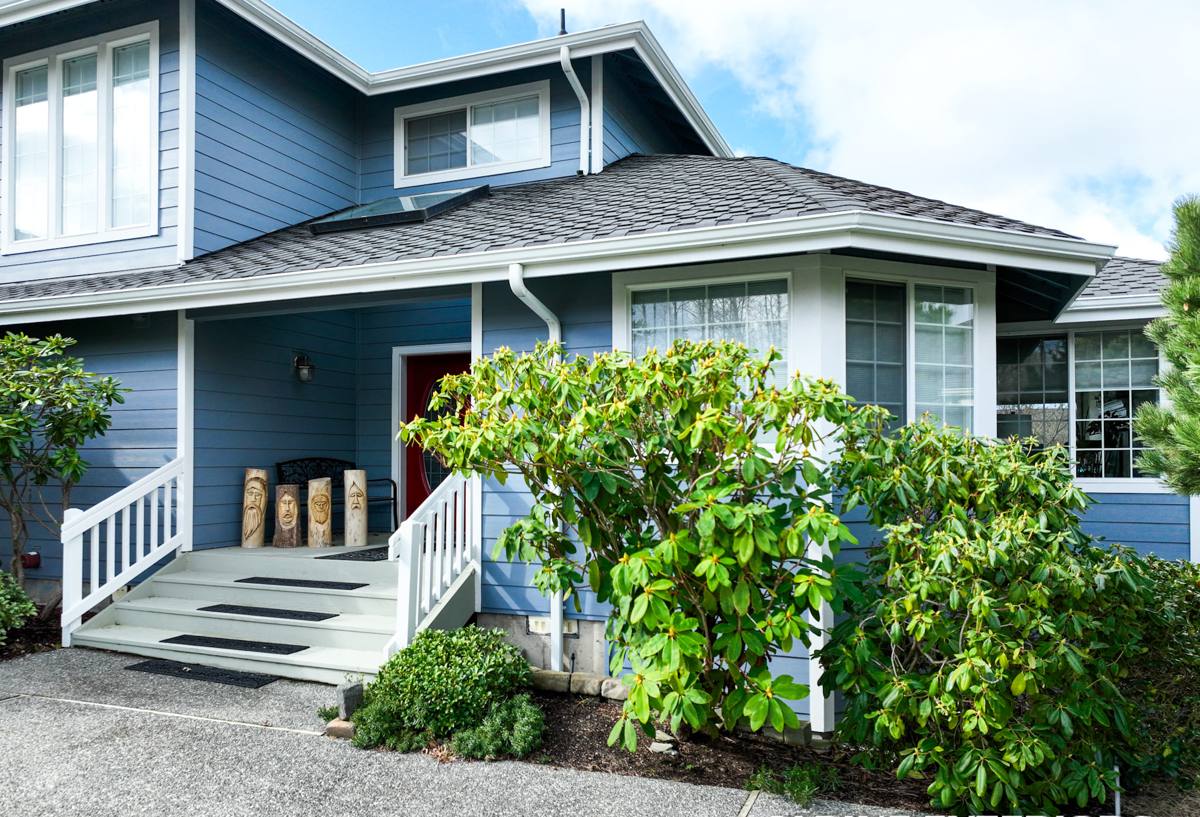
What Salt Air, Driving Rain, and Moss Do to a Marietta Home
Salt Air and Corrosion
Proximity to the water means salt is a routine part of the exposure on most Marietta properties, not just the ones with a direct water view. Salt accelerates corrosion on fasteners, flashing, and trim hardware, and it breaks down lower-grade finishes faster than a drier, more inland market would. That's a material and hardware decision, not just a siding color decision — every component on the wall needs to be chosen with that corrosion risk in mind.
Wind-Driven Rain
Waterfront exposure also means wind, and wind carries rain sideways into wall assemblies, window flashing, and roof-to-wall transitions instead of letting it run straight down and off. That's a heavier real-world moisture load than a simple annual rainfall total suggests, and it's exactly the condition that exposes a marginal installation — a board with the wrong clearance, a joint that depends on caulk instead of proper flashing — years before it would show up in a calmer, more sheltered location.
A Long Moss Season
Mild temperatures and near-constant moisture add up to a moss and mildew season that runs across most of the calendar here. Shaded walls, tree-lined lots, and north-facing elevations are usually first to show it. Any siding material that's even slightly porous, or that traps moisture against the substrate behind it, becomes an organic growth surface over time — and that trapped moisture is where a lot of long-term siding failures actually start, well before the growth itself is the real problem.
Why James Hardie Is the Only Siding We Put on Marietta Homes
We used to install a broader range of siding products. Years of service calls and tear-offs in this specific salt-and-moisture climate changed that. James Hardie fiber cement is an inorganic material — Portland cement, sand, and cellulose fiber — that doesn't rot, swell, or feed insects, and it's non-combustible. For a shoreline property like a Marietta home, a few specific things about it matter more than they would in a milder climate:
- Dimensional stability: Fiber cement doesn't swell, cup, or warp the way engineered wood products can when they take on repeated moisture cycles through a wet season.
- Factory-applied ColorPlus finish: The color is baked on under controlled factory conditions in multiple coats, which holds up against fading and chalking far better than a field-applied paint job exposed to salt air and UV.
- Climate-engineered HZ5 formulation: Hardie engineers its siding by climate zone, and the HZ5 line is built for regions with sustained moisture exposure and freeze-thaw cycling — which describes waterfront Whatcom County winters well.
- Strong transferable warranty: Hardie backs the product with a non-prorated substrate warranty and a separate ColorPlus finish warranty, both of which are conditioned on installation following the manufacturer's spec.
We won't install LP SmartSide, vinyl siding, Cemplank, Allura, primed spruce, or cedar. Each has a legitimate place in the market, and homeowners elsewhere are satisfied with them. Our call is a professional one specific to this exposure: we'd rather stand fully behind one system than offer a cheaper option that shifts more long-term maintenance risk onto a Marietta homeowner who already has enough weather working against the exterior.
What a Correct Installation Actually Involves
Fiber cement's real-world performance depends heavily on installation quality — the material doesn't do all the work by itself. On a Marietta job, the following details are non-negotiable, not optional upgrades.
Clearances and Drainage
Hardie's published spec sets minimum clearances from grade, roof lines, and decks, and those clearances exist specifically to keep splash-back and standing water off the board edge. In a climate with this much sustained rain, a board butted too tight to a deck ledger or a roofline is a moisture trap that wicks water into the cut edge over years, not weeks.
Fastening and Flashing
Fasteners have to be the correct type, driven to the correct depth, at the correct spacing — overdriven or misplaced nails affect how the siding handles wind load, which matters directly on an exposed shoreline lot. Flashing at windows, doors, and every roof-to-wall transition has to lap correctly so wind-driven rain sheds outward instead of finding a seam to sit behind.
Cut Edges and Touch-Up
Every field cut on ColorPlus-finished board has to be sealed or touched up with Hardie's approved product, not whatever's in the truck. Skipping this step leaves an unprotected edge exposed to exactly the moisture and salt load this location delivers year-round.
Comparing Common Siding Materials for This Climate
| Material | Moisture Behavior | Maintenance in Salt Air | Typical Longevity Here |
|---|---|---|---|
| James Hardie fiber cement | Dimensionally stable, resists swelling and warping | Low; factory finish resists fading and chalking | 30+ years with correct installation |
| Vinyl siding | Can distort or warp with heat and wind loading over time | Low upfront cost, but seams and fasteners are exposure points | Variable; shorter on exposed waterfront lots |
| LP SmartSide / engineered wood | Wood-fiber core is moisture-sensitive at cut edges and fastener holes | Moderate; edge sealing and caulk upkeep matter | Depends heavily on installation and ongoing maintenance |
| Cedar / primed wood | Absorbs and releases moisture readily | High; regular refinishing needed in wet, salty air | Shorter without a consistent paint or stain schedule |
Our Process for a Marietta Property
We start with an on-site walk of the existing exterior, looking specifically at how the current siding has handled moisture and salt exposure over time — where it's failed first tells us a lot about how the replacement should be detailed. From there we put together a clear, written scope covering product line, clearances, flashing plan, and price before any work starts. During the job, drainage and flashing details get installed and photographed before they're covered by siding, so there's a record of what's behind the boards rather than just a finished wall to take on faith. At close-out, you get the manufacturer's warranty documentation and our own workmanship warranty in writing.
We don't treat estimate visits as a sales pitch. If a repair or partial re-side makes more sense than a full tear-off for a given house, we'll say so.
Why a Crew That Already Works This Coastline Matters
A contractor who's worked this stretch of the Whatcom County coast repeatedly already knows how salt exposure, wind-driven rain, and a long moss season behave differently here than they do a few miles inland — and that knowledge shows up in specifics, not generalities: which fastener grade to use, how much extra flashing detail a north-facing wall needs, where drainage planes matter more than the spec sheet's minimum. A crew learning that on your house, on the fly, is a more expensive way to find out than hiring one that already knows it.
Before You Hire Anyone for Siding Work in Marietta
- Ask what siding material they install and why — and get a straight answer, not a brochure line
- Confirm current Washington contractor licensing and active liability insurance
- Ask specifically how they detail flashing at windows, doors, and roof-to-wall transitions for wind-driven rain
- Ask which Hardie climate-zone product line they'd recommend for this location and why
- Get the manufacturer warranty terms and the contractor's workmanship warranty in writing before signing anything
If you're weighing a re-side or a repair on a Marietta home, we're glad to walk the property with you and give an honest read on what it actually needs. Reach out using the form below for a free, no-pressure estimate.