 Birch Bay Siding
 Why Lynden Decks Wear Out Faster Than Homeowners Expect
Lynden sits inland from the water, so it doesn't take the direct salt spray that decks closer to the Birch Bay shoreline deal with. But don't mistake "inland" for "dry." Whatcom County's marine air still carries enough moisture and salt-laden humidity to work its way into wood fiber and metal fasteners across the whole region, and Lynden's own weather pattern adds problems of its own: long stretches of driving rain in fall and winter, heavy morning dew off the surrounding farmland, and a moss season that can run from October well into April. The combination of standing moisture and shaded, slow-drying surfaces is what actually breaks a deck down — not one dramatic storm, but months of a board that never fully dries between rain events.
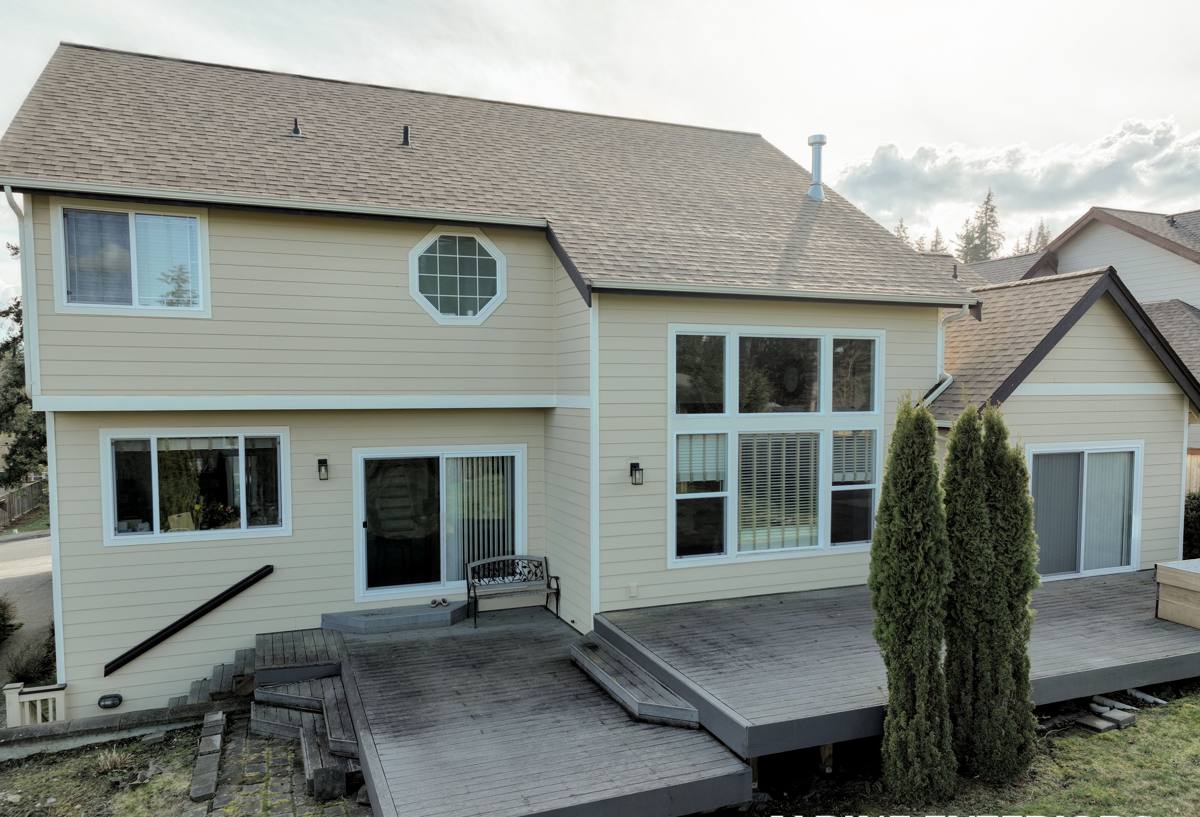
We repair decks all over this area, and the pattern is consistent. Decks that get full sun and airflow hold up for decades with basic upkeep. Decks tucked under trees, against the house on the north side, or shaded by a second story develop moss, soft spots, and fastener corrosion years ahead of schedule. Repair work here isn't just about replacing a bad board — it's about understanding why that board went bad in the first place and fixing the underlying moisture problem so it doesn't happen again in two years.
The Deck Problems We See Most Often in Lynden
Moss and Algae on Walking Surfaces
Moss isn't just cosmetic. Once it establishes on decking, it holds water against the wood around the clock and turns the surface slick and dangerous, especially on stairs. By the time moss is visible, the wood underneath has usually already started to soften.
Ledger Board and Rim Joist Rot
The ledger board — where the deck attaches to the house — is the single most important structural connection on the whole deck, and it's also the most common failure point we find. Older decks, and a lot of decks built without proper flashing, let water run behind the ledger and rot it from the inside where you can't see it until the deck starts to feel spongy or pull away from the house.
Post Base and Footing Deterioration
Posts that sit directly on or too close to grade wick up ground moisture. Combined with our wet winters, that leads to rot at the base of the post long before the rest of the structure shows any wear.
Corroded or Failing Fasteners
Older nails and non-coated screws corrode over time in our climate, which weakens their grip and can stain the surrounding wood. Corroded joist hangers are a structural concern, not just an appearance issue.
Cupped, Splintering, or Delaminating Boards
Repeated wet-dry cycles cause wood decking to cup and splinter, and can cause some composite boards to delaminate at the edges if they weren't installed with proper gapping and drainage in mind.
What an Honest Deck Repair Actually Involves
A quality repair starts underneath the deck, not on top of it. Anyone can screw down a few new boards and call it done — the harder, more important work is checking what's holding the deck up.
- Structural inspection — checking the ledger connection, joists, beams, posts, and footings for rot, movement, or inadequate original construction.
- Moisture source diagnosis — identifying where water is actually getting in, whether that's missing flashing, poor drainage, grade sloped toward the house, or gaps that trap debris.
- Fastener and hardware check — inspecting joist hangers, structural screws, and connectors for corrosion or code-deficient original hardware.
- Surface assessment — evaluating decking boards, railings, and stairs for rot, splintering, or moss damage.
- Code review — confirming railing height, baluster spacing, and stair geometry meet current requirements, since older decks are often grandfathered but not necessarily safe.
Skipping the structural check is how homeowners end up paying for the same repair twice — once for new boards, and again a couple of years later when the rot that was never addressed underneath finally causes a real problem.
Repair or Replace? How We Help You Decide
Not every deck needs a full rebuild, and not every problem can be fixed with a patch. The right call usually comes down to how much of the structure is still sound versus how much has been compromised.
| Factor | Points Toward Repair | Points Toward Replacement |
|---|---|---|
| Ledger board condition | Solid, properly flashed | Rotted or never flashed correctly |
| Framing (joists, beams, posts) | Sound, isolated soft spots | Widespread rot or undersized for current code |
| Decking surface | Localized moss or a few bad boards | Majority of boards cupped, splintering, or soft |
| Age of structure | Under 15 years, built to code | Older, unpermitted, or built before current safety standards |
| Railings and stairs | Meet current spacing and height code | Undersized rail height or wide baluster gaps |
Many Lynden decks we look at fall in between — a sound frame with a handful of problem boards and a ledger flashing issue that needs correcting. In those cases, a targeted repair extends the life of the deck for a fraction of replacement cost. We'll tell you plainly when a repair is the right call and when it isn't; patching a deck with a failing structure underneath isn't a service worth paying for.
Our Repair Process
We keep the process straightforward because homeowners deserve to know exactly what's happening to their deck and why.
- On-site assessment — we walk the deck, check underneath it, and probe suspect areas for soft wood.
- Written scope and estimate — you get a clear breakdown of what's being repaired and why, not just a lump-sum number.
- Demolition of damaged material — removing only what needs to go, exposing hidden framing issues before we close anything back up.
- Structural correction — sistering or replacing joists, correcting flashing, upgrading hardware to current code where needed.
- Surface and rail work — new decking, stair, or railing components installed and fastened to hold up under our rain and moisture load.
- Final walkthrough — we go over the completed work with you before we consider the job done.
Materials and Hardware We Use, and Why
Material choice matters more here than in drier climates because everything on a deck is exposed to months of damp weather every year.
Flashing and Waterproofing
Ledger flashing is non-negotiable on any deck attached to the house. We use flashing tape and metal flashing sized to actually shed water away from the house band joist, not just cover the gap.
Fasteners and Connectors
We use corrosion-resistant coated screws and structural connectors rated for exterior use. Mixing incompatible metals — like standard hardware with certain treated lumber — accelerates corrosion, so hardware selection is matched to the lumber and decking being used.
Decking Material Trade-offs
Wood decking costs less upfront and can be repaired board-by-board, but it needs regular cleaning and refinishing to resist moss and moisture in this climate. Composite decking resists rot and moss buildup better and needs less maintenance, but it costs more initially, and quality of installation — proper gapping, ventilation underneath, and manufacturer-approved fastening — matters even more than with wood, since a poorly installed composite deck can trap moisture just as badly as a neglected wood one. We'll walk through the honest trade-offs for your specific deck rather than pushing one material as a default.
Maintenance That Actually Protects Your Repair
A repair is only as good as the upkeep that follows it. These habits go a long way toward keeping moss and rot from coming back:
- Sweep leaves and debris off the deck and out of gaps between boards regularly, especially in fall
- Rinse or scrub visible moss and algae before it spreads, particularly on shaded sections and stairs
- Keep gutters and downspouts near the deck clear so runoff isn't draining directly onto or under it
- Check the ledger board area and any flashing once a year for signs of water staining or gaps
- Reseal or refinish wood decking on the manufacturer's recommended schedule, not just when it looks worn
- Trim back overhanging branches and vegetation to improve airflow and sun exposure on shaded sections
- Address soft or spongy boards immediately rather than waiting for a full season
Why It Matters That We Already Work in Lynden
A deck repair crew that only shows up occasionally in this area is guessing at things a local crew already knows — where moss problems show up first based on tree cover and sun exposure, how Whatcom County's permitting and inspection process works for structural deck repairs, and which construction shortcuts on older decks in this area tend to cause the ledger and post-base failures we see most. Timing matters too: scheduling repairs before the heaviest fall rain sets in, or catching moss buildup early in the season, makes a real difference in how long a repair lasts.
We also don't disappear after the invoice is paid. If a repair we did doesn't hold up the way it should, you can reach the same crew that did the work — not a call center or a subcontractor we've never met.
Get a Straight Answer About Your Deck
If your deck has soft spots, visible moss, a ledger that looks questionable, or boards that just aren't holding up the way they used to, it's worth having someone look underneath it before the next wet season sets in. We offer free, no-pressure estimates for Lynden homeowners — we'll tell you honestly whether you're looking at a targeted repair or something bigger, and what it will take to fix it right. Use the form below to request your estimate.