 Birch Bay Siding
 Why Storm Damage Hits Lummi Island Roofs Differently
Lummi Island sits out in open water, which means roofs there take weather that mainland Birch Bay and inland Whatcom County homes are partly shielded from. Wind off the Salish Sea doesn't just blow — it drives rain sideways under shingle edges, into flashing laps, and behind trim that would stay dry in a more sheltered location. Add the salt content in that air, which slowly attacks exposed fasteners, metal flashing, and drip edge, and you get a roof that ages on a different timeline than one a few miles inland.
Then there's the moss. Whatcom County's damp, mild winters and long shoulder seasons give moss months to establish itself on north-facing slopes and shaded valleys. Moss doesn't just look bad — it holds water against the shingle surface, works its way under tabs, and lifts material just enough for wind-driven rain to find a way in during the next storm. On an island property, where a small leak can go unnoticed longer between visits, that matters even more.
None of this means Lummi Island homes need exotic solutions. It means storm damage repair here has to account for wind exposure, salt exposure, and moisture retention as a package — not just patch the spot that's visibly damaged and move on.
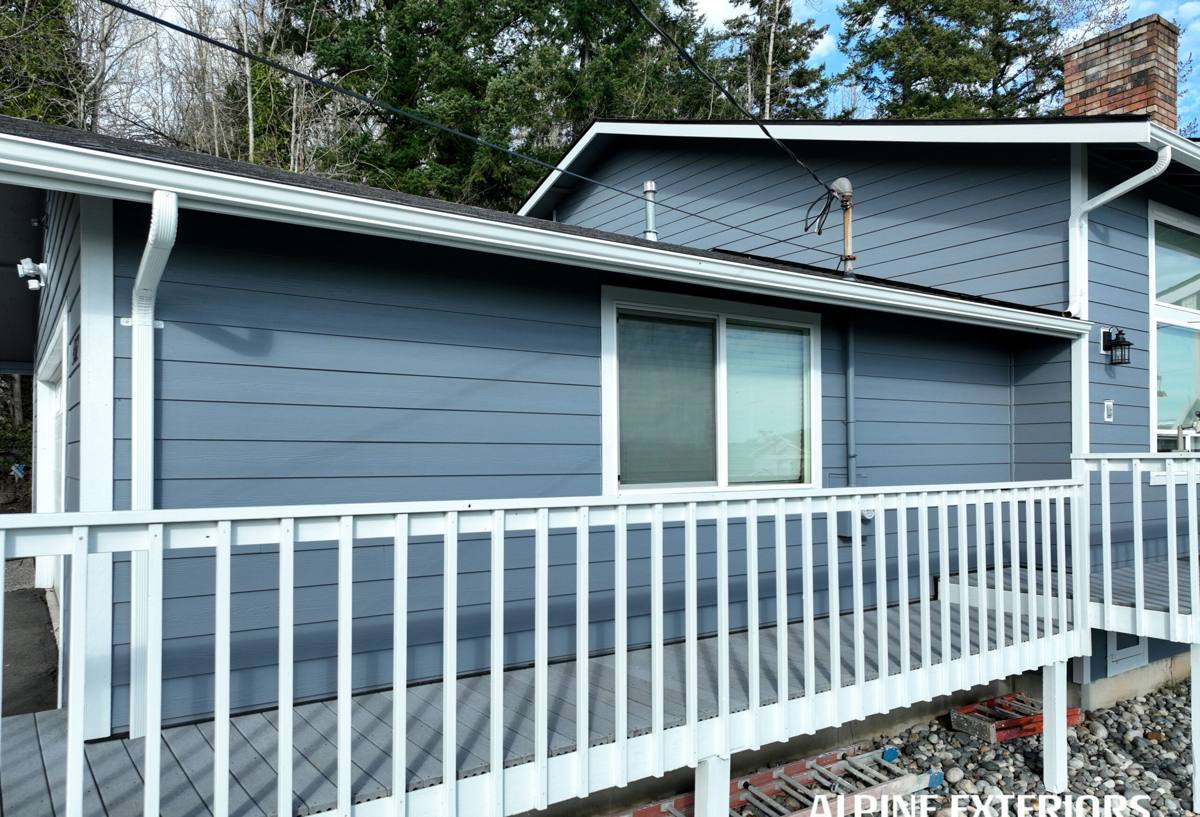
Recognizing Storm Damage Before It Becomes a Bigger Problem
Storm damage isn't always obvious from the ground. Some of the most costly problems start small and get worse quietly over a wet winter. After any significant wind event, it's worth checking for the following:
- Shingles that are missing, curled at the edges, or visibly lifted
- Granules collecting in gutters or at downspout outlets (a sign of shingle wear or impact damage)
- Exposed or backed-out nail heads along shingle courses
- Cracked, bent, or separated flashing around chimneys, vents, skylights, or where the roof meets a wall
- Soft or spongy spots when walking the attic or noticing sagging from below
- Water stains, discoloration, or a musty smell in the attic or on ceilings
- Gutters pulling away from the fascia or holding standing debris after rain
Any one of these on its own might be minor. Several together, especially after a named storm or a stretch of high wind, usually means it's time for a real inspection rather than a wait-and-see approach.
What Happens If You Wait
A lifted shingle that lets in a trickle of water in November can be a soaked deck and stained drywall by February. Moisture that gets under roofing material in a salt-air environment also accelerates corrosion of the fasteners holding everything down, which turns a repair into a larger tear-off sooner than it would inland.
What a Proper Storm Damage Repair Actually Involves
A correct repair starts with figuring out how the water actually got in — not just replacing whatever looks torn. Wind-driven rain often enters at transitions: where a roof plane meets a wall, around a chimney, at a valley, or under a ridge cap. Those spots need to be opened up and inspected, not just resealed on the surface.
A repair job we'd stand behind includes:
- A full inspection of the affected area and the roof generally, including the attic side where accessible
- Assessment of the decking underneath — replacing any wood that's delaminated, soft, or stained, not just the shingles above it
- Matching shingle type, color, and exposure as closely as possible so the repair doesn't stand out or create a mismatched wear pattern later
- Proper step flashing and kick-out flashing at wall intersections, which is the detail most often done wrong or skipped entirely on quick patch jobs
- Fasteners and sealants suited to a salt-air environment, since standard hardware corrodes faster this close to the water
- A check of surrounding gutters, vents, and penetrations, since storm damage rarely stays confined to one shingle
The goal is a repair that holds through the next storm season, not one that needs revisiting after the first hard blow off the water.
Materials That Hold Up to Salt Air and Wind
Material choice matters more on an exposed island roof than it does in a sheltered subdivision. Here's how the common options compare for this specific environment:
| Material | Wind resistance | Moss/moisture resistance | Salt-air durability | Typical lifespan |
|---|---|---|---|---|
| Standard 3-tab asphalt shingles | Fair | Fair | Fair — fasteners corrode faster | 15–20 years |
| Architectural (laminate) asphalt shingles | Good to very good, depending on wind rating | Good | Good with corrosion-resistant fasteners | 25–30 years |
| Standing seam metal roofing | Very good | Very good — sheds moisture, doesn't hold moss the way shingles can | Good, provided the coating and fastener system are marine-rated | 40–50+ years |
| Synthetic underlayment upgrade (under any surface material) | Improves overall system performance | Very good secondary barrier | N/A — protective layer, not a finish material | Lasts life of roof system |
We don't push one product as the only right answer. Architectural shingles with a high wind rating are a solid, cost-effective choice for most storm-damage repairs. Metal roofing is a strong option for homeowners planning to stay long-term or dealing with a north-facing, moss-prone slope. The honest trade-off with metal is a higher upfront cost and the need for a crew experienced with its specific installation details — done wrong, metal roofing fails in different but equally frustrating ways.
Navigating the Insurance Claim Process
Most storm damage repairs on Lummi Island involve an insurance claim, and getting that process right saves homeowners time and money. A few things worth knowing:
- Document damage with photos as soon as it's safe to do so, before any tarping or temporary repair covers it up
- Insurance typically distinguishes between sudden wind/storm damage and gradual wear — a clear inspection report helps establish which applies
- A written, itemized estimate that separates emergency tarping, decking repair, and finish material replacement gives the adjuster something concrete to work from
- Know your deductible before assuming a repair will be fully covered — smaller storm damage sometimes falls under it
We're glad to provide a detailed inspection report and estimate that homeowners can bring directly to their adjuster. We don't handle the claim itself, but a clear, honest documentation of what's damaged and what it takes to fix it correctly makes that conversation go a lot smoother.
What Drives the Cost of Storm Damage Roof Repair
Every storm damage job is different, but the same handful of factors determine cost:
| Factor | Why it matters |
|---|---|
| Extent of damage | A few missing shingles is a very different job than a section with compromised decking |
| Decking condition | Rotted or delaminated sheathing has to be replaced before new roofing goes on — this is discovered during, not before, tear-off |
| Material match | Matching an existing architectural shingle costs more in sourcing time than a straightforward full-slope replacement |
| Roof pitch and access | Steeper roofs and tight access points take longer and require more safety setup |
| Ferry-dependent logistics | Material and crew transport to the island has to be scheduled and staged in advance, which affects timing more than base cost |
| Insurance deductible | Determines how much of the job is out-of-pocket versus covered |
Broad ranges vary widely depending on these factors — a straightforward shingle repair after a wind event is a very different number than a job requiring deck replacement and full flashing rework. We give a specific number after seeing the actual damage, not before.
Our Process, Built Around Island Logistics
Repairing a roof on Lummi Island isn't the same as pulling a truck up to a driveway in Birch Bay. Getting crew and materials to the island requires planning around ferry access, and that shapes how we run the job:
- Initial assessment — often from photos or a phone conversation first, to understand urgency and whether emergency tarping is needed
- Emergency response when needed — active leaks get prioritized and scheduled as soon as ferry logistics allow
- On-site inspection — a full look at the roof, decking, and flashing, with a written estimate
- Material staging — we order and stage materials ahead of the crossing so the crew isn't making multiple trips for missing parts
- Efficient on-site work — because a day on the island is a day on the island, we plan the job to get it done right in as few trips as possible
- Cleanup and walkthrough — nails, debris, and old material hauled off, with a final check alongside the homeowner
This isn't a shortcut on quality — it's just planning around the reality of working on an island property, which a crew unfamiliar with Lummi Island often doesn't account for until they're already behind schedule.
Why a Crew That Already Works Lummi Island Matters
A contractor who hasn't worked the island before will usually underestimate two things: how much wind exposure affects material performance there, and how much ferry scheduling affects the timeline. Both lead to surprises — either a repair that doesn't hold up, or a job that drags out over more trips than it should.
A crew that already works Lummi Island brings a few real advantages:
- Familiarity with which sides of a roof take the worst wind-driven rain on an exposed island lot
- Established habits around staging materials and grouping trips to minimize crossings and delays
- Experience with Whatcom County permitting requirements that apply to island properties
- A track record of repairs that have actually held up through subsequent storm seasons, not just looked fine on install day
That familiarity isn't a marketing point — it's the difference between a repair that gets done efficiently and one that turns into a frustrating back-and-forth over ferry schedules and missing materials.
Protecting Your Roof Between Storms
Storm damage repair fixes what's already broken. A little maintenance in between storms reduces how often you need it:
- Clear moss during its active growing season rather than letting it build up over multiple winters
- Keep gutters and downspouts clear so wind-driven rain has somewhere to go instead of backing up under the roof edge
- Have flashing and sealant checked periodically, especially around chimneys and wall transitions, since these fail quietly
- Schedule a visual inspection after any major wind event, even if nothing looks obviously wrong from the ground
None of this eliminates storm risk on an exposed island roof, but it does mean fewer surprises and smaller repairs when weather does cause damage.
If a recent storm has left you with missing shingles, a leak, or just questions about what shape your roof is really in, we're happy to take a look. We offer free, no-pressure estimates for Lummi Island homeowners — just fill out the form below and we'll get in touch to schedule a visit.