 Birch Bay Siding
 The Climate Lummi Island and Birch Bay Roofs Actually Deal With
A roof on Lummi Island or in Birch Bay isn't fighting the same conditions as a roof twenty miles inland. Being this close to Puget Sound and the Strait of Georgia means salt-laden air moves across these homes constantly, and salt is corrosive to anything metal that isn't specified correctly — fasteners, flashing, panel edges, all of it. Add Whatcom County's long wet season, where driving rain comes in sideways off the water more often than it falls straight down, and you get roofs that see more wind-driven moisture at eaves, valleys, and wall-to-roof transitions than most manufacturers' installation manuals assume.
Then there's moss. Western Whatcom County's mild, damp winters and shaded, tree-covered lots give moss and algae a long growing season — often eight or nine months of the year when conditions stay favorable. On a roof that isn't shedding water fast enough, or that has debris collecting in low spots, moss gets a foothold and doesn't let go. It holds moisture against roofing material, works into seams, and accelerates wear on anything underneath it.
None of this means metal roofing is a bad fit here — it's actually one of the better options for this exact environment, when it's specified and installed correctly. The problems we see almost always come from a roof that was designed for a drier, calmer climate and installed here anyway.
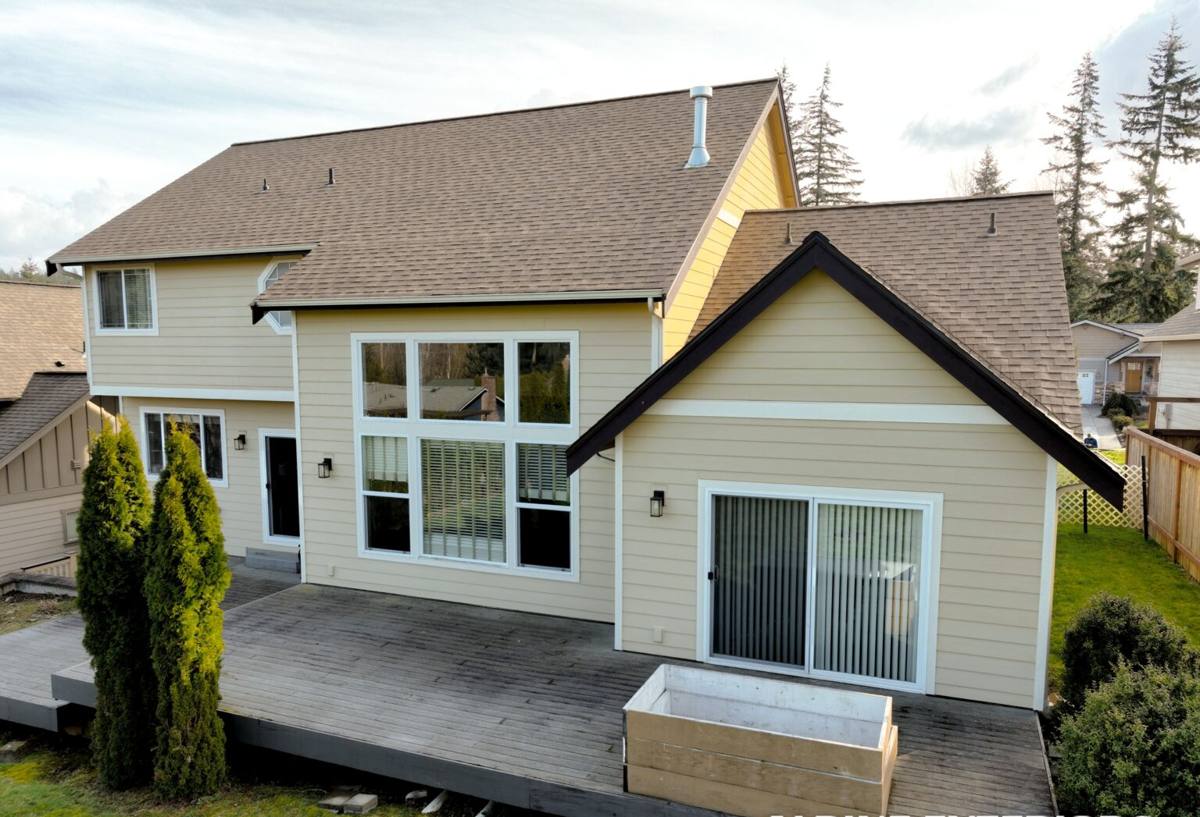
Why Metal Roofing Makes Sense for This Coastline
Metal's advantage in a marine climate comes down to a few honest factors, not marketing claims:
- Smooth, steep-shedding surface. Moss and algae have a much harder time establishing on a slick metal panel than on a textured asphalt shingle, especially on steeper pitches common to this area.
- Fewer seams and laps to fail. A properly installed standing seam roof has far fewer places for wind-driven rain to find a way in compared to a shingle roof with hundreds of exposed tab edges.
- Wind performance. Homes on Lummi Island and along the Birch Bay shoreline take real wind loading off open water. Metal panels, properly fastened, handle sustained wind and gusts better than most other roofing materials.
- Long service life — if the metal and fasteners match the exposure. This is the part that gets skipped by installers who don't work coastal jobs regularly, and it's the difference between a 40-plus-year roof and one that shows corrosion in under a decade.
That last point is the one that matters most here, and it's worth its own section.
Choosing the Right Metal and Hardware for Salt Air
Not all metal roofing is built the same, and not all of it belongs this close to salt water. The panel material, its coating, and the fasteners holding it down all need to be chosen with this specific exposure in mind — not just picked from a standard catalog.
| Option | Coastal Performance | Trade-Offs |
|---|---|---|
| Aluminum, standing seam | Naturally corrosion-resistant; doesn't rust even with coating wear | Higher material cost; softer, so panel handling and installation care matter more |
| Steel with a quality protective coating, standing seam | Very good if the coating system is rated for coastal/marine exposure | Coating integrity is everything — any breach in the finish becomes a corrosion starting point |
| Exposed-fastener steel panels | Workable for outbuildings and lower-exposure sections | Exposed fasteners and gasket seals are the first thing to fail in salt air; higher long-term maintenance |
| Uncoated or mismatched fasteners (any panel type) | Poor — this is where most coastal metal roof failures start | Galvanic corrosion between dissimilar metals, rust streaking, early leaks |
For most homes in this area, a standing seam system in either aluminum or a marine-grade coated steel is the right call, fastened with stainless or otherwise coated fasteners rated for the panel metal. Exposed-fastener panels aren't wrong for every application, but we treat them as a lower-tier option for coastal, water-facing roof planes because the exposed gaskets and fastener heads are exactly the components salt air attacks first.
Fasteners and Flashing Matter as Much as the Panel
We've been called out to look at metal roofs less than ten years old with visible rust streaking — not because the panels failed, but because the fasteners or the flashing metal didn't match the panel material, and galvanic corrosion set in where two dissimilar metals touched in the presence of moisture and salt. It's a completely avoidable problem, and it's one of the first things we check on any coastal metal roof, new or existing.
What a Correct Installation Actually Involves
A metal roof is only as good as the details underneath it. On a Lummi Island or Birch Bay home, we treat the following as non-negotiable, not upgrades:
- Ice-and-water shield membrane at eaves, valleys, and any wall-to-roof transition, not just standard underlayment across the whole deck
- Closed or properly vented ridge details that keep wind-driven rain out without trapping moisture inside the attic
- Panel fastener spacing and clip systems matched to the wind exposure of that specific roof plane — a shoreline-facing slope and a sheltered back slope aren't the same wind load
- Flashing metal that matches or is compatible with the panel metal, everywhere a roof meets a wall, chimney, skylight, or vent
- Balanced attic ventilation, since a sealed-tight metal roof without adequate airflow can trap condensation underneath the panels — a slower, quieter failure mode than a leak, but just as damaging over time
- Valleys and low-slope transitions detailed to move water fast, since these are the spots where moss and debris collect first
Skipping any one of these doesn't necessarily show up in year one. It shows up in year six or seven, as a leak that's hard to trace back to its actual cause because the visible symptom is far from where the water actually got in.
Common Mistakes We Find on Existing Coastal Metal Roofs
When we're called to inspect an older metal roof in this area — whether we installed it or not — the same handful of issues come up repeatedly:
- Mismatched metals at flashing points, causing corrosion where a panel meets a dissimilar-metal flashing or fastener
- Under-ventilated attics leading to condensation staining on the underside of the deck, mistaken for a leak
- Moss and needle debris built up in valleys, holding moisture against the panel finish far longer than open roof sections ever see
- Sealant used as a substitute for proper flashing at penetrations — sealant degrades in UV and salt air far faster than metal flashing, and it's a maintenance item, not a permanent fix
Most of these are inspection-and-maintenance issues rather than reasons to replace a roof outright. Part of an honest evaluation is telling a homeowner when a repair or a maintenance visit solves the problem, versus when the underlying installation was wrong from the start and a section needs to be redone properly.
Our Process for a Metal Roof on Lummi Island or in Birch Bay
We approach every metal roofing project here the same way, adjusted for the specific site:
- On-site assessment. We look at roof pitch, exposure direction relative to the water, existing ventilation, and the condition of the current roof deck before recommending a system.
- Material and system selection. Based on that exposure, we recommend a panel metal, coating, and fastener combination suited to that specific roof — not a one-size answer.
- Tear-off or overlay decision. We evaluate the existing deck and roofing to determine whether a clean tear-off is needed, which is almost always the right call when moisture has already reached the deck.
- Installation. Underlayment and membrane details go in first, then panels, with flashing and ventilation addressed at every transition, not just the field of the roof.
- Final inspection and cleanup. We walk the roof and the property before calling the job done, and we go over maintenance expectations specific to a metal roof in this climate.
For Lummi Island specifically, logistics factor into scheduling. The island is reached by county ferry, which means material deliveries and crew trips are planned around the ferry schedule rather than treated as an afterthought. A contractor who hasn't worked the island before often underestimates this and it shows up as delays mid-project. We build it into the plan up front.
Why a Crew That Already Works This Area Matters
Metal roofing isn't a product you install the same way everywhere and expect the same result. A crew that regularly works Birch Bay and Lummi Island knows which roof orientations take the worst of the wind-driven rain, which older homes in the area are more likely to have ventilation issues under their roof decks, and how to plan a Lummi Island job around the ferry rather than losing a day to it. That local pattern recognition is the difference between a roof that's technically installed to code and one that's actually built for the exposure it's going to face for the next several decades.
It also matters for permitting and inspection. Whatcom County's requirements are consistent, but a crew that pulls permits here regularly moves through that process without the delays a less familiar contractor runs into.
Maintenance Checklist for a Coastal Metal Roof
A correctly installed metal roof needs less maintenance than most materials, but "less" isn't "none" — especially with a long moss season working against it. We recommend homeowners keep an eye on:
- Valleys and low-slope areas clear of needles, leaves, and other organic debris that hold moisture
- Visible rust streaking at any fastener, flashing point, or panel edge — an early sign of a metal mismatch worth having looked at
- Moss growth at shaded roof sections, particularly north-facing planes under tree cover
- Gutter and downspout flow, since a blocked gutter backs water up under the roof edge
- Attic ventilation intakes and exhaust points staying clear and unobstructed
- Sealant at penetrations (vents, skylights) checked periodically, since sealant is a wear item even on an otherwise low-maintenance roof
Most of this is a once-or-twice-a-year visual check, not ongoing work — but skipping it is how small, cheap-to-fix issues turn into deck damage.
Get a Straight Answer for Your Roof
If you're weighing a metal roof for a home on Lummi Island or in Birch Bay, the right answer depends on your roof's specific exposure, pitch, and current condition — not a generic recommendation. We're happy to take a look and give you a straightforward, no-pressure estimate, including what we'd actually specify for your home and why. Use the form below to get started.