 Birch Bay Siding
 Metal Roofing for Ferndale Homes
Ferndale sits close enough to the water that salt air is part of daily life, and close enough to the foothills that rain shows up sideways more often than homeowners in drier parts of the country would ever believe. Add in a moss season that can run most of the year in shaded, north-facing sections of a roof, and you've got a climate that is genuinely hard on roofing materials. Asphalt shingles were never designed for this combination of moisture, wind-driven rain, and organic growth pressure — which is a big part of why more Ferndale homeowners are asking us about metal.
Metal roofing isn't the right fit for every home or every budget, and we'll tell you that plainly during an estimate rather than push a sale. But for a lot of Whatcom County properties, especially ones that see heavy tree cover, coastal exposure, or a roofline that's due for its second or third replacement, metal solves problems that shingles keep re-creating every 12 to 15 years.
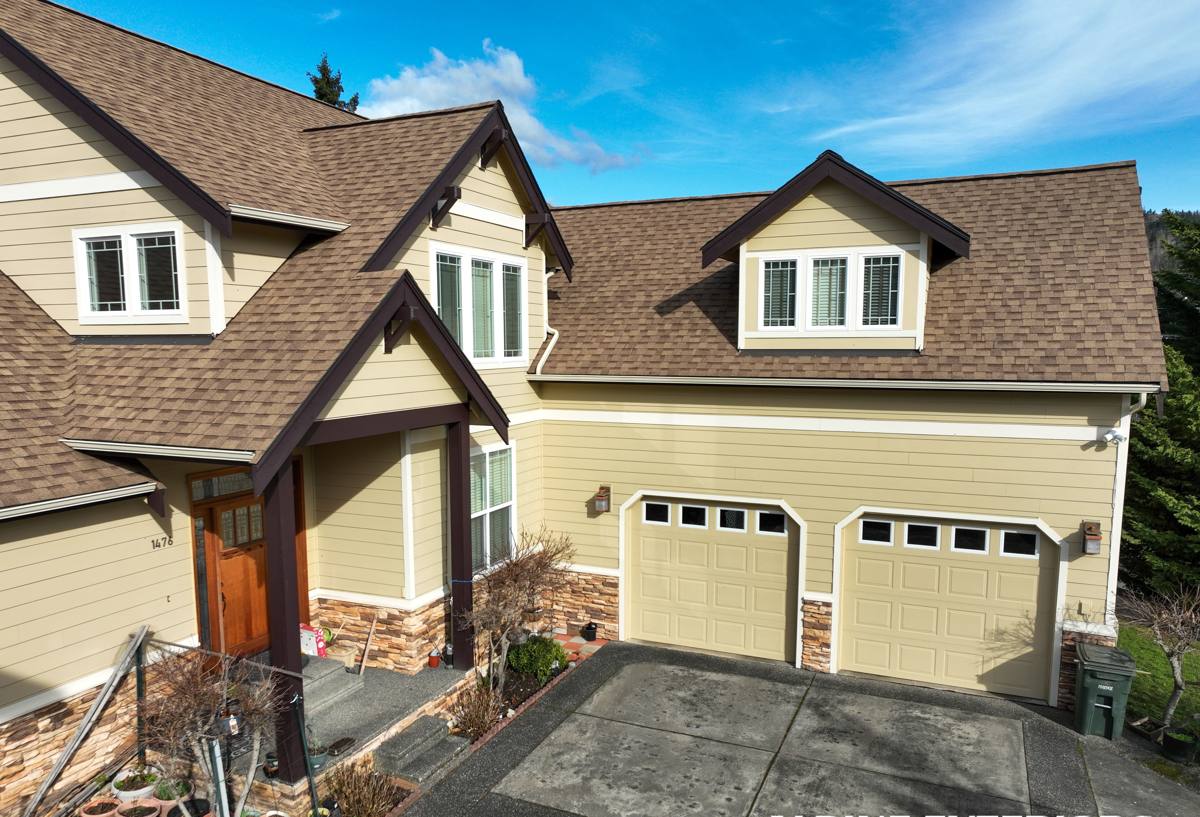
What This Climate Actually Does to a Roof
Understanding the failure pattern matters more than any brand name. Here's what we see repeatedly on Ferndale and greater Birch Bay roofs:
Salt Air
Proximity to Puget Sound and the Strait means airborne salt settles on roofing surfaces and accelerates corrosion on unprotected metal fasteners, flashing, and vent stacks. It also degrades the granule coating on asphalt shingles faster than inland installations of the same product.
Driving Rain
Wind off the water doesn't just drop rain straight down — it pushes it sideways and up under laps, seams, and flashing that were only ever designed for gravity-fed drainage. This is where poorly detailed valleys, chimney flashing, and roof-to-wall transitions fail first, regardless of what material sits on top.
Moss and Organic Growth
Shaded roof sections, especially north- and east-facing slopes under mature trees, stay damp for days after a storm. Moss roots work into shingle mat and granule layers, lifting edges and holding moisture against the deck. On a metal roof, moss has nothing to grip — it can grow on debris that collects in valleys, but it can't establish itself on the panel the way it does on a shingle surface.
Metal Roofing Systems We Install
"Metal roofing" covers a range of products with real differences in cost, appearance, and performance. We walk every Ferndale customer through the trade-offs rather than defaulting to whichever system has the best margin.
| System | Typical Use | Strengths | Trade-Offs |
|---|---|---|---|
| Standing seam (concealed fastener) | Full roof replacements, higher-end homes | No exposed screws to fail over time, clean lines, best long-term seal against driving rain | Higher upfront cost, requires experienced installers |
| Exposed fastener panel | Shops, additions, budget-conscious replacements | Lower material and labor cost, faster install | Screw gaskets age and need periodic re-torquing or replacement |
| Stone-coated steel | Homes wanting a shingle or shake look with metal performance | Mimics traditional roofing styles, durable coating | More seams and fasteners than standing seam, higher cost than exposed fastener panel |
For most primary residences in Ferndale where salt air and wind-driven rain are the main concerns, we lean toward standing seam because the concealed fastener system removes the weak point — exposed screws corroding or backing out over years of coastal exposure. For secondary structures or where budget is the deciding factor, exposed fastener panels are a legitimate, honest option as long as the homeowner understands the maintenance difference.
What a Correct Installation Actually Involves
Metal roofing performs as well as its installation, not as well as its marketing. A panel that's rated for coastal exposure will still leak if the details underneath it are wrong. The parts that matter most, and the ones that get rushed on lower-quality jobs:
- Underlayment: A synthetic, high-temperature-rated underlayment as a continuous moisture barrier, not just felt paper — metal panels can trap heat and moisture differently than shingles.
- Ice and water shield at vulnerable points: Valleys, eaves, and roof-to-wall transitions get self-adhering membrane, since these are exactly where wind-driven rain forces its way in.
- Proper fastener spacing and type: Corrosion-resistant fasteners matched to the panel material, spaced to manufacturer spec — not stretched to save a box of screws.
- Flashing detail at penetrations: Chimneys, vents, and skylights need custom-formed flashing, not generic boot covers that fight the panel profile.
- Ventilation: Ridge and soffit ventilation sized correctly so moisture doesn't condense under the panel from the inside — a mistake that shows up as hidden deck rot years later.
- Expansion allowance: Metal expands and contracts with temperature swings; fastener and clip systems need room to move without stressing the seams.
Our Process, Start to Finish
We keep the process straightforward and give Ferndale homeowners a clear picture before any work starts:
- On-site assessment: We inspect the existing roof, deck condition, ventilation, and any problem areas — moss buildup, soft spots, prior repair patches — and discuss which metal system fits the home and budget.
- Written estimate: A clear scope covering tear-off (if needed), underlayment, flashing detail, panel system, and cleanup, so there are no surprise line items later.
- Deck prep: Any damaged or soft decking gets replaced before anything else goes down — installing over a compromised deck just hides the problem.
- Underlayment and flashing: The moisture barrier and all critical flashing points go in first, since this layer does the real work if a seam ever gets stressed.
- Panel installation: Panels are installed to manufacturer spec for fastening, spacing, and expansion, with attention to how wind and rain will actually move across the roof once it's finished.
- Final walkthrough and cleanup: We walk the job with the homeowner, check gutters and downspouts are clear, and remove all debris and fasteners from the property.
Metal vs. Asphalt for a Ferndale Roof
This is the question we get most often, and the honest answer depends on how long the homeowner plans to stay in the house and how exposed the roof is.
| Factor | Metal Roofing | Asphalt Shingles |
|---|---|---|
| Typical lifespan in this climate | 40–60+ years with proper install | 15–25 years, often shorter under heavy moss/moisture exposure |
| Moss resistance | Panel surface won't host moss growth | Granule surface is vulnerable, especially on shaded slopes |
| Wind-driven rain performance | Strong when seams and flashing are done correctly | Adequate but relies heavily on underlayment and flashing quality |
| Upfront cost | Higher initial investment | Lower upfront cost |
| Maintenance | Periodic debris clearing, occasional fastener check on exposed-fastener systems | Regular moss treatment, more frequent inspection for lifted or granule-bare shingles |
Neither answer is wrong — a lot depends on whether you're planning your second re-roof of this house or your last one. We'll give you our honest read during the estimate rather than steer you toward the bigger job by default.
Maintaining a Metal Roof in This Climate
Metal roofing is lower-maintenance than shingles, not maintenance-free. In a salt-air, high-rainfall, moss-prone area like Whatcom County, a short annual routine keeps a metal roof performing for decades:
- Clear leaves, needles, and debris from valleys and gutters, especially after fall storms — debris holds moisture against the panel even though moss itself can't take root there.
- Rinse off salt residue and organic buildup in coastal-exposed areas, particularly on panels facing prevailing wind off the water.
- Check exposed-fastener systems every few years for screws that have backed out or gaskets that have hardened and cracked.
- Inspect flashing around chimneys, vents, and skylights annually — this is still the most common leak point on any roof type.
- Trim back overhanging branches that drop debris and keep sections of the roof shaded and damp longer than necessary.
Signs It Might Be Time to Consider a Metal Upgrade
If your current roof is showing any of the following, it's worth having it looked at before the next major storm season:
- Granule loss or bald patches on shingles, especially on north-facing slopes
- Moss establishing itself even after cleaning, or returning within a season
- Repeated leaks at the same flashing point despite past repairs
- A roof already past 15–20 years old with visible curling, cracking, or lifted edges
- Interior signs of moisture — stains on ceilings or attic decking near roof penetrations
Why Local Experience on This Roof Type Matters
Metal roofing rewards good installation and punishes shortcuts more visibly than shingles do — a poorly formed flashing detail or wrong fastener spacing on a metal roof tends to show up as a leak sooner, not later, once Whatcom County's wind and rain get to work on it. A crew that installs metal roofs regularly in Ferndale and the surrounding Birch Bay area already knows which slopes take the worst of the driving rain, which flashing details need extra attention near the water, and how much ventilation a given roof actually needs to avoid trapped moisture. That local pattern recognition is hard to replace with a general contractor doing their first metal job in the area.
If you're weighing a metal roof for your Ferndale home, we're happy to walk the roof with you, talk through what your specific exposure and roofline actually need, and give you a straightforward, no-pressure estimate. There's a form below — reach out and we'll set up a time to take a look.