 Birch Bay Siding
 Ferndale's Exposure: Salt Air, Driving Rain, and a Long Moss Season
Homes in and around Ferndale sit close enough to the Strait of Georgia and Birch Bay that salt-laden air is a normal part of the weather, not an occasional event. Add Whatcom County's pattern of long, driving rain systems moving in off the water, and siding here is under near-constant moisture pressure for much of the year. Then comes the shoulder seasons — cool, damp, and shaded on the north and west walls of most lots — when moss and algae get a running start and rarely fully dry out until summer.
None of this is unusual for northwest Washington. But it does mean siding material and installation choices that work fine in a drier inland climate can fall short here. Salt air accelerates corrosion on exposed metal fasteners and trim. Wind-driven rain finds gaps and gets pushed sideways and upward, not just straight down. And moss doesn't just look bad — it holds moisture against the wall longer than bare siding would on its own, which matters most where the material underneath isn't built to tolerate it.
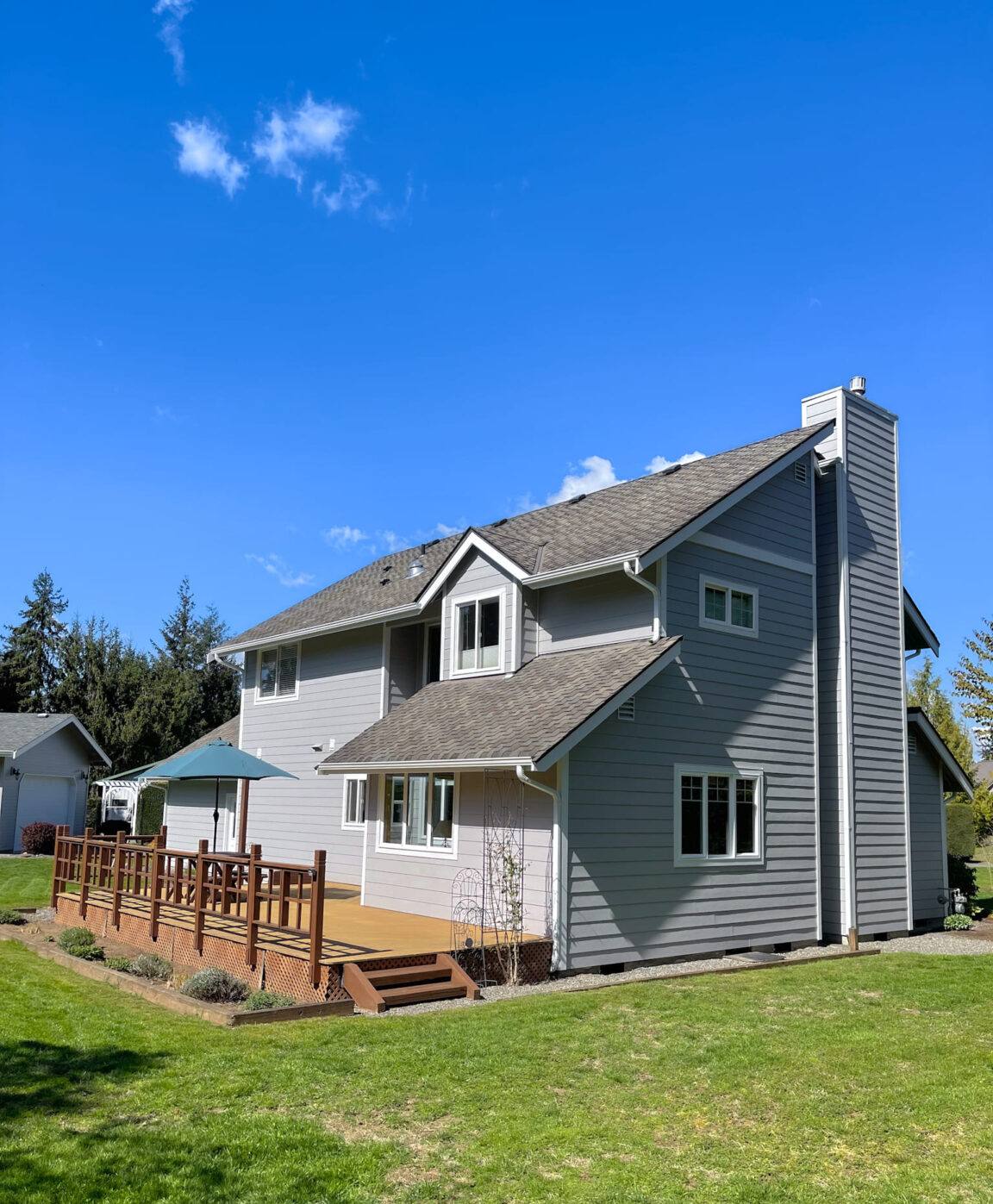
Why James Hardie Fiber Cement Fits This Climate
James Hardie fiber cement siding is engineered specifically for regional weather conditions, and the HZ5 product line is formulated for the wetter, more humid climate zones that include western Washington. It's a mix of cement, sand, and cellulose fibers, and it doesn't behave like wood or wood-composite products when it stays wet. It doesn't swell, rot, or delaminate from repeated soak-and-dry cycles the way engineered wood siding can, and it's non-combustible, which matters as much for insurance considerations as it does for wildfire-adjacent risk.
The other piece is the factory-applied ColorPlus finish. It's baked on under controlled conditions rather than brushed on at the jobsite, which gives it better adhesion and more consistent coverage than field-applied paint — especially on a material that's going to see this much rain and salt spray over its life. That matters directly for a coastal-influenced job: a finish that's failing or chalking within a few years just accelerates the moss and staining problem instead of resisting it.
We install James Hardie exclusively. We don't install vinyl, LP SmartSide, Cemplank, Allura, or primed wood siding, because we've made fiber cement from Hardie our standard for this region's conditions — proven moisture performance, a factory finish that holds up, and a transferable warranty backing it. If you're comparing materials, we're glad to talk through the honest trade-offs of each; that's a separate conversation from what we put on the wall.
Moisture Management Behind the Siding
Correct installation starts before the first plank goes up. A weather-resistive barrier, properly lapped and taped, along with rigid or engineered flashing at every window, door, and horizontal transition, is what actually keeps wind-driven rain out of the wall assembly. Siding is the visible layer, but it's the drainage plane and flashing details behind it that do the real work against Ferndale's rain pattern.
Fastening and Gaps
Hardie's installation specs call for corrosion-resistant fasteners, correct nail placement and spacing, and specific clearances at grade, roof lines, and butt joints. In a salt-air environment, fastener quality isn't a place to cut corners — the wrong fastener can start staining or failing well before the siding itself shows any wear. Gaps at trim and joints need to be sized and sealed per spec, not just eyeballed, so the assembly can handle seasonal movement without opening a path for water.
Factory Finish vs Field-Painted
Because ColorPlus is cured at the factory, it's harder and more resistant to fading and moss adhesion than a field-applied coat, but it still requires correctly treated cut edges and touch-up at any field cuts. Skipping that step is one of the more common corner-cuts we see, and it's exactly the kind of detail that shows up as a failure point a few years down the road in a climate this wet.
James Hardie vs Other Siding Materials in Whatcom County Conditions
| Material | Moisture & Rain Exposure | Moss & Algae Resistance | Salt Air Durability | Finish Longevity |
|---|---|---|---|---|
| James Hardie Fiber Cement (HZ5) | Engineered for wet climates; won't rot or swell | Dense surface resists growth better than porous wood substrates | Non-combustible substrate; factory finish resists salt-driven fading | Factory-cured ColorPlus, long warranty coverage |
| Vinyl Siding | Sheds water but can warp or buckle under temperature swings and impact | Smooth surface but seams and laps can trap moisture and debris | Can become brittle over time; color is molded-in and fades unevenly | No refinishing option once faded — full replacement only |
| LP SmartSide / Engineered Wood | Wood-based substrate is more moisture-sensitive over time | More susceptible to sustained damp conditions if finish is compromised | Requires diligent caulk and finish maintenance near salt exposure | Field or factory finish, but substrate itself is wood-based |
| Primed Cedar / Spruce | Natural wood; performs well only with rigorous maintenance | Most susceptible; needs regular cleaning and refinishing | High maintenance burden in coastal exposure | Repainting/staining cycle required, typically every few years |
What Drives the Cost of a Hardie Job Here
Every Ferndale home is a little different, and pricing depends on real project specifics — but a few factors consistently move the number more than others in this area:
| Factor | Why It Matters Locally |
|---|---|
| Wall exposure and orientation | North- and west-facing walls with more shade and wind-driven rain often need more attention to flashing and drainage detailing |
| Existing siding removal | Tear-off and disposal of old material, plus any sheathing repair found underneath, affects labor and timeline |
| Trim and detail complexity | Homes with more corners, dormers, or trim transitions require more precise flashing and cutting work |
| Product line and profile | HZ5 panel, lap, and shingle profiles vary in material cost and installation time |
| Color and finish selection | ColorPlus factory colors vs. primed-for-paint options affect both material cost and long-term maintenance |
Our Process for Ferndale Projects
- On-site assessment: We walk the exterior, check current siding and sheathing condition, and note exposure-specific risk areas — often the walls facing prevailing wind and rain.
- Written scope and product selection: You get a clear plan covering product line, profile, color, and what tear-off or repair work is included, with no surprise add-ons sprung on you mid-job.
- Prep and moisture barrier installation: Old siding comes off, sheathing is inspected and repaired as needed, and the weather-resistive barrier and flashing go in to spec before any Hardie product is installed.
- Installation to manufacturer spec: Correct fasteners, clearances, and joint treatment throughout — the details that determine how the siding performs in this climate over the long run.
- Final walkthrough: We review the finished work with you and make sure trim, caulking, and touch-up details are complete before calling the job done.
Living With Hardie Siding Through Moss Season
No siding material is completely maintenance-free in a climate this damp, but Hardie's dense factory-finished surface makes upkeep manageable rather than constant. A periodic gentle rinse — low-pressure water and a soft brush where moss or algae builds up on shaded walls — is typically enough to keep it looking clean. What you want to avoid is high-pressure washing directed at joints and laps, since that can force water where it doesn't belong regardless of siding material. Keeping gutters clear and vegetation trimmed back from walls also goes a long way toward reducing how much moss gets a foothold in the first place.
A Homeowner's Checklist Before Hiring
- Ask whether the crew is James Hardie factory-trained or certified, not just "familiar" with the product
- Confirm the scope includes weather-resistive barrier and flashing work, not just panel installation
- Get the fastener and clearance specs in writing, not just verbal assurance
- Ask how they've handled moisture-sensitive walls (north/west exposure, shaded areas) on past projects
- Check that the warranty terms — both product and labor — are clearly explained and transferable
- Make sure the estimate breaks down tear-off, repair contingencies, and finish selection separately
Why a Crew That Already Works Ferndale Matters
Installing James Hardie correctly isn't complicated, but installing it correctly for this specific climate takes judgment that only comes from working the area repeatedly — knowing which walls need extra flashing attention, which fastener choices hold up against salt air over years rather than months, and how much clearance to leave given how wet Whatcom County stays for most of the year. A crew that's only worked drier or more sheltered regions can follow the same manual and still miss the details that matter here. We install Hardie exclusively, and we install it with this coastal exposure in mind on every wall we touch.
If you're planning a siding project in Ferndale or anywhere around Birch Bay, we're happy to take a look at your home and walk you through what a correct James Hardie installation would involve for your specific exposure. Reach out for a free, no-pressure estimate using the form below.