 Birch Bay Siding
 The Marine Climate Bellingham and Birch Bay Windows Have to Survive
Windows on this stretch of the Whatcom County coastline take a different kind of beating than windows fifty miles inland. Homes in Bellingham and Birch Bay sit close enough to the water that salt-laden air, wind-driven rain, and a long stretch of damp, low-sun months all work on window frames and seals year-round. A window that's rated fine on paper can still underperform here if it wasn't built or installed with this specific exposure in mind.
Salt Air and Coastal Exposure
Salt air is corrosive to hardware, screens, and lower-grade metal components, and it accelerates the breakdown of cheap weatherstripping and gaskets faster than a dry inland climate would. It's not dramatic — it's slow, and it shows up years later as pitted hardware, stiff locks, and seals that no longer compress the way they should.
Driving Rain and Wind-Driven Moisture
Storms off the water don't just drop rain straight down — wind pushes it sideways into the wall assembly, which means the flashing and sealant details around a window matter as much as the window unit itself. A perfectly good window installed with sloppy flashing will leak in a Whatcom County windstorm regardless of its energy rating.
The Long Moss and Mildew Season
Bellingham and Birch Bay both see an extended stretch of overcast, damp weather where anything that stays wet, stays wet a while. That's the same environment that grows moss on roofs and siding, and it's hard on window sills, wood trim, and any gap where water can sit instead of shedding away.
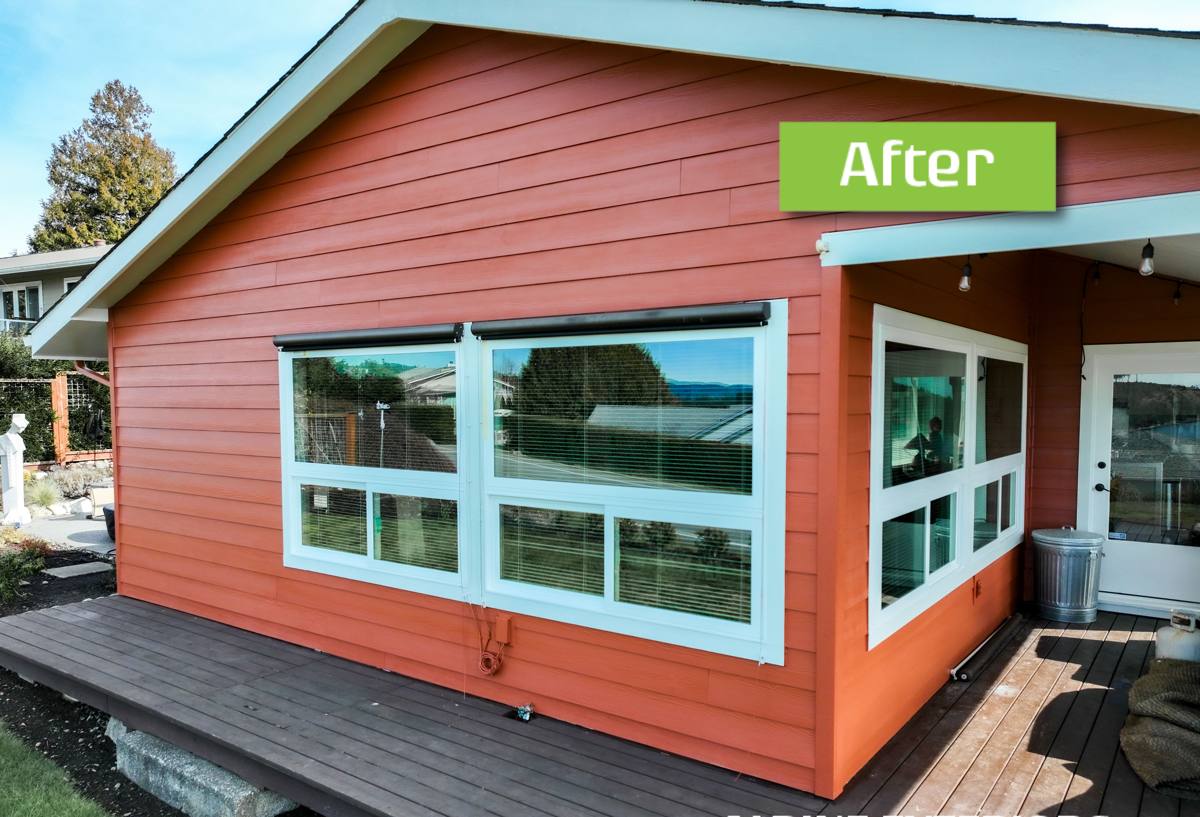
What "Energy-Efficient" Actually Means on This Coastline
Energy-efficient windows get marketed around heat loss, but in a marine climate like this one, moisture control and air sealing matter just as much as the glass package. A window can have great efficiency numbers and still perform poorly here if it's not sealed and flashed correctly, because the biggest energy loss in older Bellingham and Birch Bay homes usually isn't through the glass — it's through gaps around the frame that let cold, wet air infiltrate.
U-Factor vs. Solar Heat Gain in a Marine Climate
U-factor (how well the window resists heat loss) matters more here than solar heat gain coefficient, since this area doesn't get the intense summer sun that drives cooling-focused window choices in hotter climates. For most Bellingham and Birch Bay homes, we're prioritizing a low U-factor and good air sealing over glass tuned for solar control.
Air Sealing Matters as Much as Glass
A double-pane, low-E window installed with a proper air and water seal will often outperform a more expensive triple-pane unit that was installed loosely. This is the piece homeowners underestimate, and it's the piece that separates a good installation from a mediocre one.
Frame Materials: What Holds Up in Whatcom County
We install several frame materials, and each one has real trade-offs in this climate. None of them are "bad" — they're suited to different budgets and different maintenance expectations.
| Frame Material | Moisture/Salt Air Performance | Maintenance | Typical Lifespan |
|---|---|---|---|
| Vinyl | Good — won't corrode or rot, handles salt air well | Low — occasional cleaning | 20-30+ years |
| Fiberglass | Excellent — very stable in temperature and moisture swings | Low | 30-40+ years |
| Wood-clad | Good on the exterior face, but interior wood needs the seal to stay intact | Higher — finish and seals need periodic attention | 20-30 years with upkeep |
| Aluminum | Prone to condensation and corrosion near salt air without a thermal break | Moderate | Varies widely by quality |
For most Bellingham and Birch Bay replacement projects, we steer homeowners toward vinyl or fiberglass. Both shrug off salt air and driving rain without the ongoing finish maintenance that wood-clad units demand, and neither gives you the condensation and corrosion issues that show up on lower-quality aluminum frames near the water. Wood-clad still has a place where the look matters more than the maintenance trade-off — we just want homeowners going in with eyes open about what that upkeep looks like.
The Part Most Window Jobs Get Wrong: Integration With Siding and Flashing
As a siding contractor, we see the aftermath of bad window installs more than most people realize — not because the window itself failed, but because the flashing and water-resistive barrier around it weren't tied in correctly. Water finds the path of least resistance, and on a home taking wind-driven rain off the water, that path is usually a gap at the head flashing, a missed sill pan, or house wrap that wasn't lapped correctly over the nailing flange.
Why We Talk About This as Much as the Windows Themselves
When we replace windows as part of a siding project, we can integrate the window flashing directly with the new water-resistive barrier and siding, which is the correct sequence and the hardest one to fix after the fact. When we replace windows on their own, we still treat flashing integration with the existing wall assembly as the make-or-break part of the job — not an afterthought after the window's been set.
Full-Frame Replacement vs. Retrofit (Pocket) Replacement
There are two ways to replace a window: full-frame, where we remove the old unit down to the rough opening and rebuild the flashing from scratch, and retrofit (or "pocket") replacement, where the new window is installed into the existing frame. Retrofit is faster and less invasive, and it's a reasonable option when the existing frame and flashing are still sound. But if there's any sign of rot, past water intrusion, or a wall assembly that was never flashed correctly to begin with, retrofit just seals the problem back up behind a new window. In that situation, full-frame replacement costs more up front but is the only way to actually fix what's wrong.
Signs Your Windows Are Already Costing You
Most homeowners don't replace windows because of a single dramatic failure — it's a slow accumulation of small signs. Here's what we'd want you to look for before your next heating season:
- Condensation building up between the panes (a sign the seal has failed, not something a new sash fixes)
- Visible daylight or a draft you can feel with your hand along the frame edge
- Soft or discolored trim and sill wood, especially on the sides that take the most weather
- Windows that are hard to open, close, or lock — often a sign the frame has shifted or swelled
- Musty smell or visible mildew on the interior sill or frame, especially through the wetter months
- A noticeable difference in room temperature near the window compared to the rest of the house
- Paint or finish that's peeling or bubbling on wood-framed windows, which usually means moisture is already behind it
Any one of these on its own might just need a repair. Several of them together, especially on a home that's had the same windows for 20-plus years, usually means it's time to talk about replacement instead of patching.
Our Process for a Bellingham or Birch Bay Window Job
Assessment
We start by looking at more than the windows themselves — the surrounding trim, siding, and wall assembly tell us whether we're dealing with a straightforward retrofit or a situation where water has already gotten behind the cladding. This is also where we talk through frame material, glass package, and budget based on what actually fits the house and its exposure.
Installation
Every window gets shimmed level and plumb, sealed with the correct sequence of sill pan, jamb flashing, and head flashing, and insulated around the frame gap — not just caulked and called done. This sequence matters more here than in a dry climate, because a shortcut that might go unnoticed for years somewhere inland will show up fast on a house catching driving rain off the water.
Integration With Siding and Trim
Where windows are part of a larger siding project, we tie the new flashing directly into the water-resistive barrier before the siding goes back on, so there's no gap in the drainage plane. Where it's a standalone window job, we match the existing trim and siding tie-in as closely as possible and make sure the seal is complete before we consider it finished.
Cost Factors to Expect
We don't post fixed prices because every home and every window count is different, but these are the main things that move the number up or down on a Bellingham or Birch Bay project:
| Factor | How It Affects Cost |
|---|---|
| Full-frame vs. retrofit replacement | Full-frame costs more due to added flashing and trim work, but addresses hidden damage |
| Frame material | Vinyl is generally the most affordable; fiberglass and wood-clad run higher |
| Glass package | Double-pane low-E vs. triple-pane changes both cost and performance |
| Number of windows and access | Second-story or hard-to-access windows add labor time |
| Condition of the existing opening | Rot or past water damage found during removal adds repair costs |
| Trim and siding tie-in | Matching or replacing surrounding trim and siding adds scope but avoids a mismatched patch |
Why Hire a Crew That Already Works This Area
Window replacement done wrong doesn't usually fail on day one — it fails two or three winters later, once the seals have taken a few seasons of wind-driven rain and salt air. A crew that already works in Bellingham and Birch Bay knows what that exposure actually does to a wall assembly over time, and builds the flashing and sealing details accordingly instead of following a generic installation manual written for a drier climate. We'd also rather have an honest conversation about retrofit versus full-frame replacement up front than have a homeowner find out the hard way three years in that the cheaper option papered over a real problem.
If your windows are drafty, fogged, or just old enough that you're wondering, we're happy to take a look and give you a straight answer — no pressure, no upsell. Fill out the form below for a free estimate on your Bellingham or Birch Bay window project.