 Birch Bay Siding
 Why Point Roberts Is a Different Window Job Than "Anywhere Else"
Point Roberts sits on a small peninsula, surrounded on three sides by the Strait of Georgia and Boundary Bay, with almost every home within a short walk of open water. That location is exactly what makes it a hard place to keep windows performing over the long haul. Salt-laden air off the water accelerates corrosion on hardware, fasteners, and lower-grade metal components. Wind has an unbroken run across the water before it hits a house, so rain doesn't just fall here — it drives sideways into window assemblies during winter storms. And because the marine layer keeps humidity high for months at a time, moss and algae take hold on north- and west-facing walls, trim, and sills faster than in drier inland parts of Whatcom County.
None of that means windows fail quickly. It means the details that get skipped on an easy inland install — flashing sequence, sealant choice, frame material, weep path design — matter more here, and matter sooner. A window that's "close enough" in a sheltered neighborhood can start showing water staining, fogged glass, or soft framing within a few winters on an exposed Point Roberts lot.
What a Correct Installation Actually Involves
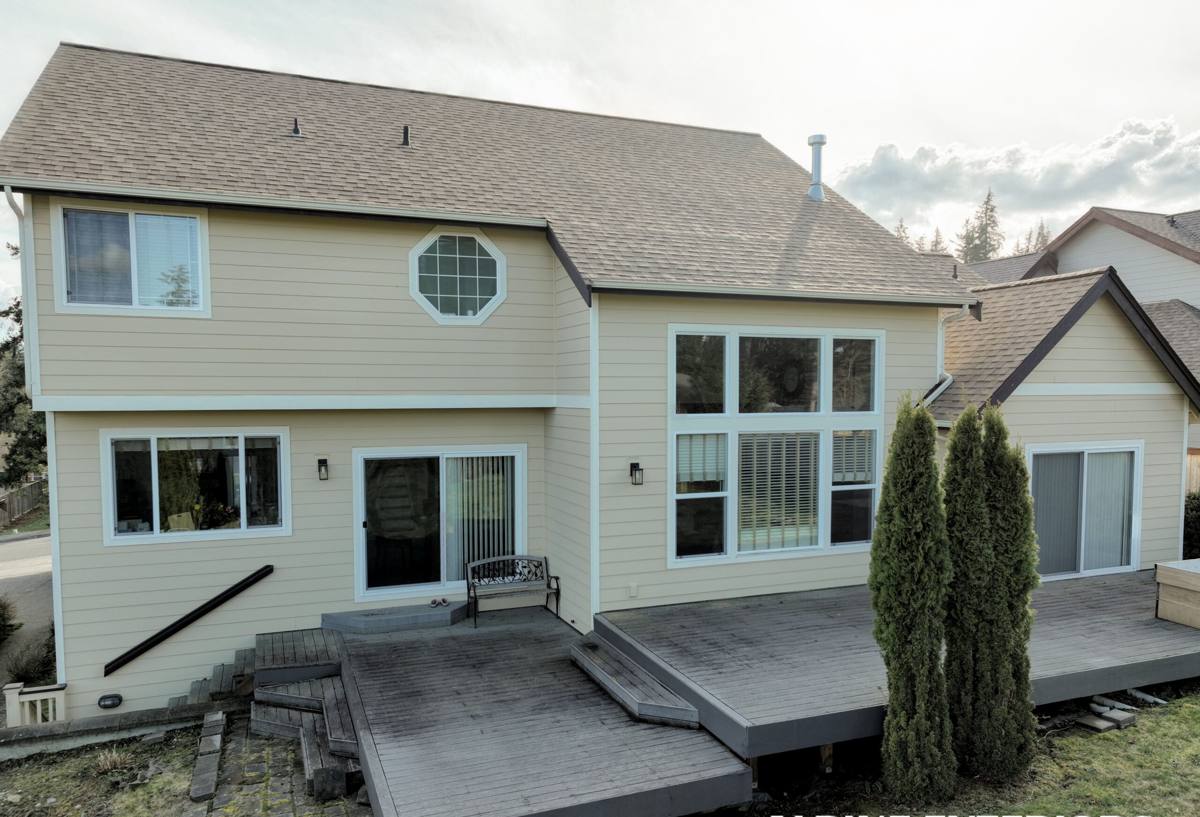
A lot of window problems we get called out to fix aren't product failures — they're installation shortcuts. The window itself is often fine. The flashing, the sealant, or the way the rough opening was prepped is not. On a site like Point Roberts, where wind-driven rain will find any gap, the installation details carry as much weight as the window brand.
The non-negotiables on an exposed coastal lot
- Housewrap and flashing tape integrated shingle-style (top piece overlaps the one below it) so water sheds outward, never inward
- A sloped sill pan under every opening to carry incidental water back outside instead of into the wall cavity
- Backer rod and a quality exterior sealant at the right joints — not sealant used as a substitute for proper flashing
- Corrosion-resistant fasteners and hardware, given the salt content in the air
- Weep holes and drainage paths left clear, not caulked shut by mistake
- Proper shimming and squaring so the sash operates and seals correctly for years, not just on install day
Skip any one of these and the window can look perfect for a season or two before problems show up behind the wall, which is the expensive way to find out.
Choosing Frame Materials for Salt Air and Constant Moisture
There's no single "best" window material for every home — it depends on your budget, the home's age and style, and how exposed the specific wall is. What we can tell you honestly is how each common frame type tends to behave in a marine environment like Point Roberts.
| Frame Material | How It Handles Salt Air & Rain | Maintenance | Typical Fit |
|---|---|---|---|
| Vinyl | Won't corrode or rot; performs well in coastal moisture | Low — occasional cleaning | Budget-conscious replacements, rental or vacation properties |
| Fiberglass | Very stable in temperature swings and moisture; strong seal retention | Low | Homeowners wanting long-term durability and a straighter frame profile |
| Aluminum | Conducts cold and can corrode without a marine-grade finish; needs a good thermal break | Moderate | Modern or large-format window designs where the look is a priority |
| Wood / wood-clad | Highest maintenance burden in this climate; exterior cladding helps but exposed wood needs regular upkeep | High | Historic-style homes where the interior wood look matters more than upkeep |
We're generally cautious about recommending bare wood exteriors on the more exposed Point Roberts lots — not because wood windows are a bad product, but because the maintenance schedule needed to keep them sealed against constant salt moisture is a real, ongoing cost that a lot of owners underestimate, especially on homes used seasonally. If you love the look of wood, a wood-interior/clad-exterior unit gets you most of that appearance with far less upkeep exposed to the weather.
Glass and Coatings
Double-pane, low-E coated glass is the standard we'd recommend for this area — it cuts down on heat loss during the wet, cool months and reduces condensation on the interior pane, which matters when indoor humidity is already fighting an uphill battle against the outside air. Argon or krypton gas fill between panes adds a modest efficiency bump but isn't a make-or-break decision the way frame material and installation quality are.
Moss, Algae, and What They Actually Do to a Window
Moss doesn't grow on the glass, but it absolutely grows on sills, trim, cladding above window openings, and anywhere water sits or drips repeatedly. Over a long moss season — which in this part of Whatcom County can run most of the fall through spring — that growth holds moisture against wood trim and can work into hairline gaps in caulking. It's less a cosmetic issue and more an early warning sign: where moss is thriving, water is lingering longer than it should, and that's worth a look at the flashing and drainage detailing, not just a pressure wash.
When we replace windows here, we pay attention to the trim and cladding immediately around the opening, not just the window unit itself, because that's usually where moss-driven moisture problems actually start.
Custom Sizing: Why It Matters More on Older Point Roberts Homes
A good number of homes in Point Roberts were built as cabins or vacation properties over past decades, later expanded or converted to full-time residences. That history means window openings are often non-standard sizes, out of square, or built to dimensions that don't match anything on a big-box shelf. Forcing a stock-size window into an opening that doesn't match it usually means extra shimming, gaps filled with more sealant than is healthy, and a weaker seal overall — exactly the wrong compromise on a site that already gets driving rain.
Custom windows are built to the actual opening, which means:
- A tighter, more consistent seal around the full perimeter
- Fewer field modifications that can compromise flashing continuity
- The ability to match unusual openings (bay, angled, oversized, or odd-height) without ugly filler panels
- Better long-term performance because the window isn't fighting the opening from day one
Our Process for a Point Roberts Window Project
Point Roberts is geographically part of Whatcom County but physically separated from it — the peninsula is only reachable by road through Canada, or by water or air. That's a real logistical factor for any contractor working here, and we plan around it rather than treating it as an afterthought.
- On-site assessment — we measure existing openings, check current flashing and sill condition, and look at sun/wind exposure on each elevation of the house
- Material selection — we walk through frame and glass options against your budget and how exposed that particular wall is
- Scheduling — because of the crossing involved, we batch Point Roberts jobs efficiently and confirm delivery timing for custom units before committing to install dates, so you're not left with an open wall waiting on materials
- Removal and prep — old units come out carefully, and we inspect the rough opening and sheathing for hidden water damage before anything new goes in
- Installation — flashing, sill pan, sealant, and the new window go in following the sequence that actually sheds water in a driving rain
- Final check — operation, seal, and cleanup, with a walkthrough so you know what to expect from the new windows
What Custom Windows Typically Cost — and Why the Range Is Wide
Every home is different, and we'd rather give you a number after actually looking at your openings than a made-up figure that doesn't hold up. In general terms, cost is driven by a handful of factors:
| Factor | Why It Moves the Price |
|---|---|
| Frame material | Vinyl is typically the most affordable; fiberglass and wood-clad cost more upfront but differ in maintenance and lifespan |
| Window size and shape | Standard openings are simpler to build for than bays, angles, or oversized units |
| Number of openings | Whole-house replacement typically brings a better per-window rate than one-off jobs |
| Condition behind the old window | Rot or water damage found during removal adds repair scope before the new window goes in |
| Access and site conditions | Second-story or hard-to-reach openings take more labor time |
A Simple Maintenance Checklist for Coastal Windows
A well-installed window still benefits from basic upkeep in this climate. A few minutes a couple times a year goes a long way:
- Rinse salt residue off frames and glass periodically, especially after winter storms
- Check exterior caulking annually for cracking or gaps and re-seal as needed
- Clear moss or algae from sills, trim, and drainage weep holes before it builds up
- Test that weep holes are actually draining, not blocked by debris or paint
- Lubricate hardware and tracks to keep operation smooth despite humidity
- Watch for soft trim or bubbling paint near window edges — an early sign of trapped moisture
Why Hiring a Crew That Already Works in Point Roberts Matters
A contractor who mostly works drier, more sheltered sites can install a technically fine window that still underperforms here, simply because they're not used to designing for wind-driven rain and constant salt exposure. Working this stretch of Whatcom County regularly means we've seen how flashing details, sealant choices, and frame materials actually hold up over multiple wet seasons on exposed lots — not just how they look on installation day. It also means we already understand the practical realities of scheduling and material delivery for a peninsula that isn't reachable by a direct domestic road route, so a Point Roberts project doesn't turn into a logistics surprise partway through.
If you're weighing a window replacement or planning new custom openings for a home in Point Roberts, we're glad to take a look and give you a straight assessment — no pressure, no inflated urgency, just what we'd actually recommend for your house and your budget. Reach out for a free estimate using the form below.