 Birch Bay Siding
 Why Custer Roofs Wear Differently Than Roofs Inland
Custer sits close enough to Birch Bay and the Strait of Georgia that homes here deal with a combination most roofing crews from further inland never have to think about: salt-laden air off the water, long stretches of driving rain, and a wet season that runs far longer than a typical shingle warranty assumes. None of these on their own is unusual for Whatcom County. Together, on the same roof, year after year, they change what "correct" asphalt shingle roofing actually means.
Salt air accelerates corrosion on exposed metal — nail heads, flashing, vent caps, gutter hangers. Driving rain, especially when it comes sideways off a winter storm, tests every lap and seam in a way that light steady rain doesn't; it pushes water uphill under shingle edges and into any flashing detail that was cut short. And the moss season here isn't a few weeks — shaded, north-facing slopes in Custer can stay damp enough to grow moss nearly year-round, which means moss isn't a cosmetic problem, it's a moisture-retention problem that shortens shingle life if it's ignored.
A roof built or repaired without accounting for all three of these will usually still look fine for the first few years. The failures that show up later — soft decking at eaves, streaking and granule loss under moss mats, rusted fasteners telegraphing through the shingle field — trace straight back to a job that was built for an easier climate than the one Custer actually has.
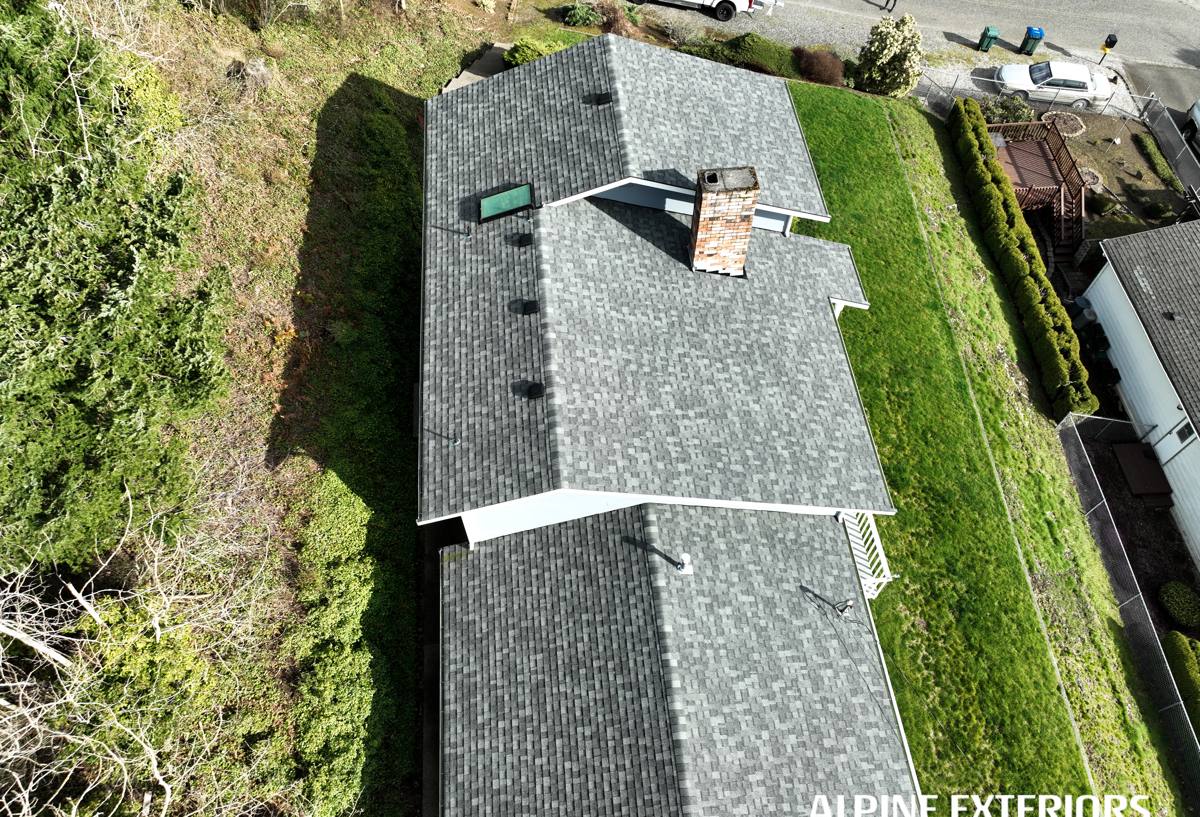
What a Correct Asphalt Shingle Job Involves Here
Underlayment and Ice/Water Protection
Given how much rain Custer sees in a normal winter, we don't treat self-adhering ice-and-water membrane as optional at eaves, valleys, and around every roof penetration. It's the layer that keeps wind-driven and backed-up water from reaching the decking when the shingles alone can't shed it fast enough. Over the rest of the roof, a synthetic underlayment that holds up to repeated wet-dry cycling without wrinkling matters more here than in drier parts of the state — underlayment that degrades under sustained moisture undermines the whole roof even if the shingles above it are in good shape.
Flashing and Fasteners
Salt air is hard on unprotected steel. We spec flashing and fasteners rated for coastal exposure rather than the cheapest galvanized option, because the cost difference is small compared to the cost of re-flashing a chimney or dormer in ten years because the metal rusted through. Every valley, sidewall, and penetration gets flashing sized and lapped to shed water downhill in a driving rain, not just a straight-down shower.
Ventilation
Balanced intake and exhaust ventilation keeps the underside of the roof deck dry and matters more in a climate where the air outside is often already saturated. A roof that can't dry out between rain events is a roof where trapped moisture does slow damage to the deck and framing long before it shows up as a leak inside the house.
Shingle Nailing and Sealing
Proper nail placement and count, and giving self-sealing strips the conditions they need to actually bond, are basic to any asphalt shingle install — but they matter more where wind-driven rain regularly tests every course. Rushed nailing patterns are one of the most common causes of early wind and water damage we see on roofs that are otherwise only a few years old.
Choosing a Shingle for This Climate
Not every asphalt shingle product is a good match for salt air, sustained damp, and moss pressure. We steer homeowners toward algae-resistant shingles as a baseline for any roof in this area — the copper- or zinc-infused granules in these products actively resist the algae growth that causes the black streaking common on older roofs here, and they hold up better under long-term moss exposure than standard granules.
| Shingle Class | Typical Lifespan Here | Best Fit For |
|---|---|---|
| 3-Tab Standard | 15–20 years | Budget-driven projects, rentals, low-slope simple roofs |
| Architectural / Dimensional | 25–30 years | Most Custer homes — better wind rating and thicker profile resists driving rain better |
| Algae-Resistant Architectural | 25–30 years, cleaner longer | Shaded lots, north-facing slopes, homes near tree cover with moss history |
| Premium / Designer | 30+ years | Higher wind ratings and heavier mat for coastal-exposed roofs |
We don't push the most expensive option on every roof — a lot of Custer homes are well served by a solid architectural shingle with algae resistance. But we do steer people away from bare 3-tab on north-facing or shaded roofs specifically because of how fast moss and algae establish here; the maintenance burden and shortened lifespan usually cost more over time than the upfront savings.
Moss, Algae, and the Long Wet Season
Moss doesn't just sit on top of shingles — it holds moisture against the granule surface long after the rest of the roof has dried, which accelerates granule loss and, over years, can lift shingle edges enough to let water underneath. On shaded or tree-covered Custer lots, this is often the single biggest factor in how long a roof actually lasts versus its rated lifespan.
A few things make a real difference:
- Zinc or copper control strips installed at the ridge, which release trace metal ions that discourage moss growth on the courses below with every rain
- Keeping overhanging branches trimmed back so shaded sections of roof get more light and airflow to dry out between storms
- Gentle, low-pressure moss removal on a schedule — never pressure washing, which strips granules and shortens shingle life faster than the moss itself
- Clean gutters and downspouts so water isn't backing up under the lowest courses during heavy rain
None of this eliminates moss entirely in a climate this wet, but it keeps it from becoming the reason a 25-year shingle needs replacing at year 15.
Our Process for a Custer Roofing Project
- On-site inspection — we look at deck condition, existing ventilation, flashing details, and moss/algae history specific to the lot's sun exposure before recommending anything
- Written scope and shingle recommendation — matched to the roof's exposure, slope, and your budget, with the trade-offs explained plainly
- Tear-off and deck check — full removal of old roofing so we can actually inspect the decking underneath rather than roofing over hidden problems
- Underlayment, flashing, and ventilation work — done to the standard the climate here actually requires, not the minimum code allows
- Shingle installation — correct nailing pattern, proper exposure, and attention to every valley and penetration
- Final walkthrough — we go over what was done, what the maintenance schedule should look like, and what to watch for going forward
Repair or Replace? Signs to Watch For
- Granules collecting in gutters or at downspout outlets — a sign the shingle surface is wearing down
- Curling, cupping, or cracked shingles, especially on south- or west-facing slopes that see more sun and wind
- Dark streaking or established moss mats, particularly on shaded or north-facing sections
- Soft spots or sagging when walked, which usually points to deck damage underneath
- Daylight visible through the roof deck from the attic, or staining on attic sheathing
- Rusted or lifting flashing around chimneys, vents, or sidewalls
- Roof age approaching or past 20 years without a full tear-off replacement
A roof with isolated flashing failure or a small area of storm damage is often a legitimate repair. A roof with widespread granule loss, multiple soft spots, or moss established across large sections is usually past the point where repair makes financial sense — we'll tell you honestly which situation you're in rather than defaulting to the bigger job.
What Affects the Cost
| Factor | Why It Matters |
|---|---|
| Roof size and pitch | Steeper roofs take longer and require more safety setup, which affects labor cost |
| Number of layers to remove | Roofs with more than one layer of old shingles cost more to tear off and dispose of |
| Deck condition | Rotted or soft decking found during tear-off needs replacement before new shingles go on |
| Shingle class chosen | Standard 3-tab, architectural, and algae-resistant/premium lines carry different material costs |
| Flashing and ventilation scope | Full flashing replacement and added ventilation cost more upfront but reduce future repair risk |
| Roof complexity | Valleys, dormers, and multiple penetrations add labor time and material |
Exact numbers depend on what we find once we're actually looking at the roof — we'll always walk you through the estimate line by line rather than handing over a number with no explanation behind it.
Why It Matters to Hire a Crew That Already Works This Area
A roofing crew that works Custer and the greater Birch Bay area regularly isn't guessing at what this climate does to a roof — they've seen how salt air ages flashing, which lots hold moss the longest, and where driving rain finds the weak point in a shortcut install. That familiarity shows up in the details: the flashing spec, the underlayment choice, the ridge vent detail, the recommendation on whether a shaded roof needs algae-resistant shingles or can get by without them.
It also matters for accountability. A local contractor is still in the area next year and the year after, which is exactly when a rushed valley or an under-spec'd fastener would start showing problems. We stand behind our work because we're not going anywhere, and because a roof that fails early in Whatcom County's climate reflects on us specifically, not on some crew that's already moved on to a different region.
If you're weighing a repair, a full re-roof, or just want an honest read on how much life your current roof has left, we're glad to come out and take a look. The estimate is free, there's no pressure attached to it, and you'll get a straight answer either way — just fill out the form below to get started.