 Birch Bay Siding
 Cherry Point's Marine Climate Is Hard on Siding
Cherry Point sits out on the water along the Strait of Georgia, just north of Birch Bay in Whatcom County, and that location shapes everything about how a home's exterior ages here. Homes on this stretch of shoreline take a combination of punishment that most siding products were never engineered to handle for decades at a time: salt-laden air blowing off open water, driving rain that hits walls at an angle instead of falling straight down, and long stretches of gray, damp weather that keep surfaces wet far longer than they would be inland. Add in the shade from mature Douglas fir and cedar stands common on Whatcom County lots, and you get a near-perfect environment for moss and algae to take hold on north- and west-facing walls.
None of this is unique to any one house in Cherry Point — it's the baseline condition for the whole area. The difference between a wall system that looks good at year fifteen and one that's cupping, staining, or rotting at year eight almost always comes down to two things: the material itself, and whether it was installed the way the manufacturer actually specifies for a coastal exposure. We only work with one material for exactly this reason.
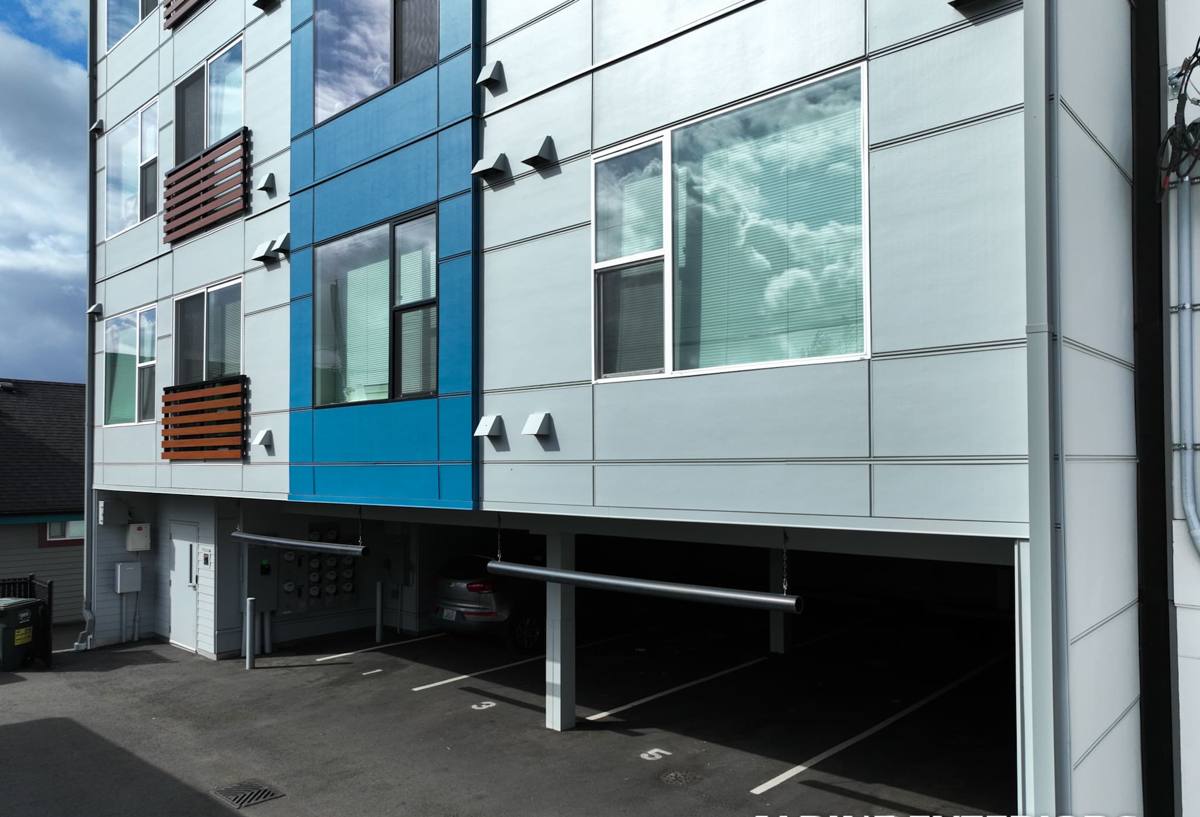
Why We Install James Hardie Fiber Cement and Nothing Else
We standardized on James Hardie fiber cement siding for every job we do, including in Cherry Point, and we don't install vinyl, LP SmartSide, Cemplank, Allura, or primed wood products. That's not a marketing position — it's a decision based on what actually holds up in this climate without turning into a maintenance project for the homeowner.
Fiber cement is made from cement, sand, and cellulose fiber, cured into a dense, dimensionally stable board. It doesn't expand and contract with moisture the way wood-based products do, and it isn't organic material for rot or insects to feed on. James Hardie also builds its HZ5 product line specifically for climates like ours — cooler, wetter, with real freeze-thaw cycles — rather than selling one board for every region in the country. That engineering matters more in a place like Cherry Point than it would somewhere dry and inland.
Salt Air and the Hardware You Don't See
The siding board is only part of the equation. Salt air corrodes standard fasteners and flashing over time, and once a fastener starts rusting, it can bleed staining down the face of the siding and eventually lose its grip. On homes with direct water exposure or open sightlines to the Strait, we use corrosion-resistant fasteners and flashing rated for that exposure, not whatever came in the cheapest box. It's a small line-item difference in cost and a large difference in how the wall performs fifteen years out.
Moss, Shade, and Airflow
Fiber cement won't rot the way wood siding can when moss holds moisture against it, but moss can still grow on the surface of any siding material in a shaded, damp spot, including Hardie board. The factory-applied ColorPlus finish sheds water and resists staining better than field-applied paint, which helps, but the real fix is airflow and drainage behind the cladding — which is a function of installation, not just the board itself. That's covered in the next section, because it's where most siding problems in this area actually start.
What a Correct Installation Actually Involves Here
A lot of the failures we see on older homes in coastal Whatcom County weren't caused by bad siding material — they were caused by a wall assembly that trapped moisture instead of letting it drain and dry. In a climate that stays damp for months at a stretch, that detail decides whether a siding job lasts twenty-five years or needs rework in eight.
The Details That Separate a Lasting Job from a Callback
- A properly lapped weather-resistive barrier behind the siding, with all penetrations and seams sealed
- A rainscreen gap or furring strip system that lets bulk water drain and the wall cavity dry instead of holding moisture against the sheathing
- Correct flashing at every window, door, and roof-to-wall intersection — the single most common failure point on older homes we inspect
- Fastener placement and spacing that follows James Hardie's published fastening schedule for the exposure and wind conditions on that specific lot
- Proper clearance between the bottom of the siding and grade, decks, and roof surfaces so water doesn't wick up into the board
- Caulking only where the manufacturer calls for it — not as a substitute for proper flashing and lapping
Every one of those items is inspectable, and every one of them is something we walk a homeowner through before we close the wall up. Skipping any of them is how a good product ends up with a bad reputation.
Our Process for a Cherry Point Project
- On-site assessment. We look at wall condition, current siding material, sheathing access points, and specific exposure — a wall facing open water gets different fastening and flashing decisions than a sheltered wall on the same house.
- Moisture and substrate check. Before we quote or promise anything, we want to know if there's existing water damage under the current siding, since that changes the scope of the job.
- Product and finish selection. We walk through Hardie's plank, panel, and shingle profiles and ColorPlus color options based on the home's style and the homeowner's preference.
- Permitting. Whatcom County generally requires a permit for a full siding replacement, especially if sheathing repair is involved; we handle that process rather than leaving it to the homeowner.
- Tear-off and inspection. Removing the old siding lets us actually see the sheathing and framing condition instead of guessing from the outside.
- Weather barrier and drainage plane installation. This is the step that determines long-term performance more than any other.
- Hardie siding installation to manufacturer spec, including fastening pattern, flashing, and clearances suited to the site's exposure.
- Trim, caulking, and touch-up, followed by a walkthrough with the homeowner before we consider the job finished.
Choosing the Right Hardie Line and Profile for This Site
Not every Cherry Point home needs the same siding profile or paint approach, and part of an honest estimate is talking through what actually fits the house and its exposure rather than defaulting to whatever's easiest to install.
| Option | Best fit | Trade-off to know |
|---|---|---|
| HardiePlank lap siding | Most homes; classic look, widest color range | More seams than panel siding, though properly installed seams aren't a weak point |
| HardiePanel vertical siding | Modern designs, accent walls, gable ends | Fewer horizontal laps but needs battens or trim at seams |
| HardieShingle | Cottage or craftsman-style homes common in the area | More labor-intensive install, higher material cost |
| ColorPlus factory finish | Homes with direct salt-air exposure | Slightly higher upfront cost than field paint, but far less repainting over the life of the siding |
What Actually Drives the Cost of a Job Here
We won't quote a number without seeing the house, but the factors that move the price up or down are consistent from job to job. Knowing them ahead of time makes for a more useful first conversation.
| Factor | Why it matters |
|---|---|
| Condition of existing sheathing | Water damage found during tear-off adds repair scope you can't quote sight-unseen |
| Wall exposure and height | Direct water/wind exposure and multi-story walls change fastening, staging, and labor time |
| Trim and architectural detail | Dormers, bay windows, and multiple rooflines multiply the flashing and cutting involved |
| Profile choice | Shingle and panel-with-batten details take longer to install than straight lap siding |
| Access | Waterfront lots and steep grades can limit staging and equipment access |
Why It's Worth Hiring a Crew That Already Works This Area
Fastening schedules, flashing details, and drainage planning all change depending on how exposed a wall is to wind-driven rain and salt spray — and that's a judgment call that comes from having actually worked on homes along this shoreline, not from a generic install manual. A crew unfamiliar with Cherry Point's conditions can install a technically correct wall assembly for an inland home and still under-build for what this location will throw at it over the next twenty years.
There's also a warranty angle worth understanding: James Hardie's product warranty and finish warranty both depend on installation following their published guidelines. An installer who doesn't know or doesn't follow the coastal-specific requirements can leave a homeowner with a warranty that looks solid on paper but is compromised by how the job was actually done. We install to those specs as a baseline, not an upsell.
Keeping Cherry Point Siding Looking Right After It's Installed
Fiber cement is low-maintenance compared to wood, but "low-maintenance" isn't "no-maintenance" in this climate. A little attention once or twice a year keeps a Hardie installation looking like it did the day it went up.
- Rinse salt residue off exterior walls a couple of times a year, especially on sides facing open water
- Keep gutters and downspouts clear so water isn't overflowing down the face of the siding
- Trim back vegetation and tree cover where it's shading a wall enough to keep it damp and encourage moss
- Check caulking at trim and penetrations annually and have any cracked or missing sections redone
- Use a soft wash and avoid directing a pressure washer straight into seams or joints
- Watch for moss buildup on shaded elevations and clean it off before it holds moisture against the wall long-term
If you're weighing a siding project on a Cherry Point home, we're happy to take a look and walk you through what your specific walls need — no pressure, no generic quote. Reach out for a free estimate using the form below.