 Birch Bay Siding
 Why Decks Near Bellingham and Birch Bay Wear Out Faster
A deck built the same way in Spokane or Yakima will not age the same way here. Homes around Bellingham and out toward Birch Bay sit close enough to saltwater that airborne salt reaches framing, fasteners, and railings even on properties that aren't waterfront. Add in a wet season that can stretch from October through May, plus a moss and algae problem that never really goes away on shaded or north-facing decks, and you get a structure that's working harder than a deck almost anywhere else in the state.
None of that means a deck can't last. It means the materials, fasteners, and construction details have to be chosen for this specific combination of salt, moisture, and shade — not for a generic "deck" spec sheet.
Salt Air and Metal Fasteners
Salt-laden air accelerates corrosion on anything metal — nails, screws, joist hangers, bolts, and post bases. On a lot of older decks in this area, the decking boards themselves still look fine while the hardware holding the frame together has been quietly rusting for years. That's a structural problem hiding behind a cosmetic one.
Driving Rain and Standing Water
Wind-driven rain off the Strait and the Sound doesn't just fall straight down — it gets pushed sideways into ledger connections, under flashing, and into any gap where a board wasn't spaced correctly. Combined with our long wet season, that means any weak point in the water management details gets tested constantly, not occasionally.
Moss, Algae, and Shade
Decks tucked under trees or on the north side of a house stay damp longer after every rain. That extended damp period is exactly what moss and algae need to take hold, and once they do, the surface gets slick and the wood or composite underneath stays wetter for longer stretches than it should.
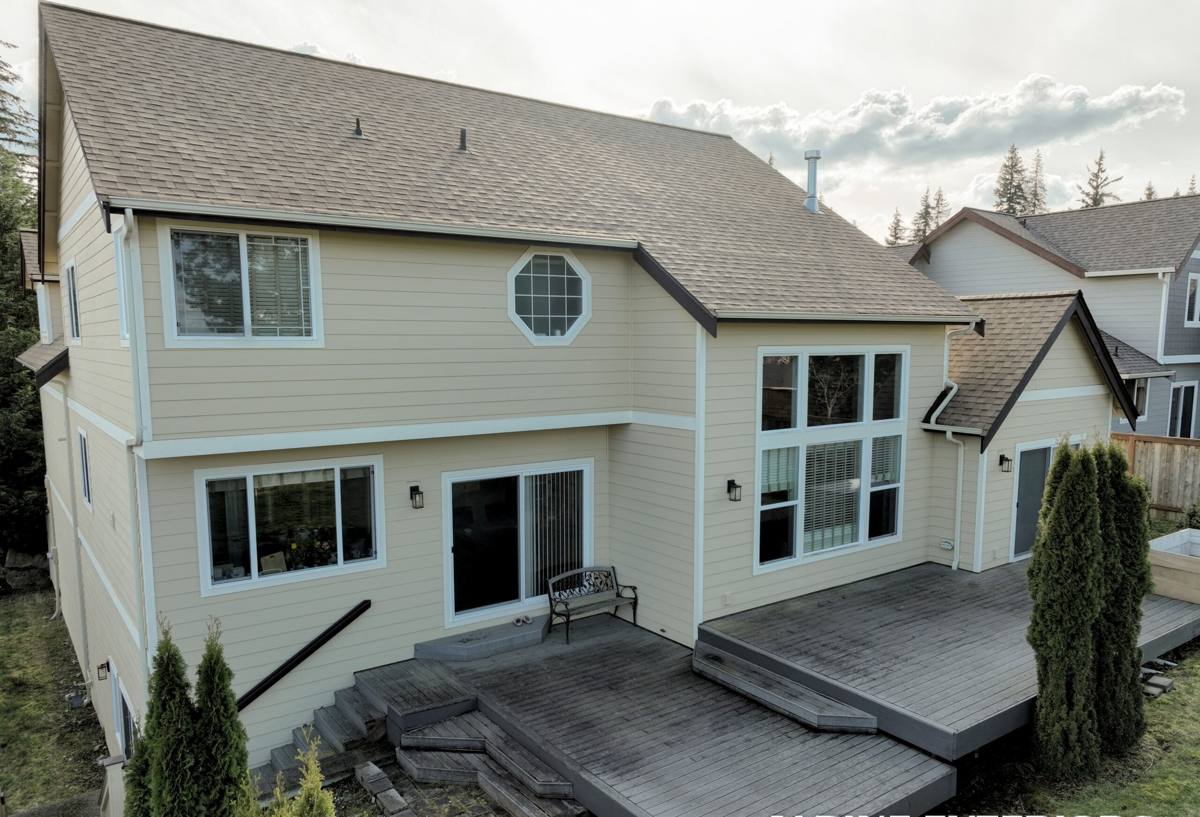
Signs a Deck Needs Replacement, Not Just Repair
Not every tired-looking deck needs to come out. But there's a point where patching boards or re-staining is just delaying a bigger, more expensive problem. Some signs point clearly toward replacement:
- Soft, spongy, or spring-loaded spots when you walk across the deck
- Rust staining bleeding out from screws, nails, or joist hangers
- Visible gaps, cracking, or rot at the ledger board where the deck meets the house
- Posts or footings that have shifted, heaved, or show rot at the base
- Railings that flex or feel loose when you lean on them
- A structure more than 20-25 years old that's never had the framing inspected
That ledger connection deserves particular attention. It's the single most common failure point on older decks in wet climates, and it's also the point that carries the most weight and the most consequence if it fails.
What a Correct Deck Replacement Actually Involves
A deck replacement done right is a lot more than swapping old boards for new ones. The parts nobody sees — framing, flashing, fasteners, and footings — matter more to how long the deck lasts than the decking material on top.
Ledger and Flashing
Where the deck attaches to the house is the most important connection on the whole structure. It needs proper flashing that directs water away from the house's siding and sheathing, not just a ledger board bolted flat against the wall. This is also the detail that protects your home's exterior from hidden water damage, not just the deck itself.
Framing and Fasteners
In a salt-air, high-moisture environment, we don't cut corners on hardware. That means corrosion-resistant, code-rated fasteners and connectors throughout — joist hangers, structural screws, post bases — matched to the pressure-treated lumber being used, since mismatched metals can accelerate corrosion in both directions.
Footings and Posts
Footings need to sit below frost depth and bear on solid, undisturbed soil. On older decks we tear out, it's common to find footings that were undersized, too shallow, or poured on top of loose fill. Replacement is the chance to get this right, since it's nearly impossible to fix later without rebuilding.
Decking Surface and Spacing
Board spacing affects drainage and drying time as much as it affects looks. Boards set too tight trap moisture and debris between them, which is exactly what feeds moss growth. Correct spacing lets water and air move through so the deck actually dries out between storms.
Choosing a Decking Material for This Climate
There's no single "best" decking material — there's a best material for your budget, your maintenance appetite, and how much shade and moisture your specific deck deals with. Here's how the common options hold up in a salt-air, high-moisture setting:
| Material | Moisture & Salt Behavior | Maintenance | Typical Lifespan |
|---|---|---|---|
| Pressure-treated wood | Good if sealed regularly; end grain and fastener points are vulnerable over time | Annual cleaning, periodic sealing/staining | 10-15 years before major work |
| Cedar | Naturally rot-resistant but still needs upkeep in constant damp/shade | Regular cleaning, sealing to hold color and resist moss | 15-20 years |
| Capped composite | Excellent moisture and salt resistance; won't rot or absorb water like wood | Periodic washing to keep moss/algae off the surface | 25-30+ years |
| PVC decking | Fully synthetic, doesn't absorb moisture at all; performs well in shaded, damp spots | Occasional washing | 25-30+ years |
We're upfront about the trade-offs on each option rather than pushing one product for every job. Wood costs less up front but asks for more of your time every year. Composite and PVC cost more initially but hold up better against the exact conditions that wear decks out around here — moisture that doesn't fully dry between rains and surfaces that stay shaded for long stretches. The right call depends on how the deck is used, how much sun it gets, and what you'd rather spend: time or money.
Our Deck Replacement Process
Every job starts with an honest look at what's actually there, not an assumption about what needs to happen.
- On-site assessment. We check the framing, ledger connection, footings, and fasteners — not just the visible boards — to see what's driving the deck's condition.
- Written estimate. You get a clear scope of work and pricing before anything is torn out, including material options at different price points.
- Permitting. We handle the permit process where required so the work is documented and inspected properly.
- Demolition and disposal. The old structure comes out cleanly, with attention to protecting landscaping and the house exterior.
- Framing and structural work. Ledger, flashing, footings, posts, and joists are built or replaced to current code, sized for our climate.
- Decking, railing, and finish work. Boards, railings, and any stairs are installed with correct spacing and fastening.
- Final walkthrough. We go over the finished deck with you and answer any maintenance questions before we consider the job done.
Cost Factors for a Bellingham or Birch Bay Deck Replacement
Every deck is different, but the same handful of factors drive most of the price difference between projects:
| Factor | Why It Matters Here |
|---|---|
| Size and shape | Square footage, multiple levels, and stairs all add material and labor |
| Decking material | Wood costs less upfront; composite and PVC cost more but need far less upkeep in our wet climate |
| Framing condition | Rotted joists, undersized footings, or a failed ledger connection add structural work beyond surface replacement |
| Height and access | Decks built up off a slope or with limited access take more time and equipment |
| Railings and stairs | Code-compliant railings and stair systems add cost, especially with composite or metal rail options |
| Permitting | Whatcom County permit and inspection requirements can affect both timeline and cost |
We give real numbers during the on-site estimate rather than a phone quote, because guessing at framing condition or footing depth from a photo isn't honest pricing.
Permits and Local Code Considerations
Deck replacement projects in Whatcom County typically require a building permit, especially when the work involves structural framing, footings, or a deck that's elevated or attached to the house. Requirements can vary depending on your specific jurisdiction — whether you're inside Bellingham city limits or in unincorporated Whatcom County near Birch Bay — so we check what applies to your property before work starts rather than assuming. Guardrail height, baluster spacing, and stair details are all governed by code, and skipping the permit process on a structural project can create real problems later, from failed inspections to issues at resale.
Why Hiring a Crew That Already Works This Area Matters
A deck built for the Bellingham and Birch Bay area needs to account for salt exposure, extended wet seasons, and shade-driven moss growth from the start — not as an afterthought. A crew that regularly works this stretch of Whatcom County has already seen how ledger connections fail in this climate, which fastener grades hold up and which don't, and where moss takes over first on a shaded deck. That's the kind of judgment that shows up in the details you can't see once the deck is finished — the flashing behind the ledger, the hardware inside the framing, the footing depth below grade.
Keeping a New Deck in Good Shape
Once your new deck is in, a little regular attention goes a long way toward hitting its full lifespan:
- Sweep off leaves, needles, and debris regularly, especially in shaded areas where moisture lingers
- Wash the surface at least once or twice a year to keep moss and algae from establishing
- Check railings and stair connections periodically for looseness
- Reseal or restain wood decking on the manufacturer's recommended schedule
- Keep gutters and downspouts near the deck clear so runoff isn't dumping extra water onto the structure
- Look underneath the deck once a year for any signs of rust staining, rot, or standing water
If you're weighing a deck replacement in Bellingham, Birch Bay, or anywhere else in Whatcom County, we're happy to take a look and give you an honest, no-pressure estimate — just fill out the form below.