 Birch Bay Siding
 Roofing in a Salt-Air, High-Moisture Neighborhood
Point Whitehorn sits close enough to the water that homes here take a different kind of beating than roofs a few miles inland. Salt-laden air corrodes exposed metal faster, driving rain off the Strait finds every gap in flashing and underlayment, and the shade and dampness that come with the tree cover in this part of Whatcom County keep roofs wet longer after every storm. That combination is exactly what accelerates moss growth, granule loss, and premature shingle failure. An asphalt shingle roof that's built and installed correctly for this specific exposure will outlast one that was installed the same way you'd install it in a dry, sunny climate.
We work on homes throughout Birch Bay and the surrounding shoreline communities, and Point Whitehorn's roofs consistently show the same wear patterns: moss establishing in shaded north-facing slopes, corrosion at nail heads and flashing edges, and soft spots where moisture has been sitting under shingles that were never properly ventilated. None of that is unusual for the area — it's just what this climate does to a roof over time. The fix isn't a different product category, it's a correct, exposure-specific installation.
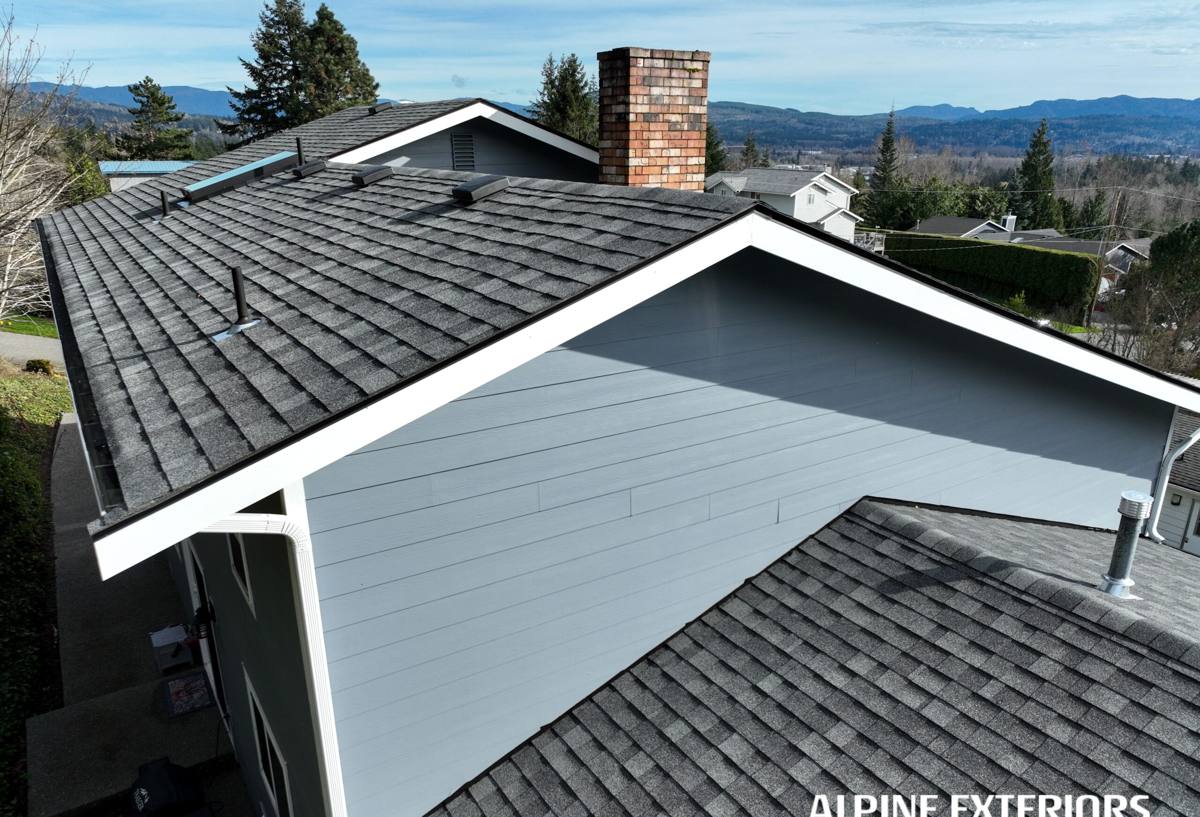
What Point Whitehorn Homes Actually Need From a Shingle Roof
A roof here needs to manage three things at once: wind-driven rain, sustained dampness, and salt exposure. Miss any one of them in the design and installation, and the roof will show problems years before it should.
Wind-Driven Rain
Storms coming off the water don't just drop rain straight down — they push it sideways, up under shingle tabs and into any seam that isn't properly lapped or sealed. That means underlayment coverage, starter strip placement, and shingle nailing pattern all matter more here than they would on a sheltered inland lot.
Sustained Dampness and Moss
Tree cover and marine humidity keep roof surfaces wet longer after rain than they would in a drier area. Moss and algae need exactly that: shade plus moisture. Once moss takes hold, its roots work under the shingle edges and lift them, which is when small leaks turn into structural water intrusion.
Salt Air and Metal Corrosion
Flashing, drip edge, and exposed fasteners corrode faster this close to the water. Using the wrong-grade metal or exposed fastener type is a common shortcut that shows up as rust streaks and failed flashing seals within just a few years.
What a Correct Installation Includes
A shingle roof is a system, not a single product. Every layer has to do its job for the whole assembly to hold up to this climate.
- Ice and water shield at eaves, valleys, and penetrations — the areas most exposed to wind-driven rain and ponding.
- Synthetic underlayment across the full deck as a secondary water barrier, not just felt paper.
- Corrosion-resistant flashing and drip edge at every roof-to-wall, chimney, and valley transition.
- Balanced intake and exhaust ventilation so the attic and roof deck can dry out between storms instead of staying damp.
- Manufacturer-specified nailing pattern — correct nail count, placement, and depth, which is what wind and warranty ratings actually depend on.
- Proper starter strip and ridge cap installation at the edges and peak, where wind uplift does the most damage.
Skipping or shortcutting any one of these is usually invisible from the ground and invisible at first inspection — it just shows up later as a leak, a lifted shingle, or a warranty claim that gets denied because the installation didn't match the manufacturer's requirements.
Choosing the Right Shingle for This Exposure
Not every asphalt shingle line is built the same way, and the differences matter more in a wind- and moisture-heavy area like Point Whitehorn than they would somewhere drier.
| Shingle Class | Wind Rating | Algae/Moss Resistance | Best Fit For |
|---|---|---|---|
| Standard 3-tab | Lower | None built in | Budget projects on sheltered, low-tree-cover lots |
| Architectural / laminate | Higher, rated for gusts common in coastal storms | Often available with algae-resistant granules | Most Point Whitehorn homes — the standard we recommend |
| Premium/designer laminate | Highest tier | Algae-resistant granules standard | Heavily shaded, moss-prone lots or homes wanting a longer service life |
For most homes in this neighborhood, a mid-to-upper-tier architectural shingle with algae-resistant granules is the right balance of cost and durability. It's not the cheapest option, but on a shaded, damp lot the algae-resistant coating alone can meaningfully delay the moss and staining that otherwise show up within the first several years.
Ventilation and Moisture Management
Ventilation is the part of a roofing job homeowners think about least and that causes the most long-term damage when it's wrong. A roof deck that can't breathe stays damp longer after every rain event, which is exactly the condition moss and wood rot need. In a marine climate like this one, we treat intake (soffit) and exhaust (ridge or box vents) as a matched pair — exhaust vents alone, without enough intake, can actually pull moist air through the attic instead of letting it escape. Getting this balance right is one of the biggest differences between a roof that stays dry and one that develops hidden deck damage under shingles that still look fine from the outside.
Our Process, Start to Finish
- On-site inspection — we walk the roof and attic, checking deck condition, existing ventilation, flashing points, and moss/moisture patterns specific to your lot's sun and tree exposure.
- Written estimate — a clear scope covering tear-off, deck repair allowances if needed, underlayment, flashing, shingle selection, and ventilation, so there are no surprise line items mid-job.
- Tear-off and deck check — old roofing comes off down to the deck, and any soft or water-damaged sheathing is identified and replaced before anything new goes down.
- Underlayment and flashing installation — ice and water shield at vulnerable areas, full synthetic underlayment, and new corrosion-resistant flashing throughout.
- Shingle installation — installed to manufacturer nailing specs, with correct starter strip, valley treatment, and ridge cap detailing.
- Ventilation check and correction — intake and exhaust balanced for the attic size and roof design.
- Final walkthrough and cleanup — magnetic sweep for debris, gutter check, and a review of the finished roof with you before we consider the job done.
Maintenance That Actually Extends a Point Whitehorn Roof's Life
Even a correctly installed roof needs some upkeep in this climate. The maintenance that matters most here is different from what you'd tell a homeowner in a dry inland town.
- Have moss physically removed (not just chemically treated) before it establishes root growth under shingle edges — usually most needed on shaded, north-facing slopes.
- Keep gutters and downspouts clear so wind-driven rain has somewhere to go instead of backing up under the eaves.
- Check and re-seal exposed flashing points every few years, since salt air corrodes sealants and metal faster than an inland climate would.
- Trim back overhanging branches to reduce the shade and debris buildup that keep the roof surface damp longer.
- Schedule a professional inspection after any major windstorm, even if there's no visible leak — lifted shingle tabs aren't always obvious from the ground.
Signs Your Roof Needs Attention
Because damage from this climate often starts underneath the shingles rather than on the surface, it's easy to miss until a leak actually shows up inside. Watch for granules collecting in gutters, shingle edges that look curled or lifted, dark streaking or moss patches on shaded slopes, and soft spots when you walk the attic floor above the roof deck. Any one of these on its own may just call for a repair; several together usually mean it's time to talk about a full replacement before hidden deck damage spreads.
Repair or Full Replacement?
Not every roofing problem in Point Whitehorn means a full tear-off. If the deck is sound and the damage is isolated — a section of moss-lifted shingles, a failed flashing seal, storm damage to one slope — a targeted repair is usually the honest recommendation. Full replacement makes sense when the shingles are past their expected service life across the whole roof, when there's widespread granule loss, or when repeated leaks point to underlying deck or ventilation problems that a patch won't fix. We'll tell you which situation you're in during the inspection, not after we've already started work.
Why Local Experience in Point Whitehorn Matters
A roofing crew that hasn't worked this specific stretch of Whatcom County coastline doesn't always know how much moss pressure a shaded, north-facing slope here will see, or how quickly unprotected metal corrodes this close to the water. That knowledge changes real decisions — which shingle line to recommend, how much ice and water shield to use, how to balance attic ventilation for a marine climate. Hiring a crew that already understands Point Whitehorn's weather patterns means fewer surprises during the job and a roof that's actually built for the conditions it has to survive, not just built to code minimums.
If you're dealing with moss, a suspected leak, or simply planning ahead for a roof that's getting close to the end of its service life, we're glad to take a look. Reach out for a free, no-pressure estimate using the form below — we'll walk the roof, answer your questions honestly, and give you a clear picture of what your home actually needs.