 Birch Bay Siding
 Why Terrell Creek Homes Wear Out Their Siding Faster
Terrell Creek sits close enough to the Birch Bay shoreline that the same air carrying that salt smell off the water is also carrying salt onto every exposed wall of your house. Add Whatcom County's long wet season, the driving rain that comes sideways off marine storms, and the shade and moisture that let moss colonize north-facing walls and roof lines for most of the year, and you've got a climate that's genuinely hard on exterior siding. This isn't a page about siding in general — it's about what siding replacement actually needs to accomplish for a house in this specific neighborhood, and what a correctly done job looks like when the crew doing it already knows Terrell Creek's conditions.
Homes here see a combination most siding products were never engineered for: chloride salts that accelerate corrosion of fasteners and finishes, near-constant humidity that keeps wood-based products damp for days after a storm, and moss and algae growth that traps moisture right against the wall surface. Whatever goes back on your house needs to handle all three at once, year after year, without babying.
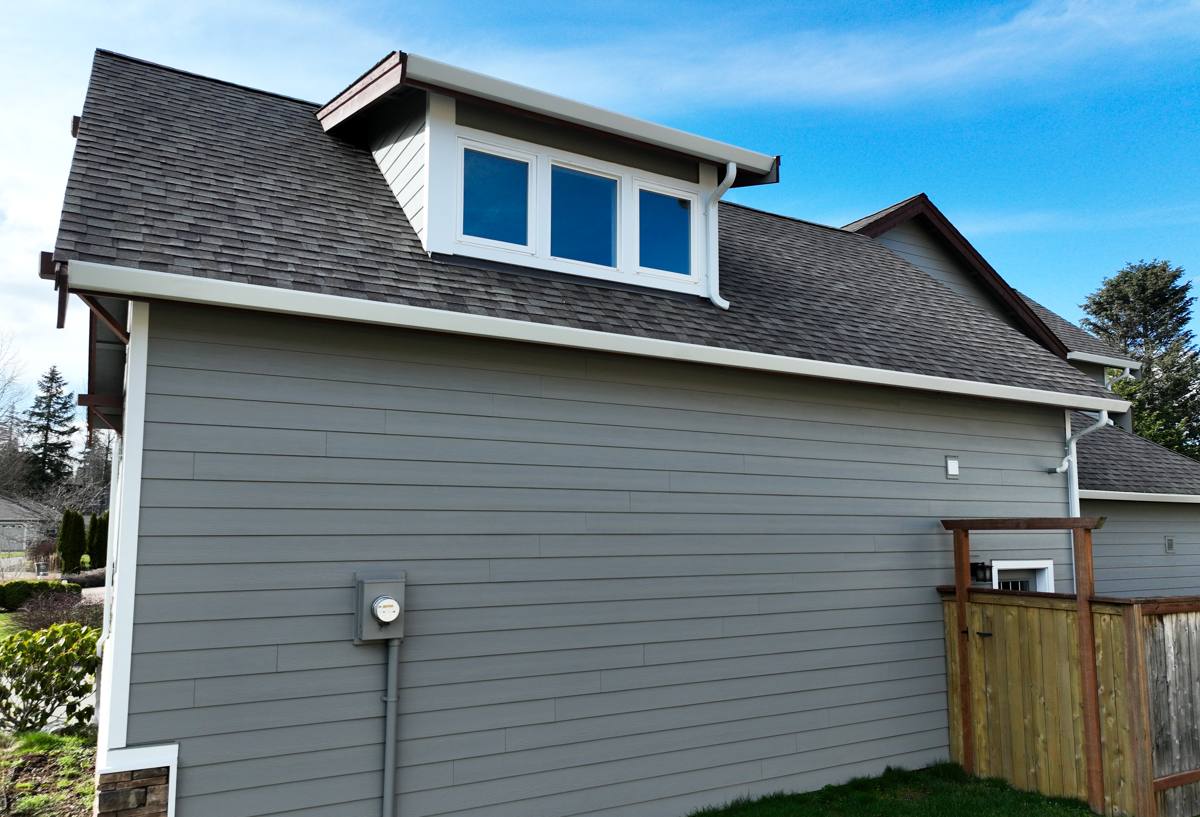
What "Correct" Siding Replacement Actually Involves
Siding replacement isn't just stripping old panels and nailing up new ones. Done right, in a climate like this, it's really a sequence of decisions that each matter on their own:
1. Full Tear-Off and Substrate Inspection
Old siding comes off completely so the sheathing underneath can actually be inspected — not guessed at. In Terrell Creek we regularly find soft or delaminated sheathing behind old siding, especially at lower wall sections, around window flashing, and anywhere moss or ivy has been sitting against the wall for years. Any rot gets cut out and replaced before anything new goes up. Covering over a compromised substrate is the single most common reason a "new" siding job fails early.
2. Weather-Resistive Barrier and Flashing
A correctly lapped weather-resistive barrier (WRB) and properly integrated flashing at windows, doors, and penetrations is what actually keeps driving rain out of the wall assembly — the siding itself is the first line of defense, but it's not the only one. In a high-wind-driven-rain area like Birch Bay, sloppy flashing details are where water gets in even when the siding itself looks fine.
3. Rainscreen or Drainage Gap Where It Matters
On walls that take the worst of the weather — typically west- and south-facing exposures that catch prevailing storms — a drainage gap behind the siding gives bulk water and trapped moisture somewhere to go and dry out, instead of sitting against the back of the panel. This detail matters more in a marine climate than almost anywhere else in the state.
4. Fastener and Trim Selection
Salt air corrodes the wrong fasteners over a handful of years, leaving rust streaks and eventually failed attachment points. Corrosion-resistant fasteners and trim hardware rated for coastal exposure aren't an upgrade here — they're the baseline.
5. Correct Installation to Manufacturer Spec
Every fiber cement product has an installation manual with specific requirements for clearances, fastener patterns, and joint treatment. Skipping these to save labor time is exactly how a good product gets a bad reputation — the material didn't fail, the installation did.
Why We Install Only James Hardie Fiber Cement
We don't install vinyl, LP SmartSide, Cemplank, Allura, primed spruce, or cedar. That's not a marketing position — it's a standard we hold because of what we've seen hold up in coastal Whatcom County conditions and what hasn't.
Vinyl siding is affordable and low-maintenance in mild climates, but it softens and can warp under sustained heat and, more relevant here, becomes brittle in cold snaps and takes damage in the wind gusts that come with winter storms off the water. Its seams and panels also give salt-laden moisture more places to work behind the surface over time.
Wood-based and engineered wood products like LP SmartSide, primed spruce, or cedar are handsome, but they're organic materials in a climate that stays damp for months at a stretch. Even with good coatings, wood siding needs more frequent maintenance — recaulking, repainting, moss and mildew treatment — to keep moisture from working into the material, and cut edges and fastener holes are places where that protection breaks down first.
Other fiber cement brands, including Cemplank and Allura, are legitimate fiber cement products. Our decision to standardize on James Hardie comes down to product line depth (their HZ5 formulation is specifically engineered for harsh, moisture-heavy climates), the ColorPlus factory finish process, and a transferable limited warranty structure we've found to be the most straightforward to stand behind for homeowners. Hardie is non-combustible, doesn't rot, and resists moss and mildew far better than wood-based sidings because it isn't an organic material moss can feed into the way it can wood.
Quick Comparison: Common Siding Options in a Marine Climate
| Material | Moisture/Rot Resistance | Salt Air Durability | Maintenance Burden |
|---|---|---|---|
| James Hardie Fiber Cement | Excellent — non-organic, engineered HZ lines | Strong; factory finish resists fading and chalking | Low — occasional wash, no repainting cycle |
| Vinyl | Good on its own, but seams trap moisture | Moderate — can chalk and become brittle | Low, but limited repair options when damaged |
| LP SmartSide / Engineered Wood | Fair — treated, but still wood-based | Moderate — coating wears at cut edges/fasteners | Moderate — recoating and edge sealing needed |
| Cedar / Primed Spruce | Fair to poor without diligent upkeep | Poor — absorbs moisture, prone to moss growth | High — regular repainting, moss treatment |
Reading Your Siding: Signs Terrell Creek Homeowners Should Watch For
- Soft or spongy spots when you press on siding near the bottom of walls or below windows
- Persistent moss or dark streaking on north- and shade-facing walls that keeps returning after cleaning
- Paint that's bubbling, peeling, or chalking heavily, especially on west- or south-facing exposures
- Visible gaps or separation at seams, corners, or trim boards
- Rust staining running down from fastener heads or trim hardware
- A musty smell in an interior room that shares a wall with a suspect siding section
- Warping, cupping, or visible cracking in panels
Any one of these on its own might just mean a cleaning or minor repair. Several together, especially soft substrate combined with staining or moss, usually means the wall assembly is taking on moisture and a full replacement conversation is worth having before it spreads.
How Our Process Works
Free, No-Pressure Assessment
We walk the exterior with you, note problem areas, and check a few spots for substrate condition. You get a straight answer on whether you're looking at repair or replacement — we're not going to sell a full re-side if a section of trim work solves the actual problem.
Detailed Scope and Product Selection
We go over Hardie's plank, panel, and shingle options, and colors available in the ColorPlus factory-finish line, matched to what suits the house and what holds up best given your wall's sun and weather exposure.
Tear-Off, Repair, and Installation
Old material comes off, sheathing gets inspected and repaired as needed, WRB and flashing go in correctly, and Hardie siding goes up to manufacturer spec — proper fastener spacing, clearances, and joint treatment throughout.
Final Walkthrough
We go over the finished work with you directly, not just hand you an invoice and leave.
What Siding Replacement Typically Involves Cost-Wise
Every house is different, and we don't quote sight-unseen, but the honest cost drivers for a Terrell Creek siding project generally break down like this:
| Factor | Why It Matters Here |
|---|---|
| Sheathing/substrate condition | Moisture-related repair needs are more common near the shoreline and on shaded walls |
| Wall exposure and complexity | More corners, gables, and trim detail mean more labor and material |
| Product line and finish | HZ5 formulations and specific ColorPlus colors vary in cost from base offerings |
| Existing flashing and WRB condition | Failing flashing found during tear-off adds scope but prevents a repeat failure |
| Access and site conditions | Steep lots, mature landscaping, and setback distances common in this neighborhood affect labor time |
Why Local Experience in Birch Bay Matters
A crew that's worked Terrell Creek and the surrounding Birch Bay area already knows which wall exposures take the worst weather, where moisture problems tend to hide, and which details matter most given how close this neighborhood sits to the water. That's not something you can fully substitute with a generic installation manual — it's pattern recognition built from doing this specific work in this specific climate, on this specific coastline, repeatedly. It shows up in small decisions: where we add extra flashing attention, which walls we recommend a drainage gap on even when it's not strictly required, and how we talk you through product choice for your home's actual exposure rather than a one-size-fits-all recommendation.
Get a Straight Answer on Your Siding
If you're seeing moss that won't quit, soft spots, or paint that keeps failing on a Terrell Creek home, it's worth getting eyes on it before the problem grows. Request a free, no-pressure estimate below and we'll walk the exterior with you and tell you honestly what your siding needs.