 Birch Bay Siding
 Decking Built for Sandy Point's Waterfront Conditions
Sandy Point sits close enough to the water that every exterior surface on a house — siding, trim, railings, and especially decking — takes a different kind of beating than a deck ten miles inland in Whatcom County. Salt-laden air drifts in off the Strait, driving rain comes in sideways more often than not, and the long, damp shoulder seasons here mean moss and algae get a real head start on any surface that holds moisture. A deck that would be fine in a drier part of the county can start showing problems in Sandy Point within a couple of seasons if it wasn't built and finished with that environment in mind.
Composite decking earns its keep here precisely because it doesn't play by the same rules as wood. It won't absorb the moisture that feeds moss, it won't splinter or cup the way a pressure-treated board does after a few wet winters, and it holds its color and finish against salt exposure far better than most homeowners expect going in. That said, "composite" isn't one product — the boards, the substructure underneath them, and the way they're fastened all matter, and getting those choices right for a Sandy Point lot is a different job than a generic composite install somewhere dry and inland.
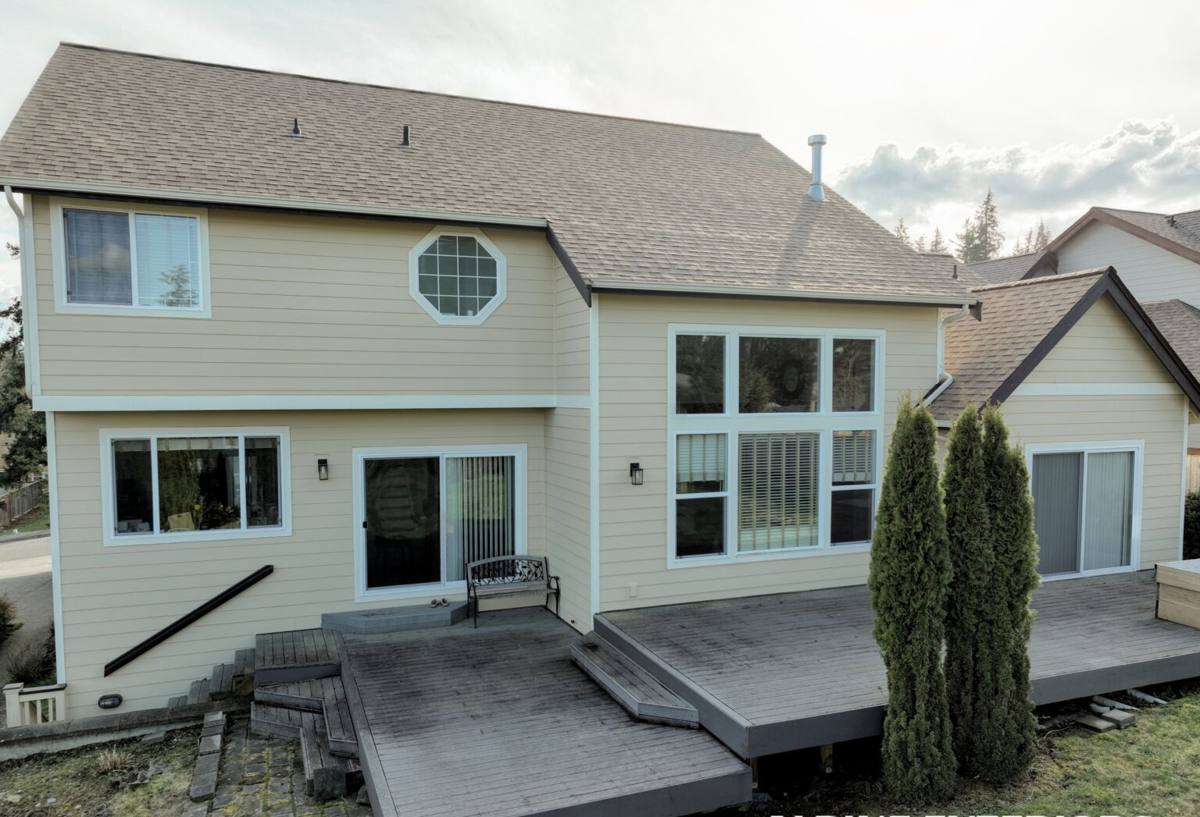
What Salt Air and Moss Season Actually Do to a Deck
It helps to be specific about what we're building against, because it changes real decisions on the job:
- Salt air corrodes hardware first. Fasteners, joist hangers, and railing brackets are usually the first thing to fail on a waterfront deck — long before the decking itself shows wear.
- Driving rain gets under boards, not just on top of them. Wind-driven rain in this area doesn't fall straight down — it pushes moisture into gaps, end grain, and fastener holes, which is where rot and mold actually start.
- Moss season is long, not occasional. Whatcom County's wet stretch runs many months of the year, and shaded or north-facing deck areas near Sandy Point can stay damp for days after a storm, which is exactly what moss and algae need to take hold.
- UV and salt together fade finishes faster. Sun exposure alone is manageable; sun plus salt residue breaks down cheaper coatings and caps noticeably quicker.
None of this means a deck can't be built to last on Sandy Point — it means the material and hardware choices need to account for these specific stresses rather than assuming standard Whatcom County conditions.
Why This Matters More on a Waterfront Lot Than Elsewhere in Birch Bay
A deck built the same way a few blocks further from the water, without the extra attention to fastener grade, drainage, and airflow underneath, will simply age faster on a Sandy Point property. It's not that the standard approach is wrong — it's that Sandy Point's direct salt exposure and rain angle push every weak point in a deck's design to fail sooner. We treat that as the baseline assumption for any Sandy Point job, not an upsell.
What a Correct Composite Deck Build Involves
Substructure First
The composite boards on top get the attention, but the framing underneath is what determines whether the deck lasts. For Sandy Point installs we look closely at:
- Joist spacing appropriate for the specific composite board being used — manufacturers vary, and undersized spacing is a common cause of bounce and long-term sagging.
- Corrosion-resistant or coated fasteners and structural hardware throughout, not just at the visible surface.
- Proper ledger board flashing where the deck attaches to the house, since this is a frequent point where water finds its way into the wall assembly.
- Adequate airflow and drainage beneath the deck so moisture doesn't sit trapped against the framing.
Board Selection and Fastening
Composite boards vary quite a bit between manufacturers and product lines — capped versus uncapped composite, different core materials, and different hidden-fastener systems all behave differently over time in a salt-air environment. We pick boards and fastening systems based on how they've actually performed in coastal-adjacent conditions, not just on price point, and we're upfront with homeowners about the trade-offs between product tiers rather than steering everyone to the same option.
Gaps, Expansion, and Edge Detailing
Composite boards expand and contract with temperature more than people expect, and proper gapping between boards matters for both drainage and long-term fit. Board ends and cut edges also need attention — an unsealed or poorly capped edge is a common entry point for moisture, especially in a rain-heavy environment like this one.
Composite vs. Wood for a Sandy Point Deck
| Factor | Composite Decking | Traditional Wood |
|---|---|---|
| Moisture absorption | Low — resists swelling and rot in wet, salt-heavy air | Higher — prone to cupping, splitting, and rot over time |
| Moss and algae resistance | Better surface resistance, especially with capped boards | Porous surface holds moisture, feeds growth faster |
| Maintenance | Periodic cleaning; no staining or sealing required | Regular sanding, staining, and sealing needed to hold up |
| Salt air / corrosion exposure | Board material unaffected; hardware still needs to be corrosion-rated | Same hardware concern, plus wood fiber degradation from salt |
| Upfront cost | Higher material cost | Lower material cost |
| Long-term cost on a waterfront lot | Lower — fewer refinishing cycles and repairs over the deck's life | Higher — repeat maintenance and earlier board replacement common near the water |
Wood isn't a bad material — it's a different maintenance commitment. On a lot with Sandy Point's direct salt and rain exposure, that maintenance commitment is steeper than most homeowners want to sign up for, which is why composite has become the more practical choice for waterfront decks in this area.
Our Process for a Sandy Point Composite Deck
1. On-Site Assessment
We walk the property, look at sun and shade exposure, prevailing wind and rain direction, existing drainage patterns, and the condition of any structure the new deck will tie into. Waterfront lots often have specific grading or drainage quirks that need to factor into the plan before we talk materials.
2. Material and Layout Discussion
We go over composite board options at different price points, hardware grades, and railing choices, and explain honestly what each trade-off means for upkeep and lifespan in this specific location — not a one-size-fits-all recommendation.
3. Permitting
Deck projects in Whatcom County frequently require permits depending on size, height, and attachment to the home. We handle that process rather than leaving it on the homeowner to sort out.
4. Build
Substructure first, with corrosion-resistant hardware and proper flashing, then decking installed with correct gapping and fastening for the specific product chosen.
5. Final Walkthrough
We go over the finished deck together, including basic care guidance specific to a salt-air, high-moss environment, so the homeowner knows what upkeep actually looks like going forward.
Living With a Composite Deck in This Climate
Composite decking is genuinely low-maintenance compared to wood, but "low-maintenance" doesn't mean "no maintenance," especially in a moss-prone coastal area. A simple seasonal routine keeps a Sandy Point deck looking and performing the way it should:
- Rinse and sweep debris off the surface regularly, especially in fall when organic matter builds up fastest.
- Clean with a mild soap and soft-bristle brush a couple of times a year — avoid pressure washers on close settings, which can damage the board's cap layer.
- Check railings, stairs, and any exposed hardware periodically for early signs of corrosion, since hardware typically shows wear before the boards do.
- Keep planters, furniture legs, and other items that trap moisture from sitting directly on the boards for long stretches.
- Address any shaded, slow-drying areas of the deck first when moss appears — it spreads fastest where it stays wet longest.
Why a Local Crew Matters for This Job
A contractor who mostly builds decks inland, away from the water, doesn't run into salt-driven hardware corrosion or moss-heavy shaded zones often enough to plan around them by default. Working regularly in Birch Bay and Sandy Point specifically means we've seen which fastener grades actually hold up here, which board products handle the salt exposure well, and where drainage tends to cause problems on these lots. That's the difference between a deck that's built to a general standard and one that's built for the conditions it will actually sit in.
It also means we're realistic with homeowners about cost. Composite decking costs more upfront than pressure-treated wood, and the exact number depends on square footage, board tier, railing style, and site conditions like grade and access. We'd rather walk a property and give an honest, specific number than throw out a broad estimate that doesn't hold up once we see the actual site.
Get a Free Estimate
If you're planning a new composite deck or replacing an aging one in Sandy Point, we're happy to come take a look, talk through material options honestly, and put together a straightforward estimate — no pressure, no obligation. Use the form below to get started.