 Birch Bay Siding
 Decks at Point Whitehorn Take a Different Kind of Beating
Point Whitehorn sits close enough to the water that homes here deal with a combination most inland Whatcom County properties never see: salt-laden air rolling off the Strait, driving rain that comes in sideways during winter storms, and a moss season that can run eight or nine months out of the year. A deck built to a generic spec — the kind that might hold up fine in a drier part of the state — often starts showing real problems here in half the time. That's not a knock on any one product or builder; it's just what this stretch of coastline does to exterior wood and hardware.
We work on decks throughout Birch Bay, and Point Whitehorn is one of the areas where we see the clearest pattern: decks that look fine from a distance but have soft framing, corroded fasteners, or trapped moisture underneath by year twelve to fifteen, sometimes sooner on the more exposed lots. A deck replacement done right for this specific spot looks a little different from a standard job, and that's what this page walks through.
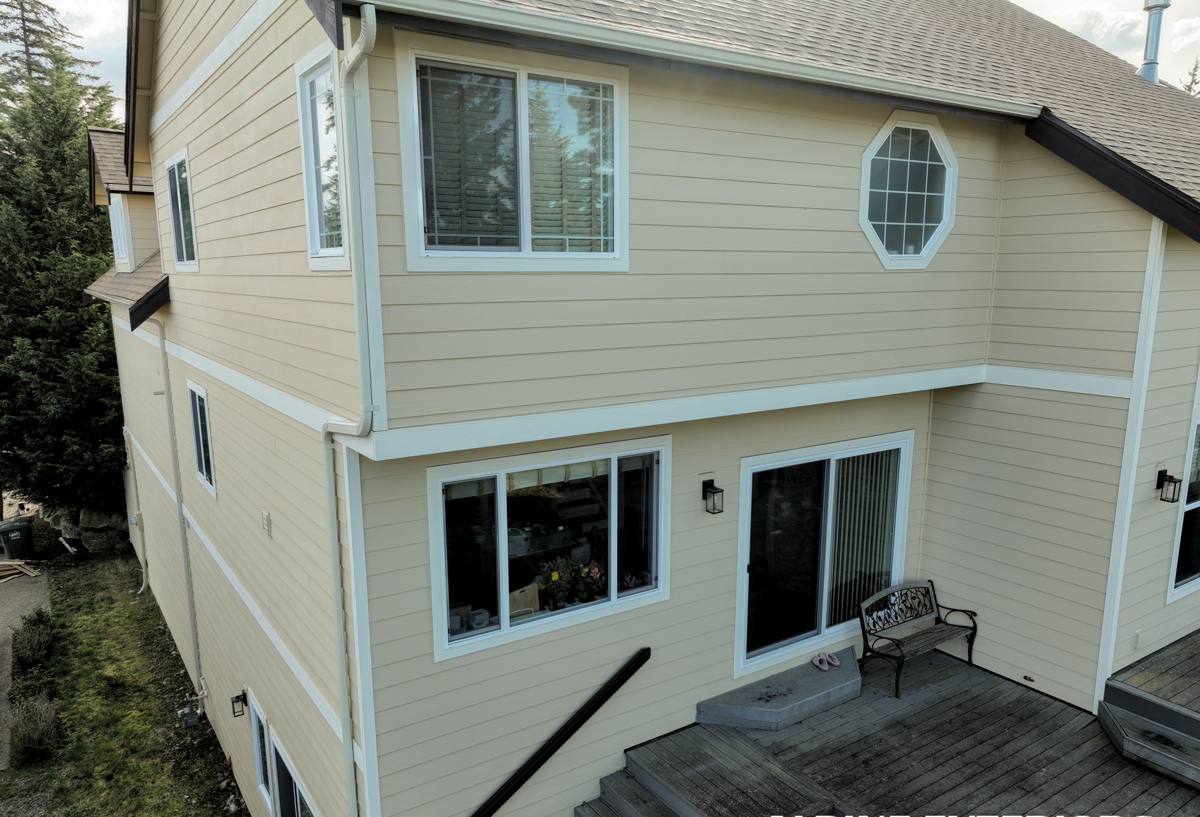
What Salt Air, Rain, and Moss Actually Do to a Deck
Fasteners and Hardware
Salt air accelerates corrosion on anything metal — screws, joist hangers, bolts, post bases. Standard electro-galvanized fasteners can start rusting from the inside out within a handful of years this close to the water, well before the visible decking shows its age. Once a fastener corrodes, it loses holding strength long before it looks obviously bad, which is part of why deck failures near the coast can be more sudden than homeowners expect.
Ledger Board and Structural Framing
The ledger board — where the deck attaches to the house — and the main support framing are the parts most likely to fail quietly. Driving rain gets pushed sideways into any gap in flashing or fastening, and without a real drainage plane behind the ledger, moisture works its way into the framing over years. By the time it shows on the surface, the wood underneath is often already compromised.
Decking Surface and Moss
Moss doesn't just look bad — it holds moisture against the decking surface for months at a time, which speeds up rot in wood decking and can make composite and PVC surfaces dangerously slick. In shaded, damp corners of a lot (which describes a lot of Point Whitehorn's tree-lined properties), moss can establish itself within a single wet season if a deck isn't sloped and ventilated properly underneath.
Signs Your Point Whitehorn Deck Needs Replacing, Not Patching
Not every problem deck needs a full tear-out. But there's a point where patching boards or re-sinking a few screws is just delaying a bigger repair. Here's what tells us a deck has crossed that line:
- Soft or spongy spots when you walk across the decking, especially near the house or at board ends
- Visible rust streaking around fastener heads or joist hangers
- Gaps or separation at the ledger board where it meets the house siding
- Persistent moss or dark staining that comes back within weeks of cleaning
- Railing posts that wiggle or feel less solid than they used to
- Structural framing (joists, beams) visibly discolored, cracked, or crumbling when probed with a screwdriver
- A deck older than 15–20 years that has never had ledger flashing or hardware upgraded
If you're only seeing one or two of these and the framing underneath tests solid, a repair might genuinely be the right call — we'll tell you that straight if it's true. If several of these apply, or the substructure is compromised, replacement is usually the more honest and more cost-effective path over the next decade.
Decking Material Options for This Microclimate
There's no single "best" decking material for every home — it depends on budget, how much upkeep you want to do, and how exposed the deck is to salt air and standing moisture. Here's how the common options actually perform in a Birch Bay coastal setting:
| Material | Moisture/Salt Behavior | Maintenance | Trade-offs |
|---|---|---|---|
| Pressure-treated wood | Decent if sealed regularly; prone to checking and moss growth if neglected | Annual cleaning and re-sealing recommended | Lowest upfront cost, shortest lifespan without upkeep |
| Cedar | Naturally moisture-resistant but still needs periodic finish maintenance near salt air | Moderate — cleaning and finish every 2–3 years | Better look and feel than treated pine, still an organic material that ages |
| Capped composite | Very good — the polymer cap resists moisture absorption and salt staining | Low — occasional washing | Higher upfront cost; can still get slick with moss film if shaded and unwashed |
| PVC decking | Excellent — fully synthetic, doesn't absorb moisture | Lowest — soap and water | Highest upfront cost; some products have a more plastic look/feel underfoot |
For heavily shaded, moisture-prone lots — which describes a fair number of properties tucked back from the water at Point Whitehorn — we usually steer homeowners toward capped composite or PVC for the field decking, even if the budget leans toward wood elsewhere on the project. The maintenance savings tend to pay for themselves within the first several years given how often a wood deck needs attention out here.
What a Correct Deck Replacement Involves
Full Demolition and Substructure Inspection
We don't just pull decking boards and reuse the frame underneath. A real replacement means getting down to the ledger, posts, and footings to actually see what's there. This is where we find the problems a homeowner usually can't see from the surface — soft joists, undersized footings, or a ledger that was never properly flashed to begin with.
Ledger Flashing and Drainage
This is the single most important detail on a coastal deck rebuild. Proper ledger flashing — installed correctly behind the siding, not just caulked on top of it — is what keeps driving rain from working its way into the house framing over time. We treat this as non-negotiable, not an upgrade option.
Fastener and Hardware Grade
Given the salt air, we build with hot-dip galvanized or stainless-rated structural hardware rather than standard electro-galvanized fasteners. It costs more up front and it's the difference between hardware that's still solid in fifteen years and hardware that's rusting through in five.
Framing and Post Spacing
We size joists, beams, and post spacing to current code requirements, not just to match what was there before — a lot of older Birch Bay decks were built to a lighter spec than current standards call for, especially if they've been added onto or modified over the years.
Decking Installation and Ventilation
Proper board spacing and airflow underneath the deck matters as much as the material choice. A deck that can't breathe underneath holds moisture regardless of what's on top of it, which is exactly the moss-and-rot cycle we're trying to break.
Permits and Site Considerations Near the Water
Deck replacement projects in unincorporated Whatcom County, including Birch Bay and surrounding areas, typically require a building permit once you're talking about a full structural rebuild rather than a like-for-like board swap. Properties closer to the shoreline or on a bluff can also fall under additional review depending on setbacks and critical areas rules. We handle the permitting conversation as part of the estimate process so there are no surprises mid-project — if your specific lot needs extra review, we'll flag that before work starts, not after.
Our Process From Estimate to Finished Deck
- Free on-site visit and inspection — we look at the deck, the substructure, and the site itself, including how exposed it is to wind, salt spray, and shade
- Honest assessment of repair vs. replace, with the reasoning explained, not just a recommendation
- Written estimate covering material options, structural scope, and permit needs
- Scheduling that accounts for Whatcom County's wetter months where possible, so framing isn't left exposed longer than necessary
- Demolition and substructure inspection, with any surprises discussed before we proceed
- Framing, flashing, and hardware installation to current code and coastal-grade fastener standards
- Decking, railing, and finish work
- Final walkthrough so you know how to maintain whatever material you chose
Cost Factors for a Point Whitehorn Deck Replacement
We're not going to quote a number here that doesn't mean anything without seeing your deck — size, framing condition, height off grade, railing style, and material all move the price. What we can tell you is what tends to move the number most:
| Factor | Why It Matters |
|---|---|
| Substructure condition | Rotted joists, beams, or footings add rebuild scope beyond the visible decking |
| Decking material | Wood, composite, and PVC span a wide cost range per square foot |
| Height and railing complexity | Taller decks and code-required guardrails add labor and material |
| Ledger and flashing work | Correcting old, improperly flashed ledgers takes extra time but protects the house |
| Site access | Slope, shoreline setback, or limited equipment access can add labor time |
Why a Crew That Already Works Point Whitehorn Matters
Anyone can build a deck. Building one that holds up to what this specific stretch of Birch Bay throws at it takes knowing the pattern of failures we see in this microclimate — where the moss builds up first, which fastener grades actually hold, how far the salt air's effects reach inland from the water. We've seen enough Point Whitehorn decks come apart at the same predictable points — the ledger, the fasteners, the shaded corners — that we build differently from the start rather than fixing the same mistake on a callback two years later.
There's also a practical side to hiring local: a crew already working in Birch Bay isn't adding a long drive to your estimate, can get back out quickly if something needs a look after the first hard winter storm, and has a reputation in the area worth protecting.
If your deck at Point Whitehorn is showing its age — or you just want an honest opinion on whether it needs replacing or can be repaired — we're glad to come take a look. The estimate is free, there's no pressure, and you'll get a straight answer either way.