 Birch Bay Siding
 Why Cherry Point's Marine Climate Is Hard on Roofs
Cherry Point sits right up against the Strait of Georgia, just a few miles from Birch Bay in Whatcom County, and that shoreline location shapes everything about how a roof ages here. Salt-laden air off the water accelerates corrosion on fasteners, flashing, and any exposed metal. Driving rain off the water doesn't just fall straight down — wind-driven storms push moisture sideways and up under shingle edges, testing every seam and lap in a roofing system. And the long, wet, shaded stretches of fall through spring create ideal conditions for moss and algae to take hold on north-facing slopes and anywhere tree cover keeps a roof from drying out between storms.
None of that means a roof in Cherry Point is doomed to fail early. It means the installation has to account for those conditions from day one — the right underlayment, the right fastener metal, correctly detailed flashing, and ventilation that actually moves air instead of just being present on paper. A roof built to a generic spec will show its age here faster than the same roof built with this coastline in mind.
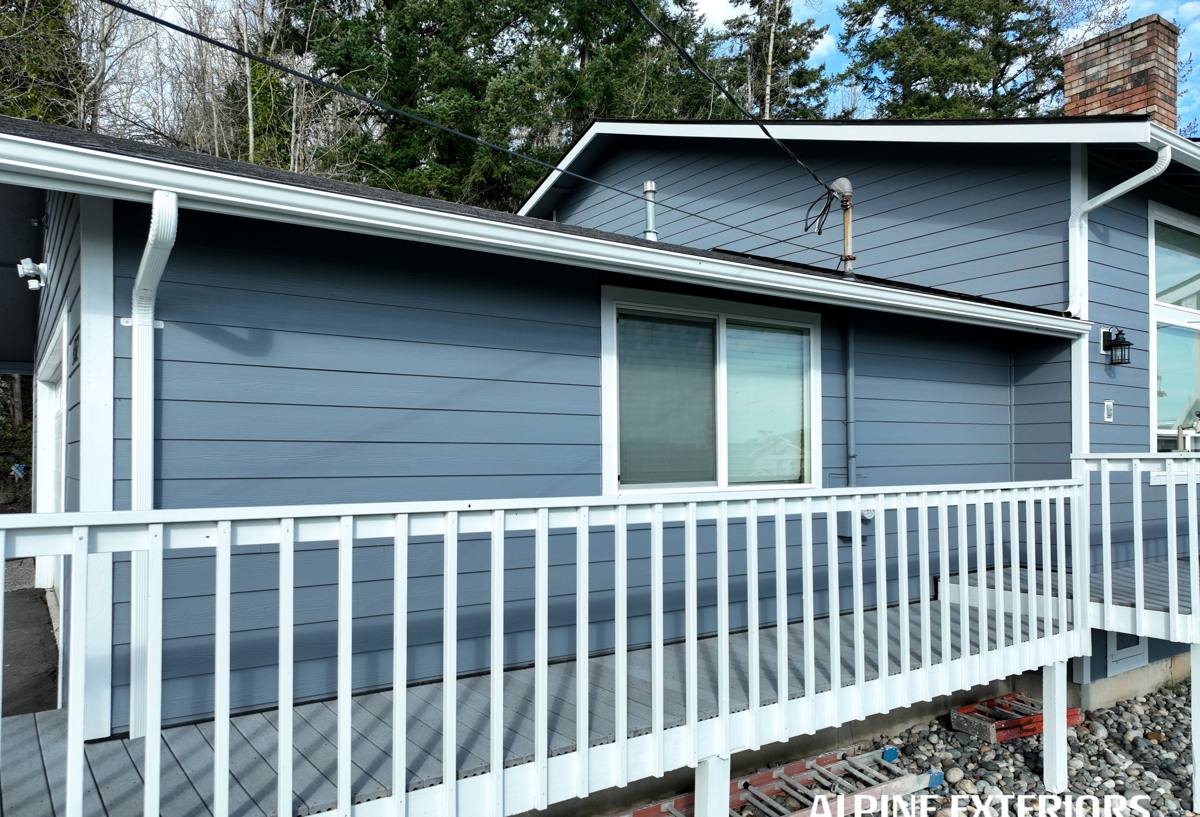
Signs a Cherry Point Roof Needs Full Replacement, Not Just a Repair
Most homeowners call us thinking they need a repair, and sometimes that's true. But there's a point where patching individual problem areas stops making financial sense and a full replacement becomes the honest recommendation. Some of the clearest signals:
- Granule loss heavy enough that you're finding gravel-like debris in gutters after every storm, not just after a wind event
- Shingles that are cupping, curling, or cracking across large sections rather than in one isolated spot
- Moss growth thick enough to lift shingle edges or hold standing moisture against the roof deck
- Soft spots or visible sagging when viewed from the ground or attic, which usually points to deck damage underneath
- Daylight visible through the roof deck from inside the attic, or water stains that reappear after repairs
- A roof that's already had two or more repair visits in the last few years for different leaks
If your roof is showing one or two of these signs in isolation, a repair may still be the right call, and we'll tell you that honestly. If several are present at once, especially on an older roof, replacement is usually the more cost-effective path — repeated repairs on a roof near the end of its service life rarely add up to less than one properly done replacement.
Roofing Materials That Hold Up Near Birch Bay and Cherry Point
There's no single "best" roofing material — the right choice depends on your budget, your home's style, and how much maintenance you're willing to do. Here's how the common options actually perform in this specific coastal environment:
| Material | Salt Air / Corrosion | Moss Resistance | Typical Lifespan Here |
|---|---|---|---|
| Architectural asphalt shingle | Good with stainless or coated fasteners | Moderate — needs clean valleys and good airflow | 20-30 years |
| Standing seam metal | Very good with marine-grade coatings and fasteners | Excellent — sheds moisture quickly | 40-50+ years |
| Synthetic / composite shingle | Good, resists moisture absorption | Good — doesn't hold water like organic materials | 30-50 years |
| Basic 3-tab asphalt | Fair — more fastener exposure over time | Weaker in shaded, wet areas | 15-20 years |
We don't push one product on every home. What we do insist on is matching fastener and flashing metal to the material — mixing incompatible metals near saltwater air causes galvanic corrosion that shows up as rust streaking and premature failure, sometimes within just a few years. That detail gets skipped more often than homeowners realize, and it's one of the first things we check when we're asked to look at a roof someone else installed.
What a Correct New Roof Installation Actually Involves
Tear-Off and Deck Inspection
A proper installation starts with a full tear-off down to the deck, not a layover on top of old material. That's the only way to actually see the deck condition — soft, delaminated, or water-damaged plywood needs to be replaced before anything new goes down, and skipping this step is how a brand-new roof ends up with problems within a few years.
Underlayment and Water Protection
Given the amount of driving rain this stretch of coastline sees, underlayment choice matters more here than in drier parts of the state. We use synthetic underlayment across the full deck and self-adhering ice-and-water membrane at the vulnerable points — eaves, valleys, and around every roof penetration — where wind-driven rain is most likely to find a way in.
Flashing Details
Flashing is where most roof leaks actually originate, not the field of the roof itself. Step flashing at walls, counter-flashing at chimneys, and properly lapped valley flashing all need to be installed in the correct sequence with the underlayment, not caulked on as an afterthought. Corrosion-resistant metal is non-negotiable this close to the water.
Ventilation
Balanced intake and exhaust ventilation keeps the underside of the roof deck dry and at a stable temperature, which slows moss growth from underneath and prevents the moisture buildup that leads to premature deck rot. We calculate ventilation needs for the actual attic and roof, not a one-size-fits-all vent count.
Moss and Algae: Prevention Built Into the Install
Moss doesn't just sit on top of a roof looking bad — its root structure holds moisture against the shingle surface and works its way under tabs and edges over time, which is how a moss problem turns into a leak problem. In a climate with as much shaded, wet weather as Whatcom County sees for much of the year, prevention has to be part of the installation, not an afterthought homeowners handle later. That means proper slope and valley design so water doesn't pool, zinc or copper strips at the ridge on shingle roofs where appropriate, and making sure nearby tree cover and airflow are factored into the layout. We'll also give you an honest maintenance schedule — periodic gentle cleaning and gutter clearing goes a long way toward protecting the investment, and we'll tell you what that upkeep actually requires rather than overselling a "maintenance-free" roof that doesn't exist in this climate.
Our New Roof Installation Process
- On-site inspection and estimate — we look at the existing roof, deck, ventilation, and any problem areas, and give you a written estimate with no pressure to decide on the spot.
- Material selection — we walk through the tradeoffs for your home and budget rather than steering you toward whatever's easiest for us to install.
- Scheduling around weather — tear-offs are timed to avoid leaving a deck exposed during an incoming storm system, which matters more here than in drier regions.
- Tear-off, deck repair, and installation — full removal of old material, deck inspection and repair as needed, then underlayment, flashing, and roofing material installed to manufacturer and code specification.
- Site cleanup — magnetic sweep for nails and full debris removal before we consider the job finished.
- Final walkthrough — we go over the finished roof with you, including what maintenance to expect and when.
Before You Hire: A Cherry Point Homeowner's Checklist
- Confirm the contractor is licensed and insured in Washington, and ask to see current proof
- Ask specifically how they handle flashing and fastener corrosion in a marine environment
- Get the underlayment and ventilation spec in writing, not just the shingle brand
- Ask what happens if deck damage is found once tear-off begins — it should be a clear add/alternate, not a surprise
- Confirm manufacturer warranty terms and whether the installer is certified to offer extended coverage
- Ask how they plan around weather during the project, given how unpredictable coastal storms can be
Why Local Experience in This Area Matters
A roofing crew that regularly works Birch Bay, Cherry Point, and the surrounding Whatcom County coastline has already seen how the local combination of salt exposure, wind-driven rain, and moss pressure plays out over years, not just at installation. That experience shows up in small decisions — which fastener metal to spec, how tight the flashing laps need to be at an exposed gable end, how much ventilation a shaded, moisture-heavy roof actually needs. It's the difference between a roof that's built to a generic checklist and one that's built for the specific conditions it has to survive here.
If your roof is showing its age, or you'd simply like an honest opinion on whether repair or replacement makes more sense for your home, we're glad to take a look. Reach out for a free, no-pressure estimate using the form below — we'll walk the roof, answer your questions straight, and give you a clear picture of your options before you decide anything.