 Birch Bay Siding
 What Lynden's Weather Actually Does to a House
Lynden sits a short drive inland from Birch Bay, and while it doesn't take the direct salt spray you get right on the shoreline, it shares the same weather pattern that defines exterior work across this part of Whatcom County: long stretches of low-intensity rain, high humidity for most of the year, and a moss and algae season that can run eight months or longer. Add wind-driven rain off the Salish Sea during winter storms, and you have a climate that punishes any siding product with weak water management or a finish that can't hold up to constant damp.
This isn't a climate that destroys a house in one dramatic event. It's a climate that finds every small gap, every unsealed joint, every spot where paint or caulking was asked to do a job it was never designed for — and works on it, year after year, until something fails. That's the lens we use when we talk to Lynden homeowners about siding: not "what looks good on install day," but "what still looks and performs the same in year fifteen."
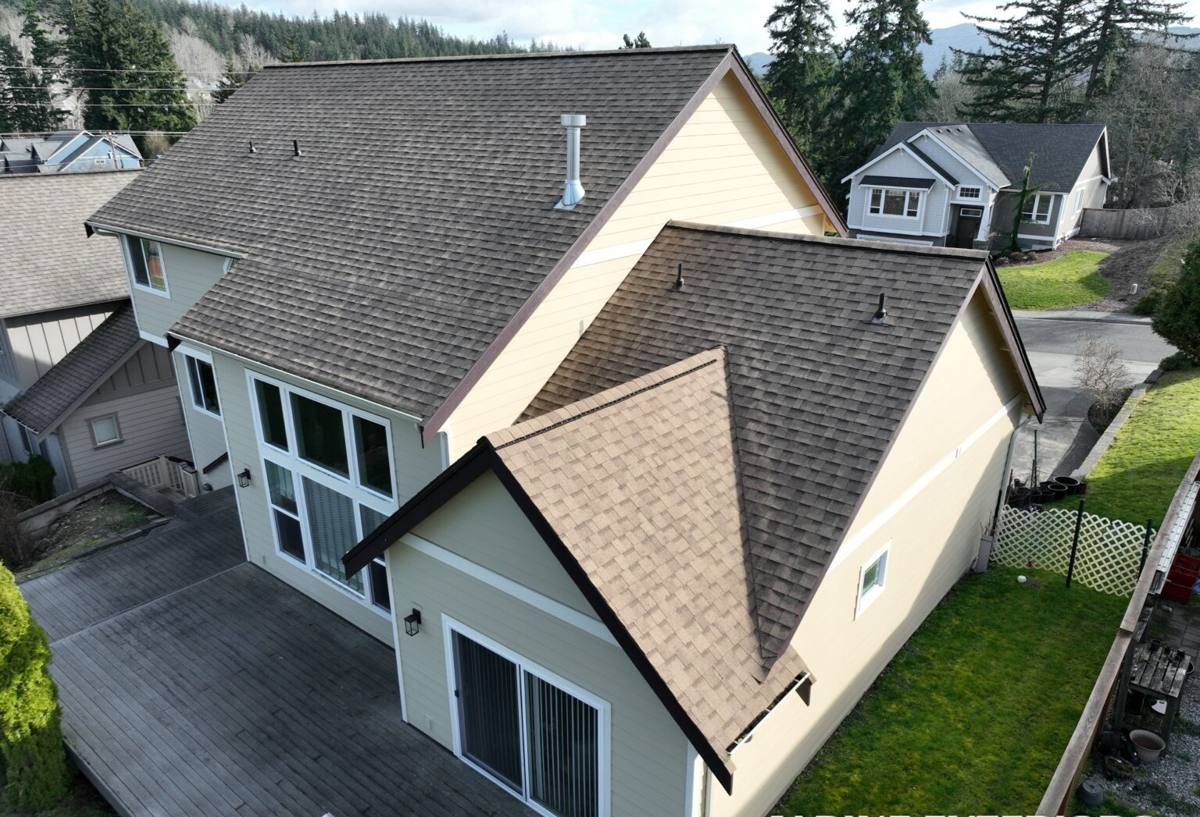
Why We Only Install James Hardie Fiber Cement
We're upfront about this with every homeowner we talk to: we don't install vinyl, LP SmartSide, cedar, or primed wood siding. We install James Hardie fiber cement, exclusively. That's not a marketing angle — it's a decision built around what actually holds up in Whatcom County's climate.
Fiber cement is non-combustible and dimensionally stable, meaning it doesn't expand and contract with moisture the way wood-based products do. That matters directly in a climate with this much sustained humidity — wood fibers in engineered wood siding absorb ambient moisture over time, and repeated wet-dry cycling is exactly what leads to swelling, edge softening, and eventual failure at cut ends and seams. James Hardie's ColorPlus factory-applied finish is also baked on and cured under controlled conditions, which gives it far better fade and moisture resistance than field-applied paint — a real advantage in a market where afternoon field-painting isn't even reliable because of how often rain interrupts a work schedule.
None of this means other products are junk. Engineered wood siding has real advantages in cost and ease of installation, and vinyl has its place for budget-conscious projects. But we've made a professional call: in this specific climate, with this much sustained moisture exposure, we want our name on a product engineered for it. That's why every job we take on is Hardie, and why we can speak to it with real depth instead of switching pitches between products.
The Right Hardie Product Line for This Area
James Hardie makes climate-specific formulations under its HZ5 engineering, designed for regions with freeze-thaw cycling and sustained moisture — which describes Whatcom County well, including the Lynden area's cooler, wetter winters. Beyond the base material, the panel style and profile choice affects how a home performs and looks:
| Product | Best Fit For | Notes |
|---|---|---|
| HardiePlank Lap Siding | Most single-family homes, classic and craftsman styles | Available in several exposure widths and textures (smooth or cedarmill) |
| HardieShingle | Accent gables, dormers, Cape Cod-style homes | Staggered or straight-edge panels for a shingle look without wood's moisture issues |
| HardiePanel Vertical Siding | Modern facades, garage gables, mixed-material designs | Often paired with board-and-batten trim |
| HardieTrim | Corners, fascia, window and door trim | Matches ColorPlus finish for uniform, low-maintenance trim lines |
Color selection matters here too. ColorPlus finishes come pre-matched to trim and accessories, which avoids the mismatched-touch-up problem that shows up fast on a house that spends most of the year under damp, overcast skies where every seam and shadow line is visible for months at a time.
Choosing Between Standard and Statement Colors
Whatcom County's muted, cloud-heavy light changes how colors read compared to a sunnier climate — deep, saturated tones can look almost black under overcast skies, while lighter neutrals tend to hold their character consistently across seasons. We talk through this with homeowners during the estimate rather than letting a color chip in bright showroom lighting make the decision alone.
What a Correct Installation Actually Involves
Fiber cement siding is only as good as the water management system behind it. James Hardie's own installation specifications are detailed for a reason — most siding failures we're called to inspect trace back to installation shortcuts, not the material itself. In a climate like this one, those shortcuts show up faster than they would somewhere drier.
- Correct weather-resistive barrier installed and lapped properly before any siding goes up
- Rainscreen or drainage gap where conditions call for it, so incidental moisture behind the siding can escape instead of sitting against the sheathing
- Proper flashing at every window, door, and roof-to-wall intersection — the single most common failure point we find on older installs
- Correct fastener type, spacing, and placement per Hardie's published fastening schedule
- Minimum clearance maintained between the bottom of the siding and grade, decks, roofing, and walkways
- All cut edges sealed or primed per manufacturer spec, since factory finish doesn't extend to a field cut
- Caulking used only where Hardie's details call for it — sealing every seam that should be able to move or drain is a common overcorrection that traps water instead of releasing it
Every one of these steps is invisible once the siding is on the wall. That's exactly why it matters who's behind the wall doing the work — a house can look identical on install day whether it was done to spec or not, and the difference only shows up years later.
Mistakes We See on Older Siding Jobs
When we're called out to look at failing siding on an existing home, the pattern is consistent: it's rarely the product that failed outright. It's usually a missed flashing detail at a window head, siding installed too close to grade or a deck surface, fasteners driven wrong so panels can't move as designed, or caulk used to "solve" a gap that should have been flashed instead. In a low-humidity climate those mistakes might take decades to matter. Here, with this much sustained moisture, they tend to surface within several years as staining, soft spots at the bottom course, or paint and finish failure around trim.
Our Process, Start to Finish
We walk every Lynden-area project through the same sequence, because skipping steps is where problems get introduced:
- On-site assessment — we look at the existing siding, sheathing condition, trim, flashing, and any moisture damage before quoting anything
- Product and color selection — matched to the home's exposure, style, and the light conditions specific to this area
- Tear-off and sheathing check — old siding removed, sheathing inspected and repaired where needed before anything new goes on
- Weather barrier and drainage plane — installed to spec, not just "good enough to cover"
- Flashing at every penetration — windows, doors, roof lines, and any wall-mounted fixtures
- Siding installation — fastened, spaced, and clearance-checked per James Hardie's published details
- Trim, caulking, and touch-up — done selectively, only where the detail calls for it
- Final walkthrough — we go over the finished work with the homeowner before calling the job done
What This Costs and What Drives the Number
We won't quote a number without seeing the house, but the honest cost drivers on a Hardie project are consistent from job to job:
| Factor | Why It Moves the Price |
|---|---|
| Tear-off scope | Removing and disposing of existing siding vs. a simpler recover scenario |
| Sheathing condition | Hidden rot or water damage found once old siding comes off adds repair work |
| Home geometry | Dormers, gables, and cut-up walls take more labor per square foot than a simple rectangle |
| Product mix | Combining lap siding, shingle accents, and panel sections costs more than one product throughout |
| Trim scope | Full HardieTrim replacement vs. reusing sound existing trim |
| Access | Multi-story sections, tight lot lines, and landscaping obstacles affect labor time |
Broadly, fiber cement siding costs more up front than vinyl but less than most premium wood systems, and the gap narrows significantly once you factor in a wood product's ongoing repainting and maintenance costs over a 20-30 year window.
Living With Hardie Siding: Moss and Long-Term Care
James Hardie siding is low-maintenance, not no-maintenance. In a moss-prone climate like this one, a small amount of routine care goes a long way toward protecting the finish and keeping the house looking right:
- Rinse the exterior annually with a garden hose and soft brush — avoid high-pressure washing, which can force water behind panels or damage the finish
- Keep gutters clear so overflow doesn't run down the face of the siding and feed moss growth
- Trim back shrubs and trees so foliage isn't holding moisture against the wall
- Watch for moss or algae buildup at north-facing walls and shaded areas, and address it early with a gentle wash rather than letting it establish
- Recaulk only where a joint was designed to be sealed — if you're not sure, that's a quick question for a siding professional rather than a guess
Why a Local Crew Matters for This Job
Siding installed to spec on paper and siding installed correctly in the field aren't always the same thing, and the difference tends to show up first in exactly the conditions Whatcom County produces — sustained rain, humidity, and moss growth. A crew that already works this area day to day has seen what actually fails locally versus what's a five-year-later problem somewhere drier, and that shapes decisions on the job — where to add extra flashing attention, which details to double-check, how to sequence work around a weather window that closes fast. That local pattern recognition is hard to replace with a spec sheet alone.
If you're weighing a siding project on a Lynden-area home, we're happy to take a look and walk you through what we'd actually recommend for your specific house — no pressure, no generic pitch. Reach out for a free estimate using the form below.