 Birch Bay Siding
 Why Decks in Lynden Wear Out Faster Than Homeowners Expect
Lynden sits in one of the wettest corners of Washington for a good chunk of the year, and that steady, driving rain is hard on outdoor structures in ways that aren't always obvious from the porch. Water doesn't just fall on a deck here — it gets pushed sideways by wind, drives under flashing, and pools in spots that never fully dry out between storms. Add in the long moss season that Whatcom County is known for, and you've got a recipe for decks that look fine on the surface while the framing underneath is quietly failing.
Moss and algae aren't just cosmetic problems. When they establish on a deck surface or in the gaps between boards, they hold moisture against the wood far longer than open air and sun exposure would allow. On shaded decks, north-facing decks, or decks tucked under trees — common around Lynden properties with mature landscaping — that trapped moisture is often the real reason a deck starts failing years before it should. Even homes further inland from the coast still sit within the same marine-influenced weather system that brings salt-tinged air and near-constant humidity across this part of the county, and it takes a toll on fasteners, connectors, and untreated wood over time.
None of this means a deck in Lynden is doomed. It means a deck built or replaced here needs to be built for these specific conditions, not just built to a generic standard that might hold up fine in a drier climate.
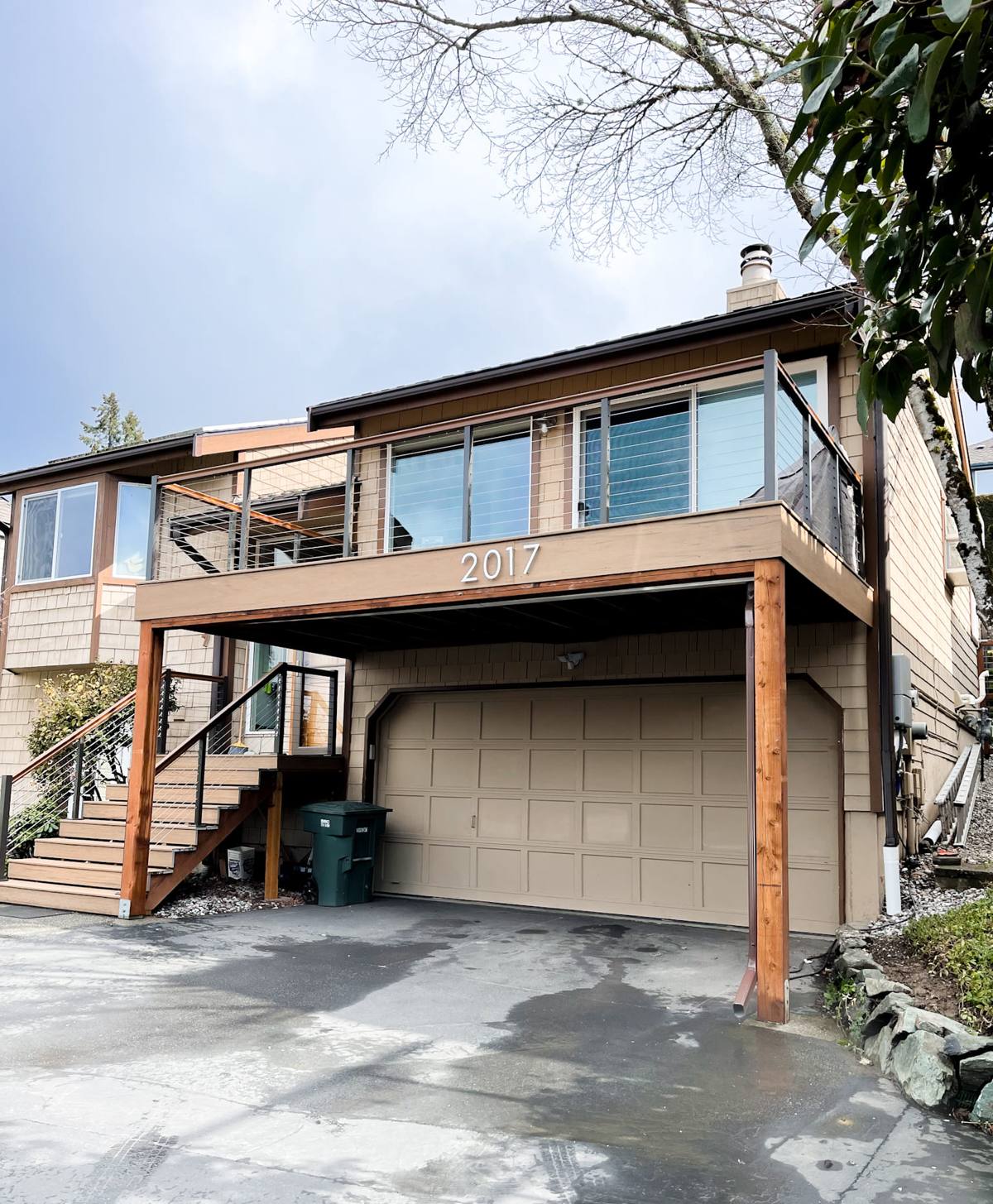
Repair or Full Replacement? How to Tell
Not every deck problem means starting over. But there's a point where patching individual boards becomes more expensive and less safe than a proper replacement. Here's what usually tips the decision toward replacement rather than repair:
- Soft or spongy spots in the decking that go beyond one or two boards
- Rot or splitting at the ledger board where the deck attaches to the house
- Posts or beams that show crumbling, punky wood when probed with a screwdriver
- Visible sag in the frame, or a deck that feels bouncy underfoot
- Rusted, corroded, or missing structural hardware — brackets, bolts, joist hangers
- A deck built without proper ledger flashing, which is common on older Lynden-area homes and almost guarantees hidden water damage behind the siding
- Railings that flex or feel loose, which is a safety issue as much as a structural one
If the problems are isolated to the surface boards and the frame underneath is sound, repair can make sense. If the issues are in the structure itself — ledger, posts, beams, footings — replacement is almost always the safer and more cost-effective path, because you're not paying to rebuild the same problem twice.
Why Patch Jobs Fail Faster Here
A repaired deck only performs as well as its weakest original component. In a climate with this much sustained rainfall, a patched board next to old, moisture-compromised framing tends to fail again within a season or two, because the underlying wood was never actually dried out or protected. That's the pattern we see most often on older decks around Lynden — surface repairs that didn't address what was happening underneath.
What a Correct Deck Replacement Actually Involves
A deck replacement done right isn't just pulling up old boards and screwing down new ones. The parts of a deck you can't see are the parts that determine whether it lasts.
Ledger Attachment and Flashing
The ledger board is where the deck ties into the house, and it's the single most common failure point on decks in this climate. Proper flashing — installed correctly, in the right order relative to the house's water-resistive barrier — keeps water from running behind the siding and into the wall framing. This is also one of the most frequently skipped or improperly installed details on older builds, and it's usually invisible until real damage has already occurred.
Footings and Framing
Footings need to be sized and set to code, with post bases that keep wood off standing water and concrete. Joist spacing has to match the actual span and decking material being used, not just whatever was there before. Given how much rain this area sees, we also pay close attention to slope and drainage in the frame itself, so water has somewhere to go instead of sitting against the wood.
Hardware and Fasteners
In a marine-influenced climate, corrosion-resistant hardware isn't optional. Hot-dip galvanized or stainless steel connectors, screws rated for ground contact and coastal exposure, and joist hangers matched to the fastener manufacturer's specs all matter more here than they would in a drier inland climate. Mismatched or under-rated hardware is a common shortcut that shows up as rust streaks and failing connections within a few years.
Ventilation Underneath
Low-clearance decks and decks built close to grade need airflow underneath to keep the frame from staying damp. We look at grading and clearance as part of every replacement, not as an afterthought.
Choosing Decking Material for This Climate
There's no single "best" decking material — there's a best material for your budget, your maintenance appetite, and how much sun or shade your deck gets. Here's how the common options actually perform in Whatcom County's wet, moss-prone conditions:
| Material | Moisture Behavior | Maintenance | Typical Lifespan |
|---|---|---|---|
| Pressure-treated wood | Resists rot when sealed regularly; end grain and fastener holes are vulnerable points | Annual cleaning and re-sealing/staining recommended | 10-15 years with upkeep |
| Cedar | Naturally moisture and insect resistant, but still needs sealing to prevent graying and moss growth | Regular cleaning and periodic sealing | 15-20 years with upkeep |
| Capped composite | Moisture-resistant shell resists rot and moss adhesion better than wood, but uncapped edges at cuts need attention | Periodic washing; no sealing or staining | 25-30 years |
| PVC decking | Fully synthetic, does not absorb water, most resistant to moss and mildew staining | Occasional washing | 25-30+ years |
We don't push one material on every job. Pressure-treated and cedar cost less up front and look great when maintained, but they demand real annual upkeep in this climate — skip a season of sealing here and moss or graying can set in fast. Composite and PVC cost more initially but hold up with far less intervention, which matters if you don't want deck maintenance on your yearly to-do list. We'll walk through the honest trade-offs for your specific deck, budget, and how much sun it gets.
Our Deck Replacement Process
- On-site assessment. We inspect the existing deck's framing, ledger, footings, and hardware to confirm what's actually failing versus what's just cosmetic.
- Design and material selection. We talk through layout, railing style, and decking material based on your budget, sun/shade exposure, and how much maintenance you want to take on long term.
- Permitting. Most deck replacements that involve structural work require a permit through your local building department. We handle that process rather than leaving it on you.
- Demolition and disposal. Old decking, framing, and hardware are removed and hauled off — no debris left for you to deal with.
- Structural rebuild. New footings, framing, ledger flashing, and hardware installed to current code, sized for your specific deck and climate exposure.
- Decking, railing, and finish work. Final surface material and railings installed, fasteners set correctly, and edges and cuts sealed or capped as needed.
- Final walkthrough. We go over the finished deck with you, including what maintenance (if any) it needs going forward.
Permits and Code Considerations
Deck replacements that involve new footings, framing, or a change in size or attachment typically require a building permit, and railing height, guardrail spacing, and stair requirements are governed by code — not personal preference. Requirements can vary depending on your specific property and jurisdiction within Whatcom County, so we confirm what applies to your project rather than assuming. Skipping the permit process on structural work can create real problems later, including at resale, so we build it into the process rather than treating it as optional paperwork.
What Affects the Cost of a Deck Replacement
| Factor | Why It Matters |
|---|---|
| Deck size and footprint | More square footage means more material, framing, and labor |
| Decking material chosen | Pressure-treated costs least up front; composite and PVC cost more but need less upkeep |
| Structural condition | Rotted footings, posts, or ledger issues add rebuild scope beyond a straight resurface |
| Height and stairs | Elevated decks and stair construction add framing complexity and railing requirements |
| Railing style | Basic wood rail versus composite, metal, or cable rail changes cost significantly |
| Demo and disposal | Removing and hauling away the old deck is part of most replacement jobs |
| Permit and inspection fees | Set by your local jurisdiction, not by us |
We don't quote decks off a phone call. An accurate number requires seeing the existing structure, confirming what's salvageable versus what isn't, and understanding what you actually want the finished deck to do for you.
Why Hire a Crew That Already Works in Lynden
A deck built without accounting for this region's rain patterns, moss cycles, and marine-influenced air is a deck that's fighting its environment from day one. Crews unfamiliar with Whatcom County conditions sometimes build to a generic standard — adequate in a drier climate, undersized here. Working regularly in and around Lynden means we've seen how local drainage, shade patterns, and weather exposure actually play out on real decks over years, not just on paper.
It also means practical advantages: familiarity with the local permitting process, established relationships with material suppliers, and scheduling that accounts for the realistic weather windows in this area rather than assuming ideal conditions. A deck replacement is a multi-day outdoor project, and knowing how to sequence the work around Whatcom County's weather is part of doing the job right.
Keeping Your New Deck in Good Shape
Whatever material you choose, a little consistency goes a long way in this climate. A basic seasonal routine we recommend to Lynden homeowners:
- Sweep debris and standing leaves off the deck regularly, especially in fall
- Rinse or wash the surface a few times a year to keep moss and algae from establishing
- Check and clear gaps between boards so water and debris don't build up
- Inspect railings and stairs for looseness at least once a year
- For wood decks, reseal or restain on the schedule your material calls for — don't wait until it's visibly graying
- Keep gutters and downspouts near the deck clear so runoff isn't dumping directly onto it
None of this requires special equipment or a big time commitment, but skipping it is how a well-built deck ends up needing early repairs anyway.
If your deck in Lynden is showing soft spots, sag, rot at the ledger, or you're just not sure whether it's a repair or a replacement situation, we're happy to take a look and give you an honest answer. Use the form below to request a free, no-pressure estimate.