 Birch Bay Siding
 Lummi Island Roofs Deal With a Different Kind of Wear
Lummi Island sits out in the Salish Sea, exposed to weather that mainland Whatcom County homes see a lighter version of. Salt-laden air comes off the water and settles on every roof surface, wind-driven rain finds its way under shingles and flashing that would hold up fine somewhere more sheltered, and the wet, shaded stretch of fall through spring gives moss months to work into a roof's weak points. None of that means Lummi Island roofs fail faster across the board — it means the failure points are different, and a repair has to account for that instead of treating the roof like it's in a subdivision fifteen miles inland.
We're based in Birch Bay and have worked roofs and siding across this stretch of the county long enough to know that a "quick patch" on an island roof either holds for years or fails again in one bad winter storm, with very little middle ground. The difference is almost always in how well the repair accounts for salt exposure, water path, and moss, not just whether a shingle got replaced.
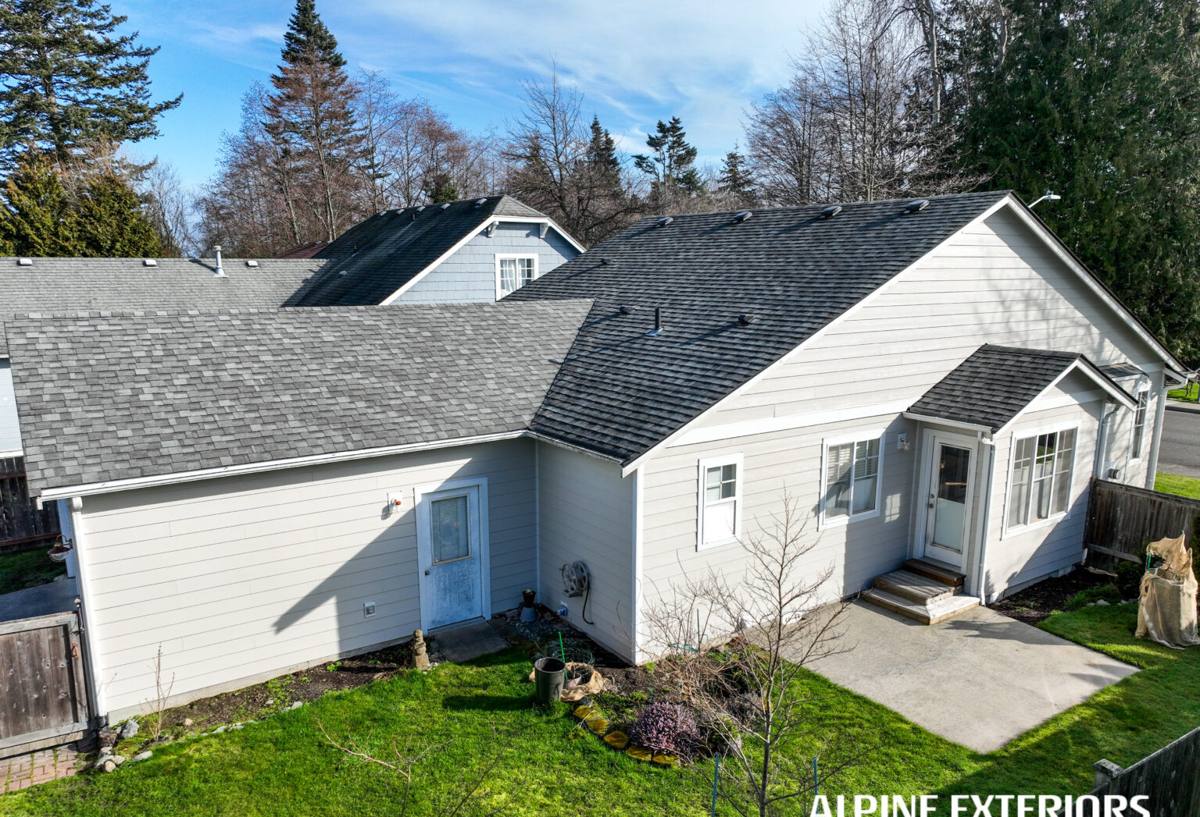
What Salt Air, Driving Rain, and Moss Actually Do
Salt Air and Corrosion
Salt air is hardest on metal — flashing, fasteners, gutter hangers, and any exposed nail heads. Galvanized fasteners and standard flashing can corrode faster near open water than the manufacturer's spec sheet assumes, and once a fastener starts to go, the seal around it goes with it. This is slow, so it's easy to miss during a quick visual check from the ground.
Wind-Driven Rain
Rain that comes in sideways off the water behaves differently than rain falling straight down. It gets pushed up under shingle tabs, into flashing laps, and around any penetration — vent stacks, chimneys, skylights — that was sealed for normal rainfall but not for wind pressure pushing water uphill against the shingle line. A lot of "mystery leaks" on exposed island homes trace back to this, not to a missing shingle.
Moss Season
Whatcom County's wet season runs long, and shaded or north-facing roof sections on Lummi Island often stay damp for weeks at a stretch. Moss doesn't just sit on top of shingles — it lifts the edges as it grows, holds moisture against the roofing material, and works its way toward valleys and flashing lines where water is already trying to get through. A roof that looks mossy but "fine" from the driveway is often further along than it looks.
Signs a Lummi Island Roof Needs Repair
Most homeowners call us after noticing one of these. On an island roof, we treat all of them as worth a real inspection rather than a guess over the phone:
- Granules collecting in gutters or at downspout outlets
- Moss or dark streaking concentrated on shaded or north-facing slopes
- Soft or discolored ceiling patches after a windy rainstorm, especially near a chimney or vent
- Lifted, curled, or missing shingles after a storm with strong wind off the water
- Rust staining below metal flashing or fasteners
- Daylight visible through the roof deck in an attic or crawlspace check
- Gutters pulling away from the fascia or sagging under moss and debris weight
What a Correct Repair Actually Involves
Diagnosis Before Anything Gets Replaced
A leak on an exposed roof rarely shows up directly above the water stain — wind-driven rain can travel several feet along the underlayment or decking before it drips through. We trace the actual entry point before touching a single shingle, because replacing shingles over the wrong spot just delays the same repair call.
Flashing Gets the Same Attention as Shingles
Most of the repeat leaks we see on island homes come back to flashing, not roofing material — around chimneys, at wall-to-roof transitions, in valleys, and around vent stacks. If the shingles are fine but the flashing underneath has corroded or lifted, replacing shingles alone won't fix anything. We treat flashing condition as equal priority to the roofing surface itself, particularly given how salt air shortens the life of standard metal flashing here.
Matching Materials, Not Just Covering the Spot
A patch that doesn't match the existing shingle's exposure, granule color, or profile will shed water differently than the surrounding roof and often becomes the next failure point. On an older roof this sometimes means we can't get an exact match — when that's the case, we say so upfront and talk through the honest options rather than installing something that looks off or performs worse.
Dealing With Moss the Right Way
Pressure-washing moss off a roof does more harm than good — it drives moisture and debris under shingle tabs and can strip granules that protect the shingle from UV and weather. Correct moss removal is a gentler process, followed by clearing the debris that's been trapping moisture against the roof deck, and addressing the shade or drainage issue that let moss take hold in the first place where that's practical.
How Our Process Works
- Phone or online request — tell us what you're seeing (stain, missing shingles, storm damage) and where on the roof.
- On-site inspection — we look at the roof surface, flashing, attic or ceiling where accessible, and gutters, and trace any active leak to its real source.
- Written scope and price range — what needs repair, what we recommend watching but not touching yet, and a clear cost range before any work starts.
- Repair, done to match — flashing, shingles, sealant, and moss treatment as needed, using materials suited to the exposure the roof actually sees.
- Walkthrough — we show you what was done and what to keep an eye on going forward.
Repair or Replacement? What Actually Drives That Decision
Not every damaged roof needs a full replacement, and not every roof that "just needs a patch" is a good repair candidate. These are the factors that actually matter:
| Factor | Favors Repair | Favors Replacement |
|---|---|---|
| Age of roof | Under roughly 12-15 years | Near or past expected material lifespan |
| Extent of damage | Localized — one slope, one flashing area | Spread across multiple slopes or recurring in several spots |
| Decking condition | Solid, dry decking under the damaged area | Soft, rotted, or repeatedly wet decking |
| Moss/algae history | First occurrence, caught early | Chronic moss returning across multiple seasons |
| Material availability | Close match to existing shingle still available | Discontinued or badly weathered material with no match |
When a repair is the honest answer, that's what we recommend. When the underlying material or decking is too far gone to repair reliably, we'll tell you that too, along with why — we're not going to sell a patch we don't expect to hold.
Why It Matters to Hire a Crew That Already Works Lummi Island
Working on Lummi Island isn't the same logistics as a mainland Whatcom County job. Getting a crew, tools, and materials to the site means planning around the ferry schedule, which affects how a job gets scoped and timed — a crew that hasn't worked the island before tends to underestimate this and either shows up without what they need or pads the price to cover the uncertainty. We've built our scheduling around it, so estimates reflect real logistics instead of guesswork, and repairs don't stall out waiting on a second trip for a part that should have come the first time.
There's also a materials side to this. A roofer who mostly works inland doesn't necessarily stock or spec fasteners and flashing rated for direct salt exposure, because most of their jobs don't need it. Working this coastline regularly means knowing which materials actually hold up here versus which ones look fine on a spec sheet but corrode early once they're a few hundred feet from open water.
Maintenance That Extends a Repair's Life Here
A good repair on an exposed roof still needs some upkeep to get its full life out of it. A few habits make a real difference:
- Clear gutters and downspouts at least twice a year — clogged gutters back water up under the roof edge
- Trim back branches overhanging the roof to cut down on shade, debris, and moss growth
- Have moss treated at the first sign of it rather than waiting for a full season of growth
- After any major windstorm off the water, do a quick visual check for lifted or missing shingles
- Have flashing checked every few years even if there's no visible leak — corrosion often starts before it shows
Get a Straight Answer on Your Roof
If you're seeing moss, a stain on a ceiling, or storm damage on a Lummi Island roof, it's worth getting a real look before deciding whether it's a repair or something bigger. We'll give you a free, no-pressure estimate and an honest read on what the roof actually needs — use the form below to get started.