 Birch Bay Siding
 Ferndale's Climate Puts Extra Demands on a New Roof
Ferndale sits close enough to the water that a roof here deals with a different mix of stress than a roof twenty miles inland. Salt-laden air drifts in off the Salish Sea and Birch Bay, and over years that air is hard on exposed metal — fasteners, flashing, drip edge, anything that isn't corrosion-resistant starts to show it. Add in Whatcom County's driving rain, which comes in sideways during winter storms instead of falling straight down, and any weak point in a roof's flashing or underlayment gets tested constantly rather than occasionally.
Then there's moss. Ferndale's mix of mild temperatures, shade from mature trees, and long stretches of damp weather means moss season isn't really a season here — it's most of the year. Moss doesn't just look bad; it holds moisture against the roofing material, lifts shingle edges, and works its way toward fasteners and decking over time. A roof designed and installed without that in mind will age faster than one built for it.
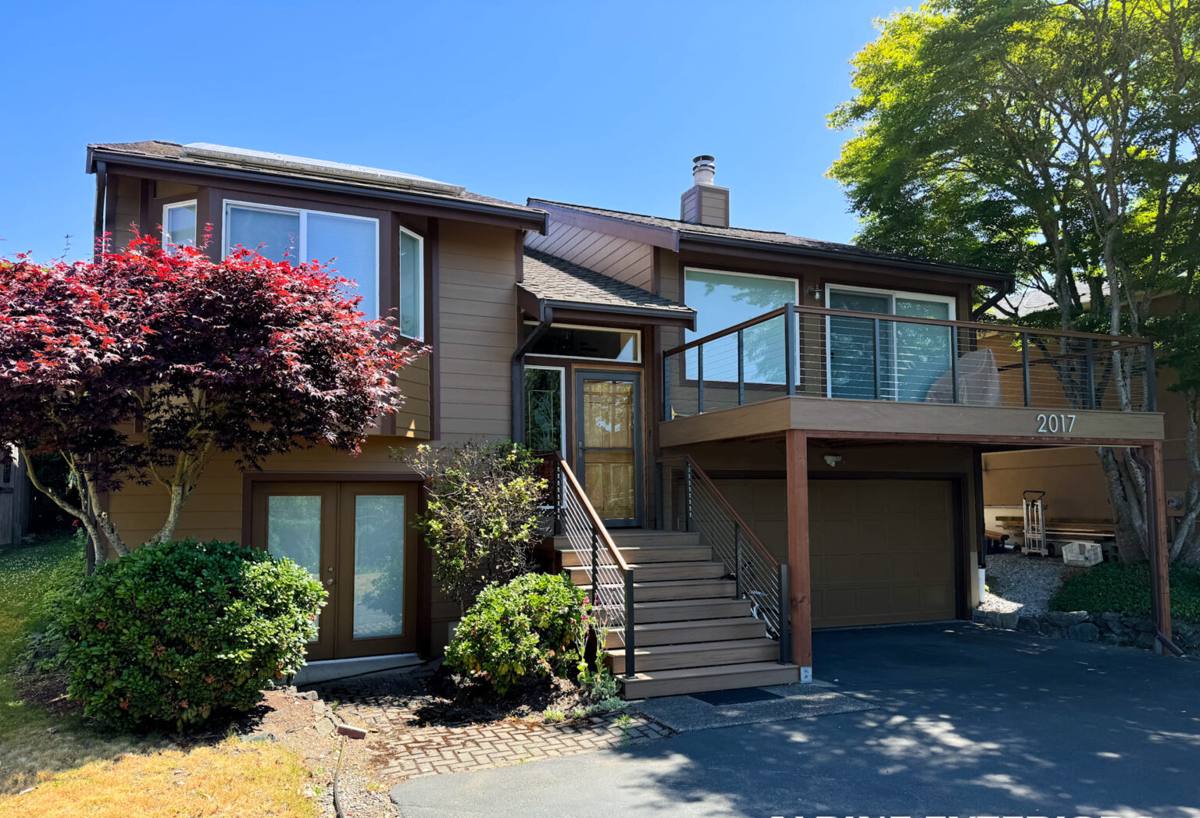
Signs a Ferndale Home Needs a New Roof, Not Another Repair
Every roof reaches a point where patching stops making financial sense. Knowing where that line is saves homeowners from paying for repairs on a roof that's already past its useful life.
Age and Material Life
Standard asphalt composition shingles are typically rated for 20 to 30 years, but that number assumes a moderate climate. In a marine environment with this much moisture exposure, the practical service life often runs shorter, especially on the north-facing slopes that stay shaded and damp longest. If a roof is past 20 years and has never been fully replaced, it's worth a real inspection rather than another round of spot repairs.
Visible Damage Patterns Common Here
A few patterns show up again and again on older roofs in this area:
- Granule loss concentrated on shaded or moss-prone slopes, exposing bare asphalt underneath
- Shingle edges lifted or curled where moss has grown along the tab lines
- Soft or spongy decking near valleys, chimneys, or skylights where flashing has failed quietly for years
- Rust streaking below flashing or fasteners, a sign the salt air has already gotten to the metal
- Daylight or water staining in the attic near the ridge or eaves after a windy rainstorm
Any one of these can sometimes be repaired in isolation. Several at once usually means the roofing system as a whole is failing, not just one section of it.
What a Correct New Roof Installation Actually Involves
A new roof is only as good as the layers homeowners never see once it's finished. Skipping or rushing any of these steps is where most premature failures start.
Tear-Off and Deck Inspection
We remove the existing roofing down to the decking rather than layering over it. That's the only way to actually see the plywood or plank sheathing underneath — soft spots, delamination, or old water damage don't show up until the old material is off. Any compromised decking gets replaced before anything new goes down; installing new shingles over a weak deck just hides the problem for another few years.
Underlayment and Ice-and-Water Shield
Given how much wind-driven rain this area sees, underlayment choice matters more here than in drier climates. We use synthetic underlayment across the field of the roof and self-adhering ice-and-water membrane at the vulnerable points — eaves, valleys, and around any roof penetration — where wind-driven rain is most likely to work its way under the shingles.
Flashing Details
Flashing around chimneys, skylights, sidewalls, and valleys is where the majority of roof leaks actually originate, not in the open field of shingles. We install new step flashing, counter-flashing, and valley metal rather than reusing old pieces, and we use corrosion-resistant materials given the salt air this close to the coastline.
Ventilation
A roof needs balanced intake and exhaust ventilation to manage moisture and temperature in the attic. We check and correct ventilation as part of every installation — this is one of the most commonly overlooked parts of a roof job, and it directly affects how long the new roof will last.
Roofing Materials We Install — and the Trade-offs
There's no single "best" roofing material for every home. What matters is matching the material to the house, the budget, and the realities of this climate. Here's how the common options compare for a Ferndale roof:
| Material | Typical Lifespan | How It Handles This Climate |
|---|---|---|
| Asphalt composition shingle | 20–30 years | Good value, wide color range, performs well with proper ventilation and moss-resistant granules |
| Architectural (laminate) shingle | 25–35 years | Thicker profile holds up better to wind uplift and driving rain than 3-tab shingles |
| Standing seam metal | 40–60 years | Sheds moss and moisture well, strong wind resistance; higher upfront cost |
| Cedar shake | Varies widely | Requires regular treatment and cleaning to manage moisture and moss in this climate; higher ongoing maintenance |
We're upfront with homeowners about maintenance burden as part of that conversation. Cedar shake can look great, but in a climate this damp it needs consistent upkeep to avoid moss and moisture issues — that's a maintenance commitment, not a defect in the product, and it's worth knowing before you commit to it. For most Ferndale homes, we recommend architectural shingle or metal as the lower-maintenance path.
Our New Roof Installation Process
Homeowners deserve to know what's happening on their house and when. Our process is the same on every job:
- On-site inspection of the current roof, decking, ventilation, and any problem areas
- Written estimate covering material options, scope of work, and timeline — no pressure to decide on the spot
- Material selection and permit pull through Whatcom County where required
- Tear-off, deck inspection, and any necessary sheathing repair
- Installation of underlayment, ice-and-water shield, and new flashing at every penetration and edge
- Ventilation check and correction if intake or exhaust airflow is inadequate
- Final installation of the chosen roofing material
- Jobsite cleanup, including a magnetic sweep for stray fasteners
- Final walkthrough with the homeowner before we consider the job done
Ventilation and Moisture Control: What Keeps a Roof Working Long-Term
A well-installed roof can still fail early if the attic underneath it can't breathe correctly. Warm, moist air that gets trapped in an attic condenses on the underside of the decking, which rots sheathing from the inside and creates ideal conditions for mold — separate from any issue on the roof's surface. In a marine climate with high ambient humidity for much of the year, this matters more than in a dry region.
We size and balance intake vents (usually at the soffits) against exhaust vents (ridge or roof-mounted) so air actually moves through the attic space instead of stalling. This is a small line item compared to the roofing material itself, but it's one of the biggest factors in whether a new roof reaches the top end of its expected lifespan or falls well short of it.
What Affects the Cost of a New Roof in Ferndale
Every roof is priced individually after an inspection, but the following factors are what actually move the number up or down:
| Factor | Why It Matters |
|---|---|
| Roof size and pitch | More square footage and steeper pitches mean more material and more labor time |
| Number of existing layers | Removing multiple old layers takes longer and adds disposal cost |
| Decking condition | Rotted or delaminated sheathing found during tear-off needs replacement before installation continues |
| Material choice | Asphalt, architectural shingle, and metal carry different material and labor costs |
| Roof complexity | Valleys, dormers, skylights, and chimneys all add flashing work and time |
| Access and site conditions | Steep lots, limited driveway access, or tree cover affect equipment staging and safety measures |
We walk through these factors with every homeowner during the estimate so there are no surprises once the work starts.
Why It Matters That We Already Work in Ferndale and Birch Bay
A roofing crew that only shows up occasionally in this area is learning your climate on your house. We work throughout Whatcom County, including Ferndale and Birch Bay, which means we already know how wind-driven rain behaves on exposed slopes here, how long moss season actually runs, and which flashing details tend to fail first on homes exposed to salt air off the water. That's not a marketing point — it changes real decisions, like which underlayment to spec, how much ice-and-water shield to use at the eaves, and when in the year to schedule work around the wettest stretches of the season.
We also know the permitting process through Whatcom County, which keeps the project moving instead of stalling on paperwork. A crew that's local to this area isn't guessing at any of this — it's routine.
After Installation: A Maintenance Checklist for the Marine Climate
A new roof still needs basic upkeep, and in this climate that upkeep matters more than it would somewhere drier. A short list of habits goes a long way:
- Clear gutters and downspouts at least twice a year so wind-driven rain has somewhere to go
- Have moss growth treated or removed before it spreads across a full slope, not after
- Trim back tree limbs that shade the roof and keep it damp longer than it needs to be
- Check attic ventilation isn't blocked by insulation or debris
- Have flashing points inspected after any major windstorm, since that's where leaks typically start
- Schedule a professional roof check every couple of years even if nothing looks obviously wrong
None of this replaces a correctly installed roof, but it protects the investment once the work is done.
If your Ferndale home needs a new roof, or you're not sure whether a repair will actually hold, we're happy to take a look and give you a straightforward, no-pressure estimate. Use the form below to get started.