 Birch Bay Siding
 Windows in Custer: A Different Kind of Whatcom County Exposure
Custer sits back from the water compared to a waterfront lot right on Birch Bay, but it's still squarely inside the weather pattern that defines this part of Whatcom County. The flat, open farmland around Custer doesn't do homes any favors when a storm rolls in off the Strait — there's little to break the wind, and rain that would fall straight down somewhere more sheltered gets driven sideways into siding, trim, and window openings instead. Add in salt-laden marine air that reaches well inland on a windy day and a moss season that can run most of the year on shaded walls, and you've got a climate that's genuinely hard on windows, not just siding and roofing.
We're a siding contractor based near Birch Bay, and windows are a service we approach the same way we approach a wall: as part of a system, not a standalone box you set into a hole. That matters more than most homeowners realize, because a window is the weakest point in an exterior wall — more seams, more moving parts, and more places for water to get behind the cladding than anywhere else on the building.
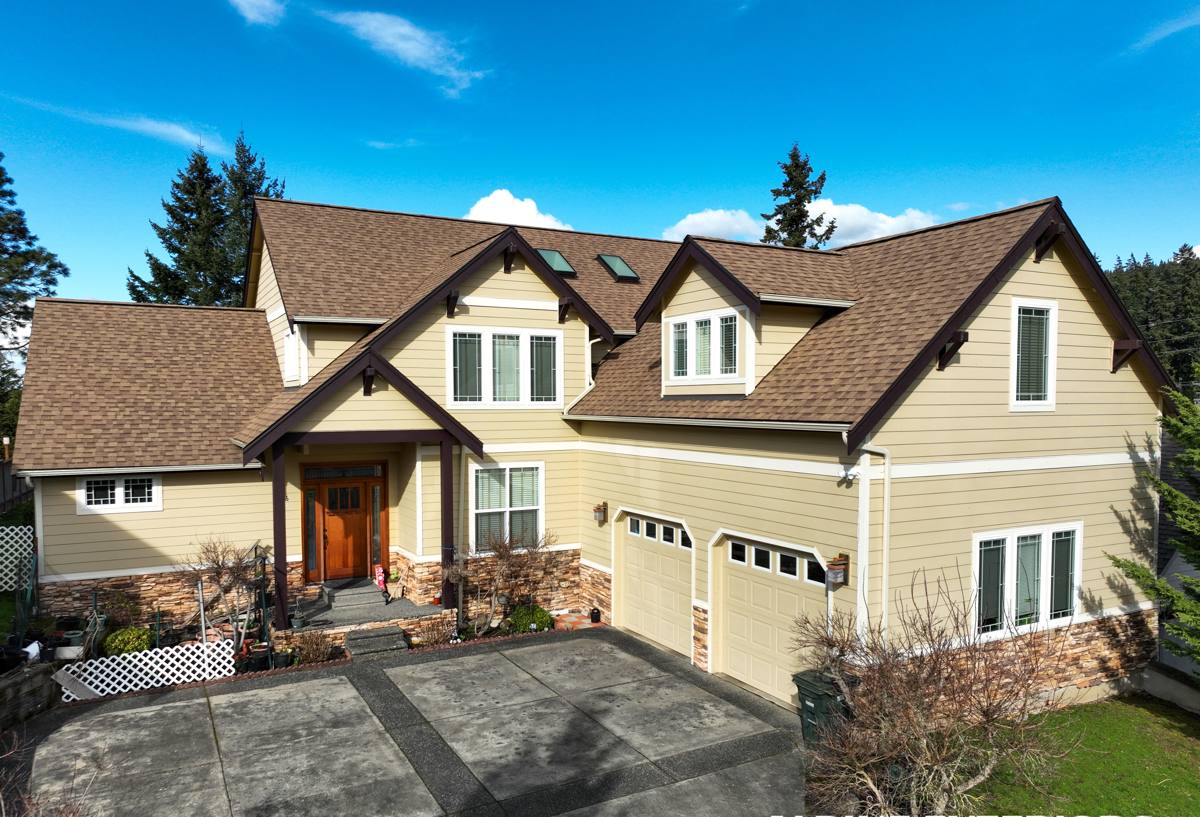
What Salt Air, Driving Rain, and Moss Actually Do to a Window Over Time
Corrosion from Salt-Laden Air
Even a few miles inland, Custer gets enough salt air carried on winter wind to accelerate corrosion on window hardware — hinges, locks, balances, and fasteners — faster than a dry inland climate would. Budget hardware that would last decades somewhere drier can start sticking, pitting, or failing within a handful of years out here. It's rarely dramatic; it just shows up gradually as a window that used to close smoothly starts binding or won't latch flush anymore.
Wind-Driven Rain Finding the Seams
Rain that comes in at an angle, rather than straight down, tests every seam around a window opening in a way calmer weather never does. That's why flashing detail matters as much as the window unit itself — water pushed sideways by wind will find any gap in the flashing or siding tie-in, and once it's behind the cladding it can travel and cause damage far from where it actually got in.
Moss and Trapped Moisture at Sills and Trim
Mild temperatures and near-constant dampness through fall, winter, and spring give moss and mildew a long growth window across this part of the county. Window sills, trim boards, and the wood framing around older windows are common places it takes hold, especially on north-facing or shaded elevations where surfaces stay wet longer between rain events. Once moisture sits instead of draining, it's only a matter of time before it starts breaking down whatever it's sitting on.
Signs a Custer Window Has Reached the End of Its Service Life
Not every symptom means full replacement, but these are the ones worth taking seriously:
- Fog or visible moisture trapped between the panes of a double-pane window
- A noticeable draft near the frame even with the window fully latched
- Sills or trim that feel soft, spongy, or discolored when pressed
- Hardware that's stiff, sticking, or won't latch flush anymore
- Visible gaps or daylight where the frame meets the surrounding siding
- Paint or finish failing noticeably faster on and around the window than on the rest of the wall
What a Correct Window Replacement Involves
Protecting the Rough Opening
Once the old unit comes out, the rough opening gets inspected before anything new goes in. This is the point where hidden problems — rot in the framing, a weather barrier that was never properly lapped, water staining that points to a long-term leak — actually get found. Skipping this step and just dropping a new window into a compromised opening is how a homeowner ends up paying for the same repair twice.
Flashing and Drainage Detail
The flashing has to lap correctly with the existing weather-resistive barrier and siding so water is directed out and down, away from the framing, rather than trapped behind the new window. This is standard on every window we install, not an upgrade a homeowner has to ask for — in a climate that sees this much driving rain, it's not optional.
Setting, Shimming, and Sealing the Unit
A window has to be shimmed level and plumb in the opening before it's fastened, or it won't operate correctly for the life of the unit — sashes will bind, locks won't seat right, and seals will wear unevenly. Insulation around the frame and sealant at the interior and exterior joints finish the job, with sealant treated as a supplement to good flashing, never a substitute for it.
Matching the Window to the Climate, Not the Other Way Around
We install vinyl and fiberglass window systems suited to a wet Pacific Northwest climate and walk homeowners through the honest trade-offs rather than steering everyone toward one product. What actually matters for a Custer home is a tight-built frame, glazing that manages both heat loss and interior condensation, and hardware that can take sustained marine air exposure without breaking down early.
| Frame Material | Moisture Resistance | Maintenance | Best Fit in Custer |
|---|---|---|---|
| Vinyl | Strong — won't rot, no coating to fail | Low; occasional cleaning | Most homes; strong value in this climate |
| Fiberglass | Strong; very stable across temperature swings | Low; can be painted if desired | Homes wanting a paintable, dimensionally stable frame |
| Wood-clad | Depends entirely on cladding integrity | Higher; cladding and seals need monitoring | Only where appearance outweighs maintenance concerns |
We steer most Custer homeowners toward vinyl or fiberglass for a practical reason: a wood-clad window's performance in this climate rides entirely on how well its cladding and seals hold up, and once that cladding is compromised, moisture gets into the wood underneath with nowhere to dry out. Vinyl and fiberglass don't carry that same maintenance burden.
Full-Frame vs. Insert Replacement: Which Makes Sense for an Older Custer Home
An insert (or pocket) replacement fits a new window into the existing frame and is faster and less invasive, but it only makes sense when that existing frame is still sound. A full-frame replacement removes the old frame entirely, down to the rough opening, and is the right call whenever there's rot, a compromised weather barrier, or a flashing detail that needs correcting rather than covering over.
On older homes in this area, we lean toward checking the frame condition carefully before recommending an insert replacement, because a fast pocket install over a frame that's already taking on water just hides the problem behind a new window instead of fixing it. It looks done. It isn't.
Why We Treat Windows and Siding as One Job, Not Two
Because we work as a siding contractor first, window replacement isn't a separate trade bolted onto our business — it's part of how we already think about the wall. The flashing around a window has to tie into the siding above, below, and to each side of it, and getting that transition wrong is one of the most common ways a window leak actually starts. A crew that only does windows, and subs out or ignores the siding tie-in, is working with an incomplete picture of the wall assembly. We don't have that gap, because the same crew handling your window flashing understands exactly how it needs to integrate with the siding around it.
Our Window Replacement Process for Custer Homes
- An on-site visit to check frame condition, seal integrity, hardware function, and how the existing flashing ties into the siding around each window
- A straightforward recommendation on which windows are reasonable to repair and which make more sense to replace, with the reasoning explained
- A written scope and quote before any work begins, with product warranty and installation warranty spelled out separately
- Proper flashing and drainage detailing on every unit installed, handled as standard practice rather than an optional upgrade
- A final check of operation, seal, and finish before we consider the job done
A Simple Checklist Before Hiring for Window Work in Custer
- Ask how flashing ties into the existing siding, not just which window brand is being sold
- Confirm active Washington contractor licensing and current liability insurance
- Get a written scope with product and installation warranties listed separately
- Ask whether each window is a repair, insert, or full-frame case — and why
- Ask about lead times, since custom-sized window orders in this region can run several weeks
A crew that already works this part of Whatcom County has already made the small calls that determine whether a window installation lasts one wet winter or several decades — how much lap a flashing detail gets, whether sealant is treated as a backup instead of the whole plan, which hardware grade actually holds up to marine air. If your Custer home has windows that are drafty, fogged, hard to operate, or you're just not sure whether repair or replacement is the right move, we're glad to take a look. Reach out below for a free, no-pressure estimate.