 Birch Bay Siding
 Siding Built for Cottonwood Beach's Waterfront Exposure
Cottonwood Beach sits close enough to the water that homes here take a different kind of beating than siding just a few miles inland in Blaine or Ferndale. Salt-laden air drifts off the water and settles on exterior walls day after day. Wind-driven rain comes in sideways during winter storms, hitting wall assemblies at angles that shingles and lap siding on a typical inland home rarely see. And because this stretch of Whatcom County stays cool, damp, and shaded for much of the year, moss and algae get a long runway to take hold on anything that holds moisture at the surface. Any siding decision for a Cottonwood Beach home has to account for all three of these conditions at once, not just one of them.
We install James Hardie fiber cement siding exclusively, and we've done work throughout the Birch Bay area long enough to know which failure patterns show up first in this specific microclimate. This page walks through what that means in practice — what the salt air and moss season actually do to different siding materials, what a correctly detailed fiber cement job looks like here, and how our process is built around this neighborhood's exposure rather than a generic install.
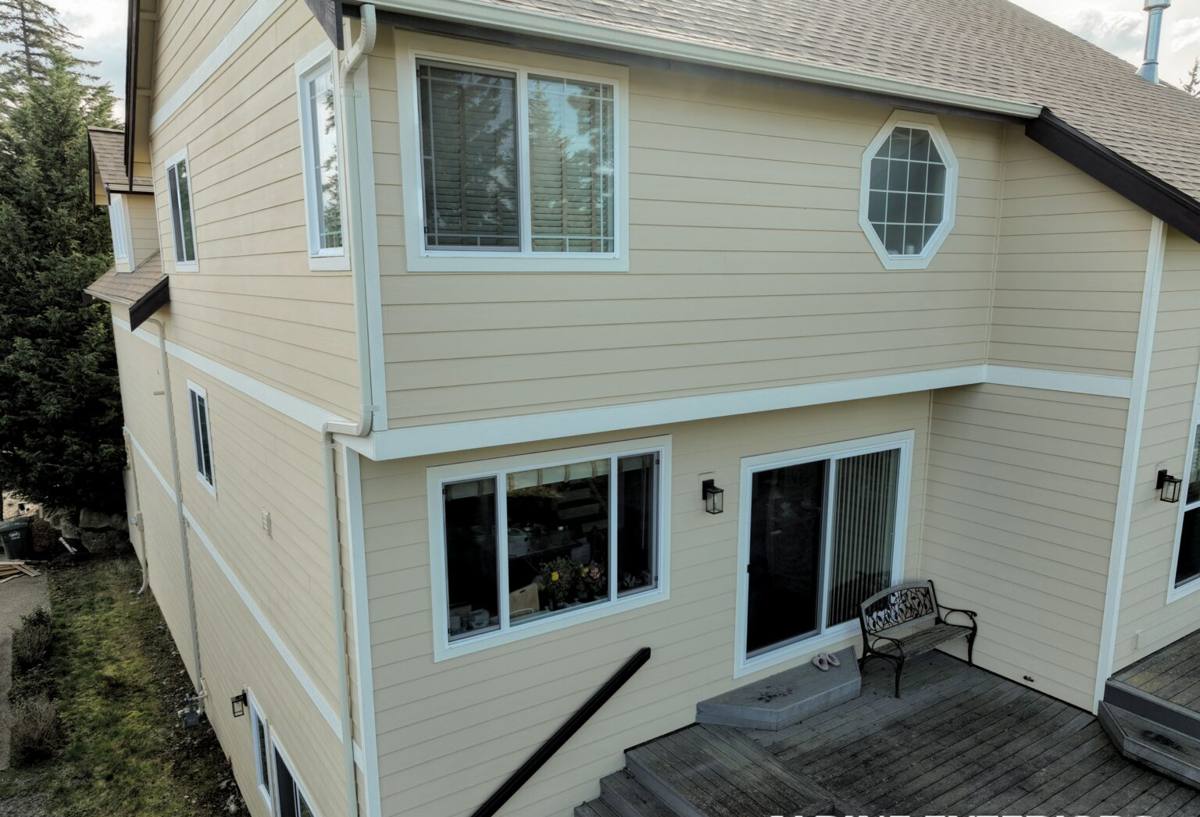
What Salt Air and Moisture Actually Do to Siding
Salt air isn't just a cosmetic nuisance. Airborne salt is hygroscopic — it pulls moisture out of the air and holds it against whatever surface it lands on. On metal fasteners, trim, and flashing, that means accelerated corrosion. On wood-based siding products, it means the surface stays damp longer between rain events, which is exactly the condition mold, rot fungi, and moss need to establish themselves.
Why This Matters More at Cottonwood Beach Than Inland Whatcom County
A home a few miles inland gets a break between rain events — surfaces dry out faster with less salt residue holding moisture in place. Homes closer to the water don't get that same drying window as often. Combine that with the shade many waterfront and tree-lined lots get for parts of the day, and you have siding that can stay damp for days at a stretch during our wetter months.
- Corrosion-prone fasteners loosen trim and siding boards over time, opening gaps for water intrusion
- Persistent surface moisture feeds moss and algae growth, especially on north- and west-facing walls
- Repeated wet-dry cycling stresses paint films and caulked joints faster than in drier climates
- Wind-driven rain finds any gap in flashing, joints, or butt seams and pushes water behind the cladding
Why Fiber Cement Is the Right Call for This Exposure
James Hardie fiber cement is manufactured from cement, sand, and cellulose fiber — there's no wood substrate to absorb moisture, swell, or feed rot fungi. That single difference matters enormously in a spot like Cottonwood Beach, where materials are wet more often than they're bone dry. Hardie's HZ5 product line in particular is engineered for exactly this kind of climate: harsh, wet, freeze-thaw-capable coastal exposure. It's manufactured to resist moisture damage and to hold its factory finish through repeated wetting without the swelling or delamination you'd expect from a wood-based product exposed to the same conditions.
The factory-applied ColorPlus finish is also relevant here specifically because of the salt air. A field-applied paint job on any siding material is only as good as its bond to the substrate and its resistance to the elements it's cured under. ColorPlus is baked on in a controlled factory environment with multiple coats and a UV-cured topcoat, which holds up better against salt exposure and coastal sun than a site-painted finish typically will — and it comes backed by its own finish warranty separate from the substrate warranty.
Moss Season and Surface Maintenance
No siding material is moss-proof — moss will grow on almost anything if conditions are right and it's left alone long enough. What matters is how the material responds to the cleaning that moss removal requires. Fiber cement tolerates gentle washing (soft brush, garden hose or low-pressure rinse) without the surface degradation you'd risk on some coated wood products, and it won't wick water into a substrate the way wood-based siding can if moss holds moisture against the wall for an extended period.
What a Correct Fiber Cement Install Requires Here
Fiber cement performs the way it's supposed to only when the installation matches the manufacturer's specifications — and in a high-moisture, salt-exposed location like Cottonwood Beach, the margin for sloppy detailing is smaller than it would be somewhere drier. The material itself is durable; most fiber cement problems trace back to installation shortcuts, not the product.
Key Details We Don't Skip
- Rain-screen or drainage plane behind the siding — a proper water-resistive barrier and drainage gap so any moisture that does get past the cladding can drain and dry rather than sit against the sheathing
- Correct fastener spacing and type — corrosion-resistant fasteners driven per Hardie's fastening schedule, not just "close enough," since under-fastened boards are a common cause of premature failure in windy coastal exposure
- Proper clearances — siding held up off decks, patios, and grade per code and manufacturer minimums so splashback and standing moisture don't sit against the bottom edge
- Flashing at every penetration — windows, doors, vents, and any wall penetration flashed and integrated with the water-resistive barrier so wind-driven rain has nowhere to get behind the wall
- Caulked and painted cut edges — factory finish protects the face of the board, but field-cut ends need to be sealed per Hardie's instructions or they become an entry point for moisture
Skipping any one of these on an inland, sheltered home might not show consequences for years. On a wind- and salt-exposed Cottonwood Beach wall, the same shortcut tends to surface as a problem much sooner — swollen trim, staining, or an early paint failure right at the joints where corners were cut.
Our Process for a Cottonwood Beach Siding Project
We approach every job here the same structured way, adjusted for the specific exposure of the home's location.
- On-site assessment — we walk the exterior, check for existing moisture damage, moss buildup, and the home's specific wind and shade exposure, and identify which walls take the worst weather
- Product and color selection — we walk you through the relevant Hardie lines and ColorPlus color options suited to coastal exposure, including how different sheens and colors handle sun and salt over time
- Tear-off and substrate check — old siding comes off and we inspect sheathing for hidden rot or moisture damage before anything new goes up; problems found here get addressed, not covered
- Water-resistive barrier and drainage plane installation — this layer is the actual first line of defense against wind-driven rain, and we treat it as such rather than rushing to get siding on the wall
- Fiber cement installation to manufacturer spec — correct fastening, clearances, and flashing integration at every window, door, and penetration
- Trim, caulking, and finish detailing — cut-edge sealing and joint caulking done to spec, not skipped for speed
- Final walkthrough — we go over the finished work with you, including basic maintenance guidance specific to a salt-air, high-moss environment
Comparing Siding Materials for This Specific Exposure
| Factor | James Hardie Fiber Cement | Untreated Wood / Primed Spruce | Vinyl |
|---|---|---|---|
| Moisture absorption | None — cement-based, won't swell or rot | Absorbs moisture, prone to rot without diligent upkeep | Doesn't absorb, but seams can let water behind panel |
| Salt air resistance | Engineered HZ5 line for coastal/harsh climates | Salt accelerates finish breakdown and decay | Material itself is inert but fasteners and trim still corrode |
| Finish durability | Factory ColorPlus finish, warrantied separately | Field-applied paint, needs repainting on a cycle | Color molded in, but fades and chalks under coastal UV over time |
| Fire performance | Non-combustible | Combustible | Can soften, deform, or burn under heat exposure |
| Wind-driven rain tolerance | High, when installed with proper drainage plane | Moderate — dependent on paint film integrity | Moderate — panel movement can stress seams over time |
Why We Don't Install Other Products Here
Homeowners occasionally ask why we don't offer vinyl, LP SmartSide, or a primed wood option as a lower-cost alternative. Each of those products has a legitimate place in the market, but we've made a professional decision not to install them, and in a location like Cottonwood Beach the reasoning is especially concrete. Vinyl siding is inexpensive and low-maintenance in the sense that it doesn't need repainting, but its seams and fastening system are more sensitive to the kind of sustained wind-driven rain this exposure sees, and it doesn't offer the fire-resistance profile of a cement-based product. Wood-based composite and primed wood siding rely on an intact paint film and diligent maintenance to keep moisture out — in a spot where the material rarely gets a long dry stretch, that maintenance burden gets heavier, not lighter, than it would inland. We'd rather put one product on every home we side, know it inside and out, and stand behind it, than offer a menu of materials with different long-term risk profiles.
Maintenance Expectations After Installation
Correctly installed fiber cement siding is genuinely low-maintenance, but "low-maintenance" doesn't mean "no maintenance," especially this close to the water. A short annual routine keeps a Cottonwood Beach home looking right and catches small issues before they become expensive ones.
- Rinse siding annually (garden hose or low-pressure wash) to remove salt residue and slow moss/algae buildup
- Inspect caulked joints around windows, doors, and trim yearly — coastal wet-dry cycling can eventually work caulk loose
- Trim back vegetation and tree limbs that keep walls shaded and damp longer than necessary
- Check gutters and downspouts before winter storms — overflow against a wall undermines even the best siding job
- Address moss on adjacent roofing or trim promptly so it doesn't spread onto siding surfaces
Why Local Experience in Birch Bay Matters
A crew that mostly works inland jobs can install fiber cement correctly by the book and still miss the details that matter most on a waterfront-adjacent home — how far to hold clearances given typical storm surge and splash patterns here, which wall orientations need extra attention to drainage detailing, or how aggressively to plan for moss given the shade pattern on a specific lot. We work Birch Bay and the surrounding Whatcom County coastline regularly, and that means we're not guessing at how this exposure behaves — we're applying what we've already seen hold up, and what hasn't, on homes with the same salt air, rain angle, and moss season your Cottonwood Beach home deals with every year.
If you're planning a siding replacement or want a straight answer on what your home's exposure actually calls for, we're happy to take a look. Reach out for a free, no-pressure estimate — we'll walk the property, tell you honestly what we see, and explain exactly what a correctly installed James Hardie system would involve for your home.