 Birch Bay Siding
 Why Lummi Island Decks Take More Punishment Than Most
A deck on Lummi Island lives a harder life than a deck twenty miles inland. The island sits fully exposed to Rosario Strait and the Salish Sea, which means salt-laden air moving across every board, every fastener, and every piece of hardware almost year-round. Add the driving rain that comes off the water in fall and winter, plus a moss season that can stretch from October well into spring, and you have a deck environment that punishes anything installed without that climate specifically in mind.
Wood decking struggles here in predictable ways: fasteners corrode faster near salt air, moss and algae take hold in shaded or north-facing sections, and the wet-dry cycling of driving rain followed by sun accelerates checking, cupping, and splintering. None of that is a defect in the wood itself — it's just what happens when a porous, organic material sits in a marine climate. Composite decking was built to handle exactly this kind of exposure, which is why it's become the default recommendation for most of the outdoor decks we build and repair on Lummi Island.
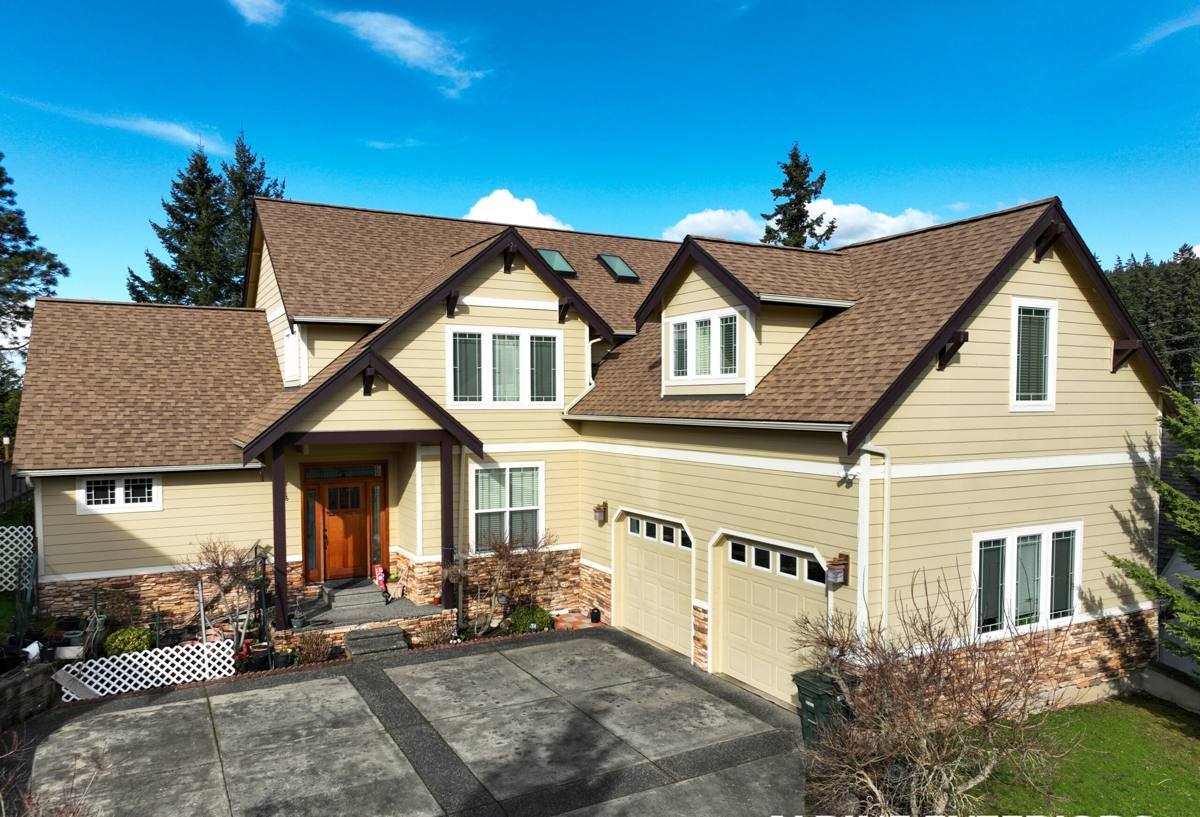
What a Marine Climate Demands From a Deck Surface
Before getting into products or installation, it's worth being specific about what "salt air and driving rain" actually does to a deck over time, because it shapes every decision that follows.
- Moisture intrusion — driving rain doesn't just wet the surface, it drives water sideways into end grain, fastener holes, and any gap where boards meet framing.
- Salt deposition — airborne salt settles on every horizontal surface and accelerates corrosion on anything metal that isn't rated for coastal exposure.
- Moss and algae growth — shaded, north-facing, or tree-covered sections of a deck stay damp longer, giving moss a foothold that stains and roughens the surface.
- UV and temperature swings — even in the Pacific Northwest, summer sun on a south-facing deck can fade or dry out materials not rated for it.
A correct deck for this location addresses all four, not just the ones that are easiest to solve.
Why Composite Decking Fits Lummi Island Homes
Composite decking is manufactured from a blend of wood fiber and recycled plastic, which gives it a different moisture relationship than solid wood. It doesn't absorb water the way natural lumber does, it doesn't need annual staining or sealing, and it resists the kind of surface checking that lets moisture and moss get a foothold in the first place. That combination matters more here than in drier parts of the county, because the island's rain and humidity give organic growth more chances to establish itself over a typical winter.
That doesn't mean composite decking is maintenance-free — no exterior product truly is in this climate — but it shifts the maintenance burden from structural concerns (rot, splintering, fastener pull-through) to cosmetic upkeep (periodic cleaning to keep moss and pollen film from building up). For most homeowners weighing years of upkeep against years of enjoyment, that's a trade worth making.
Capped vs. Uncapped Composite
Not all composite decking is built the same way, and the difference matters more in a marine climate than in a dry inland one.
| Feature | Capped Composite | Uncapped Composite |
|---|---|---|
| Moisture resistance | Full polymer shell resists water and salt intrusion on all sides | More absorbent core, higher long-term moisture uptake |
| Moss and algae resistance | Smoother, sealed surface sheds growth more easily | Textured surface can hold moisture and organic film longer |
| Fading and staining | UV-stable cap resists fading and staining | More prone to graying and staining over time |
| Upfront cost | Higher material cost | Lower material cost |
| Typical warranty | Longer, often 25-50 years | Shorter, often 10-25 years |
Given the exposure most Lummi Island decks see, we generally steer homeowners toward fully capped composite for anything facing open water or prevailing weather, and reserve uncapped or budget composite for sheltered, covered, or low-exposure areas where the climate demands are lighter.
What a Correct Composite Deck Installation Involves
Composite decking is often marketed as low-maintenance, and it is — but that reputation only holds up if the substructure and installation details are done right. A composite board over a poorly built frame will still fail early, just in different ways than wood would.
Substructure and Framing
The frame underneath matters as much as the boards on top, especially in a wet climate. That means joists spaced and sized to the manufacturer's specification for composite (composite typically needs tighter joist spacing than wood), a ledger board properly flashed where the deck meets the house so driving rain can't work its way behind the siding, and pressure-treated or coated framing rated for ground contact and coastal exposure where it's called for.
Fasteners and Hardware
This is where a lot of otherwise good decks fail early in salt air. Standard fasteners corrode faster near the water, so hardware needs to be rated for coastal or marine exposure — stainless steel or coated fasteners designed to resist salt corrosion, not just standard exterior-grade hardware. Hidden fastener systems, which are common with capped composite, also need to be installed to the manufacturer's spacing and gapping specs or they can trap moisture instead of shedding it.
Ventilation and Drainage
Composite boards need airflow underneath to manage moisture and temperature movement. Decks built low to the ground, over concrete patios, or in shaded areas need extra attention to drainage and ventilation so water doesn't pool or sit trapped beneath the surface — which is exactly the kind of damp, still condition moss thrives in.
Board Layout and Gapping
Composite expands and contracts with temperature more than most homeowners expect. Correct gapping between boards, at end joints, and against any fixed structure (posts, house walls, railings) keeps the deck from buckling or gapping unevenly as the seasons change.
Our Process From Estimate to Finished Deck
- On-site assessment — we look at sun and shade exposure, existing framing condition, drainage, and how exposed the location is to wind-driven rain off the water.
- Material recommendation — based on that exposure, we recommend capped or uncapped composite, board profile, and color, rather than defaulting to whatever's easiest to sell.
- Written estimate — a clear scope covering demolition (if replacing an old deck), framing work, decking, fasteners, and railing so there are no surprises mid-project.
- Framing and structural work — repairing or building the substructure to spec before a single composite board goes down.
- Decking installation — boards installed with coastal-rated fasteners, correct gapping, and attention to drainage and ventilation underneath.
- Final walkthrough — checking fastener lines, board gaps, edge trim, and railing before we call the job done.
Living With a Composite Deck on Lummi Island
Composite decking cuts down on maintenance, but "low-maintenance" isn't "no-maintenance" — especially with a real moss season to plan around. A simple seasonal routine keeps a composite deck looking and performing the way it should:
- Sweep off leaves, needles, and debris regularly, especially in fall — trapped organic matter is what gives moss and algae a place to start.
- Rinse the deck periodically with a hose or low-pressure wash to clear salt film and pollen before it builds up.
- Clean shaded or north-facing sections more often, since they stay damp longer and are the first spots moss will take hold.
- Check railing posts, stair stringers, and any structural hardware once a year for corrosion, since metal components age faster than the composite boards themselves.
- Keep gutters and downspouts near the deck clear so runoff isn't dumping extra water onto the surface or substructure.
Common Problems We're Called to Fix
A lot of our composite decking work on Lummi Island isn't new construction — it's correcting installation shortcuts from a previous job. The recurring issues are consistent: standard (non-coastal) fasteners corroding and staining the boards around them, decking installed with no gap against the house or posts leading to buckling, insufficient ventilation underneath causing persistent damp spots and moss growth, and framing that wasn't sized correctly for composite's weight and span requirements. Each of these is preventable with correct planning up front, which is a large part of why installation quality matters more than the brand name on the board.
What Drives the Cost of a Composite Deck Project
| Cost Factor | Why It Matters |
|---|---|
| Board tier (capped vs. uncapped) | Capped composite costs more upfront but holds up better against salt air and moss |
| Existing framing condition | Rotted or undersized substructure adds repair or rebuild cost before decking begins |
| Deck size and layout | Complex shapes, multiple levels, or built-in features add labor time |
| Railing and trim | Composite or metal railing systems vary widely in material cost |
| Site access | Material delivery and disposal logistics affect labor and staging time |
| Exposure level | Fully exposed, water-facing decks often call for higher-grade fasteners and hardware |
Every deck is different, which is why we walk the site and put together a written estimate rather than quoting off general square footage numbers. That's the only way to account for the framing condition and exposure specific to your property.
Why It Matters to Hire a Crew That Already Works Lummi Island
Lummi Island is reached by ferry, which shapes how material delivery, staging, and scheduling need to be planned — a crew unfamiliar with that logistics reality can run into avoidable delays. Beyond logistics, a contractor who regularly works the island already understands how exposed a given lot is to wind and salt spray, which sides of a house typically hold moss longest, and how Whatcom County permitting and inspection requirements apply to residential deck projects. That local familiarity translates directly into fewer surprises and a deck that's specified correctly the first time, rather than corrected after a season of exposure reveals the gaps.
If you're planning a new composite deck or replacing an aging one on Lummi Island, we're happy to walk the site, talk through board options for your specific exposure, and put together a free, no-pressure estimate. Use the form below to get started.