 Birch Bay Siding
 Why California Creek Siding Wears Differently Than Inland Homes
California Creek sits close enough to the Salish Sea and Birch Bay itself that homes here take on a different weather load than a house ten miles inland in Whatcom County. Salt-laden air drifts in off the water and settles on exterior surfaces daily, not just during storms. Add wind-driven rain that hits siding at an angle instead of straight down, and you've got a wall assembly that's wet more often, and for longer stretches, than most manufacturers assume when they write their installation manuals.
Then there's moss. Whatcom County's damp, mild winters and shaded, tree-lined lots around California Creek create a moss season that can run eight months or more. Moss doesn't just look bad on siding — it holds moisture against the surface, works into seams and laps, and accelerates rot in anything wood-based. A siding system that isn't built to shrug off standing moisture is fighting a losing battle here from day one.
None of this means siding fails fast in California Creek. It means the margin for error is smaller. Cut corners on flashing, use a product that swells when wet, or skip proper drainage behind the cladding, and problems show up years earlier than they would in a drier climate.
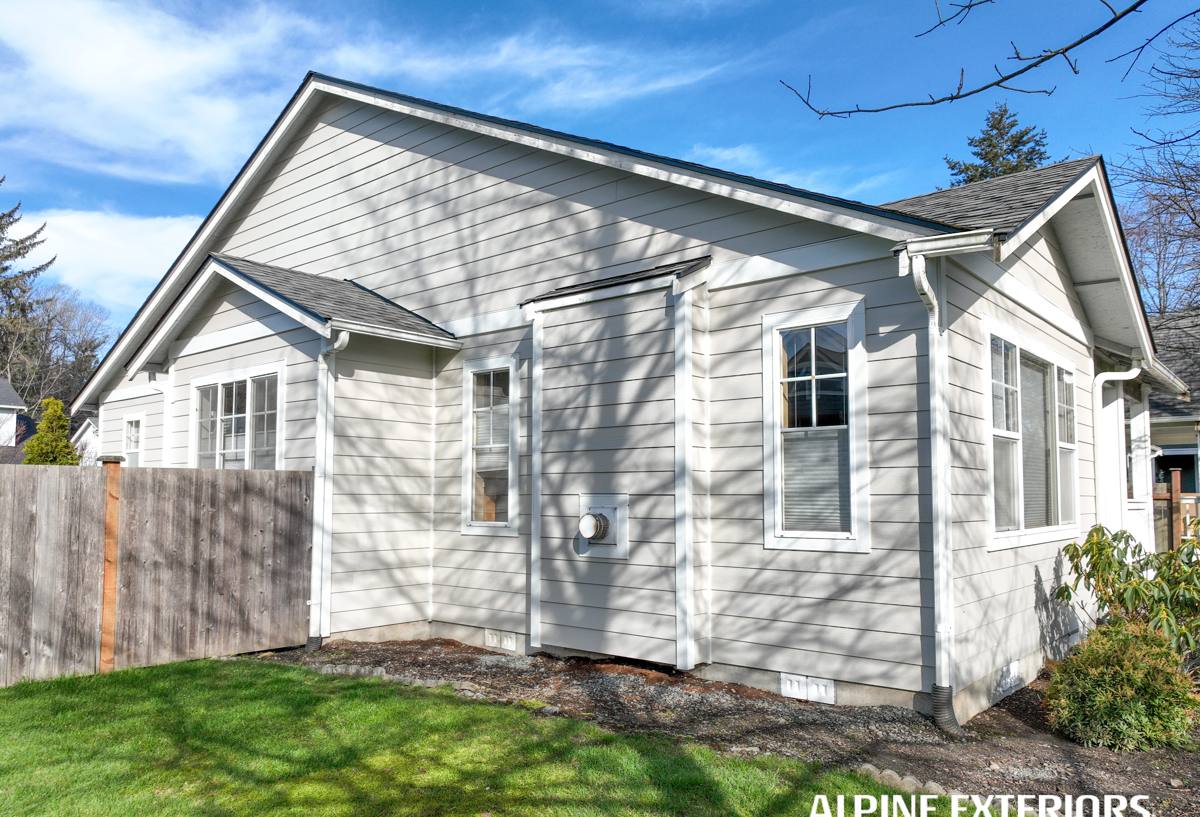
Signs a California Creek Home Needs Replacement, Not Repair
Not every siding problem calls for a full tear-off. But there's a point where patching stops making sense — where the labor to keep fixing small areas costs more, over a few years, than doing the job right once. Here's how to tell which side of that line you're on.
Repair usually makes sense when:
- Damage is limited to one or two boards or a single wall section
- The underlying sheathing and moisture barrier are still sound
- The rest of the siding is structurally solid, just cosmetically tired
Replacement is the smarter move when:
- Soft or spongy spots show up in multiple areas, especially near the bottom courses
- Moss and mildew keep coming back within a season or two of cleaning, no matter how often you wash it
- Boards are cupping, buckling, or separating at the seams
- Paint won't hold — it's peeling or bubbling within a couple of years of a fresh coat
- You can see daylight, feel drafts, or find water staining on interior walls near exterior corners
If you're seeing two or more of the replacement signs, it's worth getting a straight assessment rather than continuing to spend on patch jobs.
What a Correct Siding Replacement Actually Involves
The finished siding is the part everyone sees, but the work that determines whether it lasts 10 years or 40 happens underneath it. A California Creek job that's done right includes several steps that are easy to skip and impossible to check once the new siding is up.
Tear-off and inspection
Old siding comes off down to the sheathing, and that sheathing gets inspected for rot, soft spots, or water damage — problems that are common on homes exposed to years of salt air and driving rain, and that no amount of new siding will fix if left underneath it.
Water-resistive barrier
A continuous, properly lapped weather-resistive barrier goes over the sheathing before anything else. In a high-moisture area like this, gaps or shortcuts here are exactly where future leaks start.
Flashing at every penetration
Windows, doors, vents, and anywhere two rooflines meet a wall need correctly integrated flashing — not caulk standing in for flashing, which is a common shortcut that fails within a few years under constant rain exposure.
Drainage plane
A gap between the back of the siding and the water-resistive barrier lets any moisture that does get in drain and dry out instead of sitting against the wall. This matters more in a climate with California Creek's rain and humidity than almost anywhere else in the state.
Fastening to spec
Fiber cement siding has manufacturer-specified nailing patterns and fastener types. Installers who don't follow them void the warranty and open the door to boards that work loose or crack over time.
Why We Install Only James Hardie Fiber Cement
We standardized on James Hardie fiber cement for every siding replacement we do, including in California Creek, and we don't install vinyl, LP SmartSide, or other engineered wood products. That's a deliberate call, not a sales preference.
Fiber cement doesn't absorb water the way wood-based products can, which matters directly here given how many months a year local siding stays damp. It's also non-combustible, holds paint and factory finish far longer than wood composite products, and doesn't warp, cup, or swell the way vinyl and engineered wood can when exposed to sustained moisture and temperature swings. James Hardie's ColorPlus factory finish is baked on and backed by a real finish warranty, so you're not repainting every few years to keep salt air and UV from breaking down the surface.
James Hardie also makes climate-specific product lines engineered for exactly the conditions California Creek deals with — high moisture, coastal exposure, and heavy moss and mildew pressure. That engineering, combined with a transferable product warranty, is why we don't offer alternatives: we'd rather install one product well than several products with trade-offs we'd have to explain away later.
Our Process for a California Creek Replacement
| Step | What Happens |
|---|---|
| Site walk and assessment | We inspect current siding, trim, flashing, and any visible moisture or rot damage, and talk through what we're seeing with you directly |
| Written estimate | Scope, product line, color, and price laid out clearly — no vague allowances |
| Tear-off and sheathing check | Old siding removed, sheathing inspected and repaired where needed before anything new goes on |
| Barrier and flashing install | Water-resistive barrier and flashing installed and lapped correctly at every penetration |
| Hardie installation | Installed to manufacturer fastening and clearance specs, including proper ground and roofline clearances common issues in wetter climates |
| Final walkthrough | We walk the finished job with you before calling it done |
What Drives the Cost of a California Creek Siding Job
| Factor | Why It Matters Locally |
|---|---|
| Extent of hidden damage | Homes with years of moisture exposure often need sheathing repair, which isn't visible until tear-off starts |
| Home size and wall complexity | More corners, gables, and trim details mean more cutting, flashing, and labor time |
| Product line and profile | Hardie offers multiple plank styles and factory-finish options at different price points |
| Site access | Wooded or tight lots near the creek can add setup and material-handling time |
| Trim and accessory work | Fascia, soffits, and trim replaced alongside siding affects both cost and how well the whole system performs |
Anyone quoting a siding job sight-unseen, or without pulling any siding to check the sheathing, is guessing. A number worth trusting comes after a real look at the house.
Choosing a Contractor Who Already Works California Creek
Siding crews that mostly work drier, inland parts of Whatcom County sometimes don't build in the drainage and flashing detail that homes closer to the water actually need — not out of carelessness, but because it isn't second nature when it's not what they see every day. A crew that regularly works Birch Bay and the surrounding coastal neighborhoods treats moisture management as the default, not an upgrade.
When you're vetting a siding contractor for a California Creek home, it's reasonable to ask directly:
- Are you a certified James Hardie installer, and can you explain their fastening and clearance specs?
- What's your plan for flashing around windows, doors, and roof-to-wall transitions?
- Will you inspect and, if needed, repair the sheathing before installing new siding — not just cover it up?
- What warranty covers labor, separate from the manufacturer's product warranty?
- Can you walk me through why you'd recommend one Hardie product line over another for this specific house?
A contractor who answers those specifically, rather than in generalities, is one who's actually done the work in conditions like these before.
After Installation: Keeping California Creek Siding Performing
Correctly installed James Hardie siding needs very little upkeep, but a few habits go a long way in this climate:
- Rinse salt residue and grime off the siding once or twice a year, especially on sides facing open water or prevailing wind
- Keep gutters clear so overflow doesn't run down the siding face repeatedly in one spot
- Trim back vegetation and tree cover that keeps siding shaded and damp, which extends moss season on that section of wall
- Check caulking at trim and penetrations annually — caulk is a maintenance item, not a permanent seal
- Address any small paint chips or dings promptly so bare fiber cement isn't left exposed to weather
None of this is heavy maintenance. It's the difference between siding that looks and performs like new for decades and siding that starts showing its age early because small issues went unaddressed.
Get a Straight Answer on Your California Creek Home
If your siding is showing signs of wear, or you just want an honest read on whether repair or replacement makes more sense for your home, we're glad to take a look. We'll walk the exterior with you, point out what we actually see, and put together a clear, no-pressure estimate — no guesswork, no upsell. Use the form below to get started.