 Birch Bay Siding
 Why California Creek's Coastline Demands a Different Siding Standard
California Creek sits close enough to the water that homes here take a different kind of weathering than a house ten miles inland in Whatcom County. Salt-laden air drifts in off the water for much of the year, wind-driven rain hits west- and south-facing walls at an angle instead of falling straight down, and the long stretch of shaded, damp weather keeps moss and algae established on anything that holds moisture. None of that is unique to one street or one lot — it's the baseline condition for siding anywhere in this part of Birch Bay. Siding that's rated for an average Pacific Northwest town isn't automatically rated for this specific combination of salt exposure and sustained dampness.
That's the lens we bring to every California Creek project: not just "what siding looks good," but "what siding will still look good, seal properly, and hold its finish after a decade of this exact weather." For most homeowners, siding is a once-in-a-generation purchase, so the material and the installation both need to be right the first time.
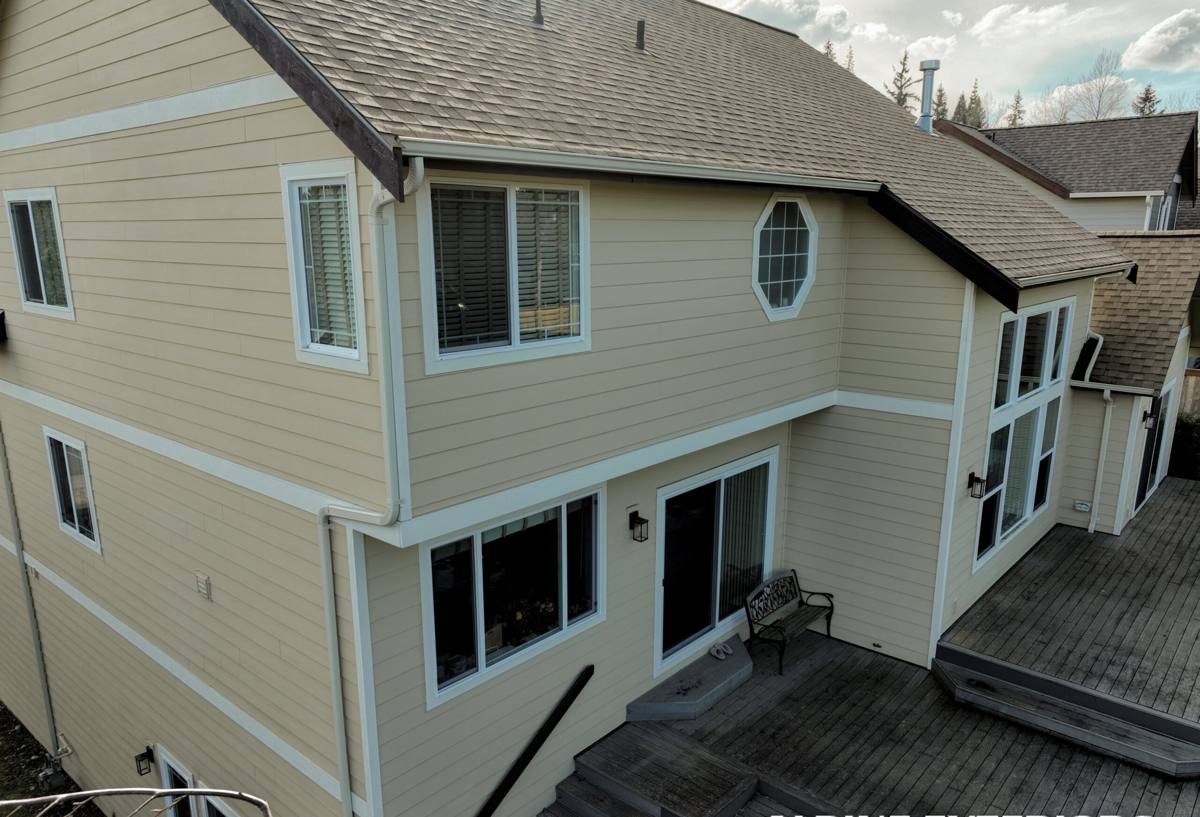
What Salt Air, Driving Rain, and Moss Season Do to Siding Over Time
Salt Air
Salt in the air settles on exterior surfaces and, combined with moisture, accelerates corrosion of fasteners, staples, and any exposed metal trim. On siding materials with weaker factory finishes, salt residue also speeds up fading and chalking, since it holds moisture against the surface longer than plain rainwater does. Over several seasons, that shows up as dull, patchy color long before the siding itself has physically worn out.
Driving Rain
Wind-driven rain doesn't just wet the face of a wall — it gets pushed sideways and upward into laps, seams, and any gap around trim, windows, and penetrations. A siding system that isn't installed with the right clearances and flashing details will eventually let that water behind the cladding, where it can sit against sheathing and framing far longer than anyone on the ground can see. By the time a stain or soft spot shows up on the surface, the moisture problem behind it has usually been building for a while.
Moss Season
Whatcom County's long wet season — roughly fall through spring — gives moss, algae, and lichen months of shade and standing moisture to work with, especially on north-facing walls and anywhere tree cover blocks the sun. Organic growth on siding isn't just cosmetic; it holds moisture against the surface, and on materials that can absorb or swell with water, that sustained dampness is exactly where real damage starts.
Why We Install James Hardie — and Only James Hardie
We standardized on James Hardie fiber cement for every home we side, including here in Birch Bay, and we don't install vinyl, LP SmartSide, cedar, or other fiber cement brands. That's a deliberate professional standard, not a sales position. Fiber cement doesn't rot, doesn't feed moss the way untreated wood fibers can, and doesn't warp or buckle the way vinyl can under repeated damp-and-dry cycles near the water. James Hardie's ColorPlus factory finish is baked on under controlled conditions, which gives it better fade and moisture resistance than field-applied paint — something that matters far more here than it would on a drier, more sheltered inland lot.
We're not going to tell you every other product is worthless — vinyl and engineered wood sidings have real uses and reasonable price points elsewhere. But for a home absorbing salt air, driving rain, and months of damp shade every year, we've made the call that Hardie is the only product we're willing to put our name behind. It also comes with a strong, transferable manufacturer warranty, which matters if you ever sell the home — a future buyer inherits real coverage, not just our word for it.
The Right Hardie System for a California Creek Home
James Hardie makes climate-specific product formulations, and the HZ5 line is engineered for wetter, harsher climates like ours — it's what we spec for Birch Bay by default rather than a generic national product. Beyond the base formulation, the profile and finish choice affects how the house performs and looks over time:
- HardiePlank lap siding — the most common choice, available in several exposure widths and textures (smooth or cedar-grain), works well on both older Birch Bay homes and newer builds.
- HardiePanel vertical siding — often used as an accent on gables or entry features, paired with lap siding on the main walls.
- HardieTrim — matched trim boards around windows, corners, and fascia, finished to resist the same moisture and salt exposure as the field siding.
- ColorPlus finishes — factory-applied color with a matching touch-up system, which holds up to salt air and UV exposure far better than a site-applied paint job.
The right combination depends on the home's age, its existing trim details, and whether you're matching an addition to existing siding or doing a full replacement. We spec the system to the specific wall exposures on your lot, not a single template applied to every house.
What Correct Installation Actually Involves Here
Fiber cement siding is only as good as the installation behind it, and in a salt-air, high-rain environment the margin for error is smaller than it is elsewhere. A correct install for a California Creek home includes:
- Proper water-resistive barrier and flashing at every window, door, and penetration, lapped so water is always directed outward and down.
- Correct fastener type and spacing — corrosion-resistant fasteners rated for the exposure, driven per James Hardie's published fastening schedule, not just "close enough."
- Minimum clearance between the bottom of the siding and grade, decks, patios, and roof lines, so splash-back and standing water don't sit against the board.
- Painted or factory-finished edges on every field cut, since a raw cut edge is the fastest path for moisture into the board.
- Correct panel gaps and caulking at butt joints, sized for expansion and sealed with a product compatible with ColorPlus finishes.
Skip any one of these on a sheltered inland lot and you might get away with it for years. Skip one on a home exposed to salt air and driving rain, and it tends to show up much sooner — as a stained joint, a soft spot at the bottom course, or a fastener bleeding rust through the finish.
Siding Options at a Glance
| Factor | James Hardie Fiber Cement | Vinyl | Untreated Wood / Cedar |
|---|---|---|---|
| Salt air resistance | Strong — non-combustible core, factory finish holds up well | Can become brittle and fade faster under salt and UV exposure | Absorbs moisture and salt residue; finish needs frequent upkeep |
| Moss/algae resistance | Doesn't feed organic growth; surface cleans well | Doesn't feed growth, but seams and laps trap debris | Wood fiber can host and hold moss/algae if not maintained |
| Driving rain performance | Excellent when flashed and installed to spec | Can allow water intrusion at seams over time | Prone to swelling and cupping with repeated wetting |
| Finish longevity | ColorPlus factory finish, strong fade resistance | Color molded in but can chalk/fade; not easily repainted | Requires repainting or restaining every few years |
| Typical upfront cost | Mid-to-higher | Lower | Mid-to-higher, plus ongoing maintenance cost |
The upfront cost gap between Hardie and vinyl is real, but on a coastal Whatcom County lot, the maintenance and replacement cycle over the following fifteen to twenty years is where the comparison actually plays out.
Our Process for California Creek Homeowners
Assessment
We walk the home, note current siding condition, moisture or moss patterns, trim and flashing details, and any problem areas — usually north walls, spots under overhangs, and areas where landscaping keeps siding shaded and damp. This is also when we flag anything unrelated to siding itself, like a gutter or grading issue, that's contributing to moisture problems.
Product and Color Selection
We help you pick the right Hardie profile, exposure width, and ColorPlus color for the home, factoring in neighborhood expectations where relevant and how the color will hold up under this area's light and salt exposure.
Installation
Old siding comes off, the wall is inspected for hidden moisture or sheathing damage before anything new goes up, and the new water-resistive barrier, flashing, and Hardie system go on to manufacturer spec — the details described above aren't optional add-ons, they're the baseline of the job.
Walkthrough
We walk the finished job with you, cover basic care, and answer questions about warranty coverage before we consider the project done.
Living With Hardie Siding in Birch Bay's Climate
Hardie siding installed correctly is low-maintenance, not zero-maintenance. A short annual routine keeps it performing the way it's designed to in this climate:
- Rinse the siding down once or twice a year, especially shaded and north-facing walls where moss and algae are most likely to establish.
- Keep gutters clear so overflow isn't running down the siding face during heavy rain.
- Trim back shrubs and landscaping so air can move along the wall and siding isn't sitting in constant shade and moisture.
- Check caulking at trim and butt joints periodically and have any cracked or missing sealant replaced before winter's rain arrives.
- Address any fastener staining or visible damage early rather than waiting — it's almost always cheaper to fix a small issue than a spread one.
None of this is heavy upkeep, but skipping it entirely is how a well-installed job starts to look tired years before it should — especially this close to the water.
Why a Crew That Already Works California Creek Matters
A lot of siding problems in coastal Whatcom County trace back to installation details that were fine for a drier, more sheltered climate but weren't quite enough here. A crew that's already worked this stretch of Birch Bay knows which walls take the worst of the driving rain, where moss tends to establish first, and which flashing and clearance details actually hold up against salt air over years, not just at the final walkthrough. That's the difference between a siding job that looks right on installation day and one that's still performing the way it should a decade later.
If you're weighing a full re-side or need to replace siding that's failing on a California Creek home, we're happy to take a look and give you a straightforward, no-pressure estimate — fill out the form below to get started.