 Birch Bay Siding
 Why Blaine's Coastal Climate Is Hard on Siding
Blaine sits about as close to the water as a Whatcom County home can get, and that proximity shapes everything about how siding ages here. Salt-laden air moves in off the water and settles on exterior surfaces daily, not just during storms. Combine that with wind-driven rain that comes in sideways during winter systems, and you have a climate that tests every seam, joint, and fastener on a house far more aggressively than an inland town would.
Then there's moss. Whatcom County's damp, mild winters and shaded, humid microclimates near Birch Bay and Blaine create a moss and algae season that can run eight months or longer. Moss doesn't just look bad — it holds moisture against a wall surface, and sustained moisture contact is the single biggest driver of premature siding failure, regardless of what material is on the house.
Put those three factors together — salt exposure, driving rain, and a long moss season — and it's clear why siding installation in this area isn't a job you can approach the same way you would in a dry inland climate. The material matters, but so does exactly how it's installed.
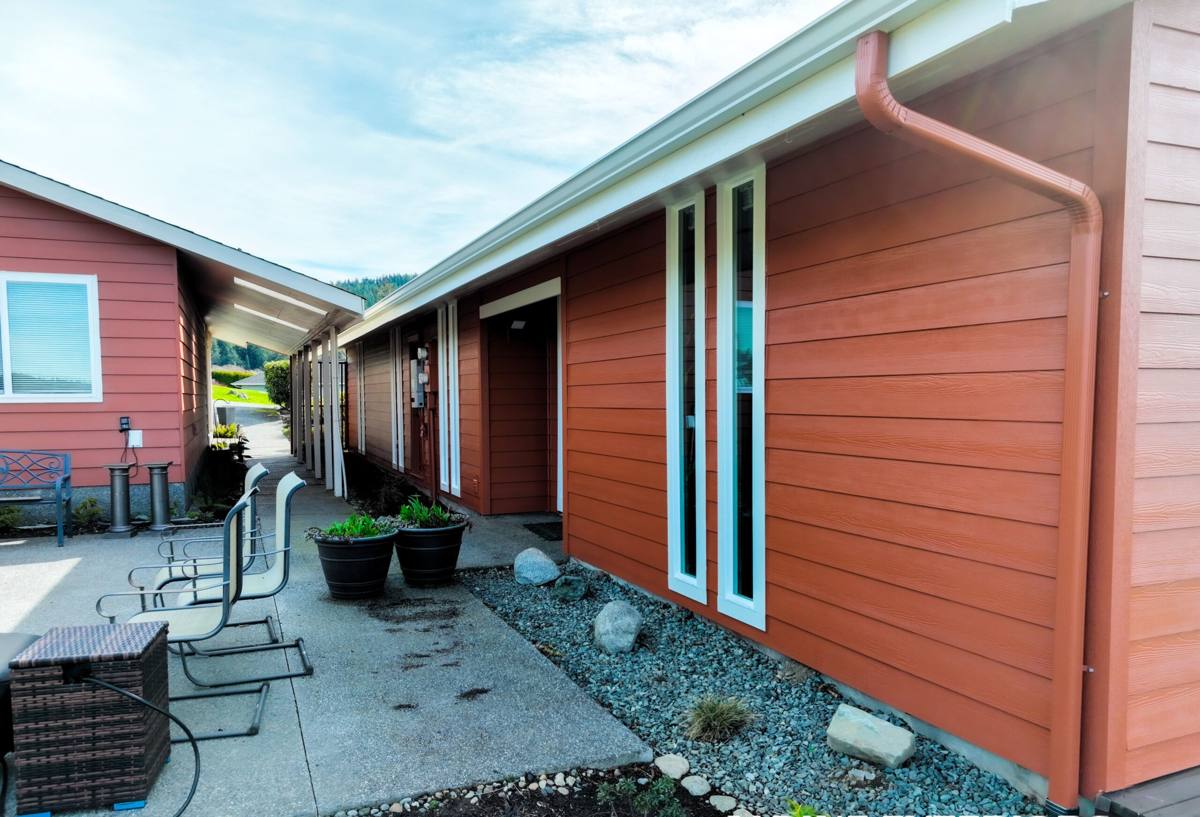
What Correct Siding Installation Involves Here
A siding job can look right from the curb and still be wrong underneath. In a climate like Blaine's, the parts nobody sees — the drainage plane, the flashing, the gap behind the panel — matter more than the finish coat.
Water Management Details
Every wall needs a continuous water-resistive barrier behind the siding, lapped correctly so water sheds outward and down, never inward. Openings around windows and doors need properly integrated flashing so wind-driven rain can't work its way behind the trim. Bottom courses need enough clearance off the foundation, deck ledgers, and grade so splashback and standing water don't sit against the cut edges of the panel.
Salt Air and Fastener Considerations
Fastener choice matters more near the water. Corrosion-resistant fasteners, correctly spaced and set to the manufacturer's schedule, hold panels tight through decades of wind and moisture cycling. Trim and caulking at joints need to be rated for exterior UV and moisture exposure, since a failed caulk joint near the coast lets salt-laden moisture in faster than it would inland.
Ventilation Behind the Panel
A rainscreen gap — a small airspace between the back of the siding and the water-resistive barrier — lets any moisture that does get past the outer layer drain and dry out instead of sitting trapped against the wall sheathing. This detail is often skipped to save time, but in a high-moisture climate like Birch Bay and Blaine, it's one of the details that separates a siding job that lasts thirty-plus years from one that starts showing problems in ten.
Why We Install Only James Hardie Fiber Cement
We made a decision to stop installing vinyl, LP SmartSide, primed spruce, cedar, and other fiber cement brands, and to install James Hardie exclusively. That's not a marketing position — it's the product we've found actually holds up to the conditions this area throws at a house year after year.
Fiber cement is non-combustible and dimensionally stable, meaning it doesn't expand and contract with moisture the way wood-based products do, and it doesn't soften or degrade when it stays damp for long stretches — which, in a Blaine winter, it will. James Hardie's ColorPlus factory finish is baked on under controlled conditions rather than field-painted, which gives it better adhesion and color retention against UV and salt exposure than a job-site paint job typically achieves. That matters directly for moss and algae resistance too: a tighter, more consistent factory finish gives biological growth less texture to grip onto compared to a porous or field-finished surface.
Climate-Engineered Product Lines
James Hardie makes different HZ (HardieZone) formulations engineered for different climate demands — some optimized for wet, moderate coastal climates like ours, others for hot, dry, or freeze-heavy regions. Installing the version engineered for this region, rather than a generic one-size-fits-all product, is part of what makes the system perform as designed over the long run.
Warranty That Follows the House
James Hardie backs its siding with a manufacturer's warranty that is transferable to a subsequent owner, and its ColorPlus finish carries its own separate finish warranty. For a coastal property, where sun, salt, and moisture work on a finish harder than average, having a real, transferable warranty behind the product is worth more than it would be somewhere drier.
How Siding Materials Compare in This Climate
| Factor | James Hardie Fiber Cement | Vinyl | Wood / Untreated Cedar | LP SmartSide (Engineered Wood) |
|---|---|---|---|---|
| Moisture behavior in wet climates | Dimensionally stable, resists water absorption | Doesn't absorb water but can warp or bow with heat/cold cycling | Absorbs moisture, prone to rot without diligent upkeep | Wood-based core is moisture-sensitive if seals fail |
| Moss/algae resistance | Factory finish limits surface texture growth clings to | Smooth surface, but seams and lap joints trap grime | Porous surface, feeds moss and algae readily | Engineered surface, still an organic-based material |
| Salt air / coastal exposure | Engineered HZ lines built for coastal moisture demands | Can become brittle over time with UV and salt exposure | Requires frequent refinishing to hold up near salt air | Manufacturer specifies coastal exposure guidelines closely |
| Fire resistance | Non-combustible | Combustible, can melt or deform near heat sources | Combustible | Combustible |
| Finish longevity | Factory-baked ColorPlus finish, separate finish warranty | Color is through-body but can fade and chalk over time | Field-applied finish needs reapplication every few years | Field- or factory-primed, still needs ongoing paint maintenance |
This isn't to say every alternative is a bad product everywhere — vinyl and engineered wood both have their place. It's that after years of installing and repairing siding in Whatcom County's wet, salt-exposed, moss-heavy conditions, fiber cement engineered for this climate is what we're willing to warranty our labor on.
Our Installation Process for Blaine Homes
- Inspection and moisture check. Before we talk product or price, we look at the existing wall assembly, siding condition, trim, and any signs of past moisture intrusion around windows, doors, and roof-to-wall transitions.
- Tear-off and sheathing assessment. Old siding comes off and we check the sheathing underneath for rot or soft spots — a problem worth catching now, not after the new siding is up.
- Water-resistive barrier and rainscreen installation. A continuous drainage plane goes on first, followed by furring or a rainscreen product where the wall assembly calls for it, so the finished wall can dry properly.
- Flashing at every penetration. Windows, doors, hose bibs, vents, and any other wall penetration get flashed and integrated with the water-resistive barrier before siding goes on around them.
- James Hardie panel or lap installation. Siding is installed to manufacturer fastening specifications, with correct clearances at grade, decks, and roof lines.
- Trim, caulking, and touch-up. Joints are caulked with exterior-rated sealant, and any factory finish that needs field touch-up is matched and applied.
- Final walkthrough and cleanup. We walk the job with the homeowner, confirm everything meets spec, and clear the site of debris and old material.
Moss, Algae, and Long-Term Maintenance
Even the right siding installed correctly still lives in a wet, shaded, salt-air environment, so a little ongoing maintenance keeps it looking and performing its best. Shaded, north-facing walls and areas near mature trees or dense landscaping tend to hold moisture longest and show moss growth first — those are the spots worth checking each fall before the wet season sets in.
Gutters and downspouts play a bigger role in siding longevity than most homeowners expect. A clogged gutter that overflows down a wall face, or a downspout that dumps water at the base of the siding instead of away from the foundation, creates exactly the kind of sustained moisture contact that shortens the life of any exterior material. Keeping gutters clear and grade sloped away from the house does as much for your siding's lifespan as the siding material itself.
A gentle rinse or soft wash once a year, along with keeping vegetation trimmed back a few inches from the wall surface for airflow, is usually enough to keep moss and algae from taking hold in the first place.
What to Ask a Contractor Before Hiring Them for Siding Work in Blaine
- Do they install a continuous water-resistive barrier and address rainscreen or drainage detailing on every job, not just when asked?
- Can they explain their flashing details at windows, doors, and roof-to-wall transitions specifically?
- Are they installing a product engineered for this region's moisture and salt exposure, or a generic version?
- Do they carry proper licensing and insurance for exterior work in Washington State?
- Will they put their installation workmanship in writing, separate from the manufacturer's product warranty?
- Do they have experience specifically with coastal Whatcom County homes, not just siding in general?
Why Local Experience in Blaine Matters
A crew that regularly works Blaine and the broader Birch Bay area already knows how this climate behaves — which walls take the worst of the wind-driven rain, how fast moss establishes on shaded elevations, and how to sequence a tear-off and install around a coastal weather window instead of getting caught mid-project by a system rolling in off the water. That local pattern recognition doesn't show up on a spec sheet, but it shows up in how the finished job holds up five and ten years down the road.
Working locally also means straightforward accountability. If a question comes up after the job is done — a caulk line, a trim detail, anything — you're dealing with a crew that's still working in your neighborhood, not a company that moved on to the next region.
Ready to Talk About Your Siding?
If your Blaine home's siding is showing its age — fading, moss buildup, soft spots, or just years of coastal wear — we're happy to take a look and give you a straightforward assessment. Fill out the form below for a free, no-pressure estimate on James Hardie siding installation built for this stretch of Whatcom County's coastline.